
Crematogaster sabatra
- Sci. Name
- Crematogaster sabatra
- Tribe
- Crematogastrini
- Subfamily
- Myrmicinae
- Author
- Blaimer, 2010
- Distribution
- Found in 1 countries
Introduction
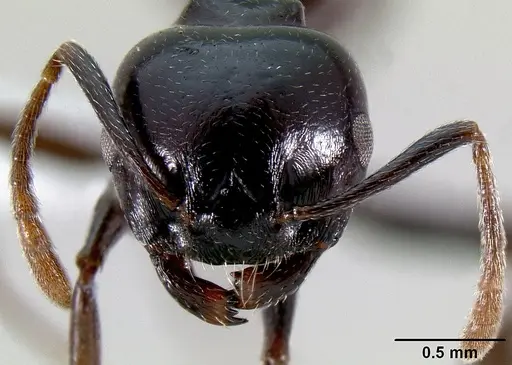
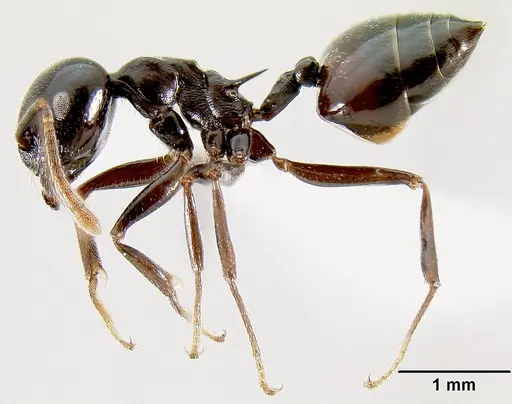
Crematogaster sabatra is a large acrobat ant endemic to the mountainous rainforests of central Madagascar. Workers have remarkably long, sword-like propodeal spines that give this species its name - 'sabatra' means 'sword' in Malagasy . They are mostly black (rarely brown) with distinctive hexagonal petioles and 5-toothed mandibles . This species belongs to the Decacrema group and was separated from the Crematogaster hova-complex as a distinct species in 2010 . What makes C. sabatra unique is its arboreal lifestyle - like other Decacrema species, it nests in dead branches, twigs, and carton nests made from chewed plant fibers . These ants are often found tending Coccoidea (scale insects) for honeydew . However, no queens or males have ever been collected, making this one of the most poorly known Crematogaster species in Madagascar . All known specimens come from four high-elevation montane rainforest localities between 1250-1700m altitude .
Quick Summary
- Difficulty: Expert
- Origin & Habitat: Endemic to central Madagascar, found only in montane rainforests at elevations of 1250-1700m in the P.N. Andringitra, P.C. Ankazomivady, P.N. Befotaka-Midongy, and R.S. Kalambatritra regions [1][3].
- Colony Type: Colony structure is unconfirmed, queens and males have never been collected, so whether colonies are single-queen or multi-queen is unknown [1].
- Size & Growth:
- Queen: Size data unavailable, queens have never been collected [1].
- Worker: Size data unavailable, the context provides head width and mesosoma measurements but not total body length. Based on Crematogaster genus patterns, workers are likely 2-5mm.
- Colony: Size data unavailable, no colony size data exists for this species.
- Growth: Unknown, no development data exists for this species.
- Development: Unknown, no direct measurements exist for this species. (No species-specific development data is available.)
- Antkeeping:
- Temperature: No specific data exists. As a montane Madagascar species from 1250-1700m elevation, they likely prefer cooler temperatures than typical tropical ants. Start around 20-24°C and observe colony behavior.
- Humidity: No specific data exists. As an arboreal species from montane rainforest, they likely need moderate to high humidity. Provide a humid nest environment with some ventilation.
- Diapause: Unknown, no research on seasonal behavior has been documented [1].
- Nesting: In nature, they nest arboreally in dead branches, twigs, and carton nests [2]. For captivity, provide a naturalistic setup with twigs/branches or a Y-tong/plaster nest with chambers scaled to their size. Avoid fully enclosed test tubes, they prefer more open, arboreal-style setups.
- Behavior: Crematogaster workers are known for their defensive behavior, they raise their heart-shaped gaster over their head when threatened and can emit defensive secretions [4]. They are generally active foragers and tend Coccoidea for honeydew. Workers are relatively large so escape prevention is easier than tiny ants, but they can still squeeze through small gaps. They are not aggressive toward keepers but will defend their nest vigorously.
- Common Issues: queen unavailability, queens have never been collected, so this species cannot currently be kept by hobbyists [1], no captive breeding data exists, even if found, no one knows how to successfully breed this species, unknown temperature and humidity requirements create high risk of killing colonies through improper conditions, montane origin means they may be sensitive to overheating, keep cool and provide temperature gradients, very limited availability and lack of documented care means this is strictly an expert-level species
Why This Species Is Currently Unavailable to Keepers
Before discussing care requirements, it's critical to understand that Crematogaster sabatra cannot currently be kept by ant hobbyists. The reason is straightforward: queens and males have never been collected in the wild [1]. Every known specimen of this species is a worker, collected through beating vegetation or ground sampling. Without queens, there are no colonies to establish. This is one of the most significant gaps in Madagascar ant documentation, a species described in 2010 has never had its reproductive caste observed. This means even if you wanted to keep this species, there is no legal or practical way to obtain a colony. The purpose of this caresheet is therefore primarily educational, it documents what we know and what we would need to learn if this species ever becomes available.
Natural History and Distribution
Crematogaster sabatra is endemic to the central highlands of Madagascar, known only from four protected areas: Parc National d'Andringitra, Parc Classé d'Ankazomivady, Parc National de Befotaka-Midongy, and Réserve Spéciale de Kalambatritra [1]. All these localities are mountainous regions harboring mid-elevation to montane rainforest at elevations between 1250-1700 meters [1]. This makes it one of the highest-elevation Crematogaster species in Madagascar. The species was formally described in 2010 by Bonnie Blaimer, who distinguished it from the closely related C. hova-complex based on size differences, the angular character of the mesonotum, and reduced sculpture [1]. Both mitochondrial and nuclear DNA data confirm populations from all localities are conspecific, though they form a cluster within the hova-complex, suggesting very recent speciation [1].
Nesting Preferences
Based on limited field observations and what we know about the Decacrema group, C. sabatra is arboreal, it nests above ground in dead branches, twigs, and specially constructed carton nests [2]. This is typical for the Decacrema group, which has evolved to exploit arboreal microhabitats. The carton nests are constructed from chewed plant fibers and provide protection from predators and weather. Workers have been collected mostly by beating vegetation, suggesting they forage in the canopy and understory [1]. For captive care, if this species ever becomes available, a naturalistic setup with twigs and branches or a Y-tong/plaster nest with more open chambers would be most appropriate. Avoid small test tube setups, these are arboreal ants that need space to move through their nest structure.
Feeding and Diet
While no specific feeding observations exist for C. sabatra, other Decacrema species and Crematogaster in general are generalist omnivores. They commonly tend Coccoidea (scale insects) and other hemipterans to harvest honeydew, a sugary secretion [2]. They also forage for small insects and may scavenge. In captivity, if this species becomes available, you would likely need to offer sugar water or honey as an energy source, small live insects for protein, and possibly an artificial honeydew substitute. However, this is speculative, no actual feeding trials have been conducted with this species. Start with small amounts of sugar water and observe acceptance before offering other foods.
What Would Be Needed to Keep This Species
If C. sabatra ever becomes available to antkeepers, several research gaps would need to be filled through observation and experimentation. First, we need to discover and document the queen caste, this is the fundamental blocker. Second, we need to understand their founding behavior, colony structure, and development timeline. Temperature and humidity requirements are completely unknown, start with conditions matching their montane habitat: cooler temperatures around 20-24°C and moderate to high humidity. The key challenge is that this is a montane species, so they likely cannot tolerate the warm conditions that work for tropical ants. Begin with room-temperature conditions and provide a gradient so the ants can choose their preferred temperature. Given how little we know, this would truly be an expert-level species requiring careful observation and documentation to advance our understanding. [1]
Frequently Asked Questions
Can I keep Crematogaster sabatra as a pet?
No, this species is currently unavailable to antkeepers. Queens have never been collected, so there are no colonies to establish. This is one of the most poorly documented Crematogaster species in Madagascar.
Where does Crematogaster sabatra live?
It is endemic to central Madagascar, found only in four montane rainforest locations at 1250-1700m elevation: P.N. Andringitra, P.C. Ankazomivady, P.N. Befotaka-Midongy, and R.S. Kalambatritra.
What does Crematogaster sabatra look like?
Workers are large and mostly black. They have remarkably long, sword-like propodeal spines (the 'sabatra' in their name means 'sword' in Malagasy), a hexagonal petiole, and 5-toothed mandibles.
How big do Crematogaster sabatra colonies get?
Unknown, no colony size data exists for this species.
Do Crematogaster sabatra ants sting?
Crematogaster ants have the ability to emit defensive secretions when threatened. They are not dangerous to humans but will defend their nest vigorously if provoked.
What do Crematogaster sabatra eat?
Not specifically studied, but like other Decacrema species, they likely feed on honeydew from scale insects and small insects. In captivity, they would likely accept sugar water and small live prey.
What temperature do Crematogaster sabatra need?
Unknown, no thermal data exists. As a montane species from 1250-1700m elevation, they likely prefer cooler conditions than typical tropical ants. Start around 20-24°C and observe behavior.
Do Crematogaster sabatra need hibernation?
Unknown, no seasonal behavior has been documented. As a montane Madagascar species, they may experience cooler periods but whether they require a dormancy period is unstudied.
Is Crematogaster sabatra good for beginners?
No, this species is not currently available and would be expert-level even if obtainable. No captive care information exists, and queens have never been collected.
How long does it take for Crematogaster sabatra to develop from egg to worker?
Unknown, no development data exists for this species.
Why is Crematogaster sabatra called the sword ant?
The species name 'sabatra' comes from the Malagasy word for 'sword', referring to the workers' remarkably long propodeal spines [1].
Report an Issue
The current care sheet is based fully on literature. See inconsistencies, or something that's incorrect? Please , it will be resolved after review from an admin. Contributing to the blogs tab also helps providing information, to make us be able to further improve the caresheets. Thank you for your support!
References

This caresheet is licensed under CC BY-SA 4.0 .
Community Blogs
CASENT0193162
View on AntWeb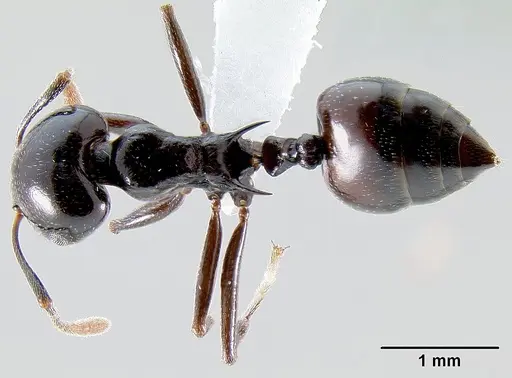
Literature
Loading distribution map...Loading products...