
Colobostruma unicorna
- Sci. Name
- Colobostruma unicorna
- Tribe
- Attini
- Subfamily
- Myrmicinae
- Author
- Shattuck, 2000
- Distribution
- Found in 1 countries
Introduction
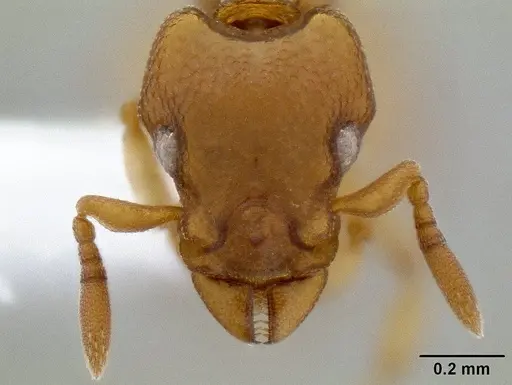
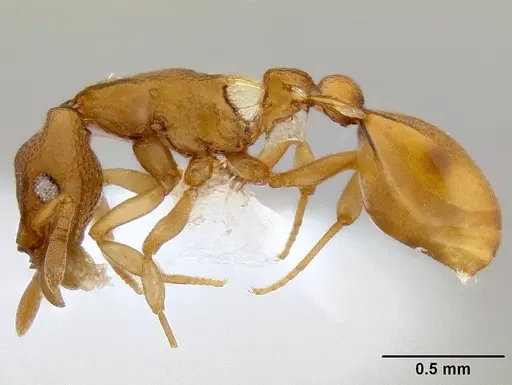
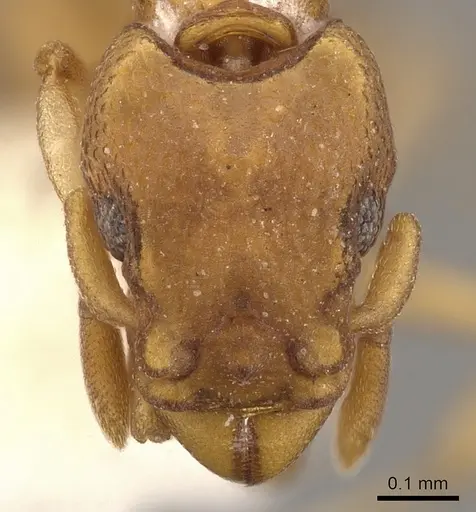
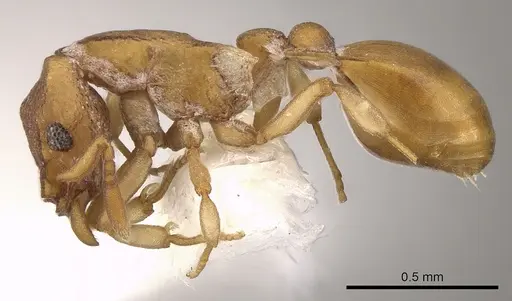
Colobostruma unicorna is a tiny Australian ant belonging to the tribe Attini. Workers measure 3.0mm in total length and have a honey-yellow body with a slightly darker head. The most striking features are the raised frontal lobes above the antennal insertions and a unique pointed projection in the center of the clypeus - this is where the species name 'unicorna' (one-horned) comes from. These ants have 5 or 6 segmented antennae and belong to the dacetine group of ants, which are typically small, cryptic foragers . This species has an extremely limited known distribution, found only in mid to southern coastal Queensland, Australia. The only known nest was discovered under rocks in soil within open sclerophyll forest on a ridge slope at Mt Coot-tha, Brisbane. Notably, these ants were found living in association with nests of two other ant species - Polyrhachis ammon and Pseudoneoponera mayri - which suggests either a close ecological association or possible social parasitic relationship .
Quick Summary
- Difficulty: Expert
- Origin & Habitat: Mid to southern coastal Queensland, Australia. Found in open sclerophyll forest, nesting under rocks in soil on slopes. The only known specimens were collected from Mt Coot-tha, Brisbane at 300-800 feet elevation [1].
- Colony Type: Unknown colony structure. The species has been found living in association with nests of other ant species (Polyrhachis ammon and Pseudoneoponera mayri), which may indicate a temporary parasitic or commensal relationship [1].
- Size & Growth:
- Queen: Size data unavailable, queen described but measurements not provided [1]
- Worker: 3.0mm total length [1]
- Colony: Unknown, no colony size data available
- Growth: Unknown, no development data available
- Development: Unknown, no direct development data for this species. (Related dacetine ants typically develop from egg to worker in 6-10 weeks under warm conditions, but this has not been confirmed for C. unicorna.)
- Antkeeping:
- Temperature: Aim for 22-28°C with a gentle gradient. As a Queensland species from the Brisbane area, they are adapted to subtropical conditions.
- Humidity: Keep the nest substrate moderately moist but not waterlogged. In nature they nest under rocks in soil, which would have variable moisture. Provide a moisture gradient so ants can choose their preferred humidity.
- Diapause: Queensland experiences mild winters, so a true diapause is likely not required. A brief cool period at 15-18°C for 2-3 months during winter months may be beneficial.
- Nesting: Natural nesting is under rocks in soil in open forest. In captivity, a small test tube setup or small nest with fine chambers would work well given their tiny 3mm size. Provide some soil or fine substrate for them to burrow in if desired.
- Behavior: Behavior is poorly documented. As a dacetine ant, they likely forage individually for small prey and are not aggressive. Their tiny size makes them vulnerable and they likely prefer to stay hidden. Escape prevention is critical, these tiny ants can easily slip through standard gaps. Use fine mesh and tight-fitting barriers. The association with other ant species in the wild suggests they may be shy or may benefit from the presence of other ants.
- Common Issues: extremely limited distribution and availability, this species is rarely kept, no established care guidelines exist, keepers must experiment with conditions, association with other ant species in the wild suggests complex ecological needs, tiny 3mm size makes escape likely without proper barriers, no information on diet acceptance, may be specialized feeders
Discovery and Distribution
Colobostruma unicorna is one of the rarest Australian ants, known only from a handful of specimens collected in Queensland, Australia. The type specimens were collected from Mt Coot-tha in Brisbane at an elevation of 300-800 feet. The original collection was made on December 29th,1964,by B.B. Lowery, who found the ants under rocks in soil on a slope within open sclerophyll forest. The type material includes 1 holotype worker,16 paratype workers, and 1 paratype queen [1]. What makes this species particularly unusual is that the specimens were found living within nests of two other ant species, Polyrhachis ammon and Pseudoneoponera mayri. This association is not fully understood but could indicate a temporary parasitic relationship where the queen invades another colony, or possibly a commensal relationship where they live alongside host colonies without direct harm [1]. This species is endemic to the Australasian region [2].
Identification and Morphology
Colobostruropa unicorna can be identified by several distinctive features. The most notable is the raised frontal lobes immediately above the antennal insertions, combined with raised lateral margins of the clypeus. Most uniquely, there is a distinct raised pointed projection in the center of the clypeus, this is where the species name 'unicorna' (one-horned) comes from. Workers measure 3.0mm in total length, making them quite small. They have 5 or 6 segmented antennae, and when 6 segments are present, the fourth funicular segment from the base is much shorter than the third. The body is honey yellow in color, with the dorsum of the head being slightly darker. The propodeum is high with broad, thin lamellae, and the postpetiole has distinctive flangelike wings with translucent windows. This species is similar to Colobostruma bicorna but can be separated by the raised frontal lobes and the unique central clypeal projection [1].
Housing and Nesting
Given the limited natural history information, housing recommendations are based on inference from related species and the known collection data. The ants were found under rocks in soil, suggesting they prefer a setup with some substrate moisture and shelter. A small test tube setup with a cotton water reservoir works as a starting point, or a small nest with fine chambers scaled to their tiny 3mm size. Provide a moisture gradient by having part of the nest slightly damp and another section drier. Since they have been found in association with other ant species, consider housing them in a way that provides some visual isolation from vibrations and light, as they may be shy. Escape prevention is critical, these tiny ants can slip through gaps that larger species cannot, so use fine mesh and check all connections carefully [1].
Feeding and Diet
The diet of Colobostruma unicorna has not been documented, but as a member of the tribe Attini (which includes leaf-cutter ants but also many small, predatory dacetine species), they likely eat small invertebrates and may tend aphids for honeydew. Based on related dacetine ants, they probably accept small live prey such as springtails, fruit flies, or other tiny arthropods. Offer small protein sources like pieces of mealworm or cricket, and provide sugar water or honey as an energy source. Start with very small prey items given their tiny 3mm size, and observe acceptance carefully. Remove any uneaten food after 24-48 hours to prevent mold issues [1].
Temperature and Seasonal Care
As a Queensland species from the Brisbane area, these ants are adapted to subtropical conditions with warm temperatures year-round. Aim for a temperature range of 22-28°C in the nest area, with a slight gradient allowing the colony to choose their preferred spot. Room temperature in most homes (20-24°C) may be suitable, but you may need a small heating cable on one side of the nest to reach optimal temperatures. Regarding winter care, Queensland winters are mild (typically 10-20°C), so a true hibernation is likely not required. However, a brief cool period at 15-18°C for 2-3 months during winter months may simulate natural conditions and promote colony health. Monitor your colony's activity levels, if they remain active through winter, they may not need cooling [1].
Frequently Asked Questions
How do I keep Colobostruma unicorna ants?
This is an extremely rare species with no established care guidelines. Based on related species and their natural history, provide a small nest with moderate humidity, warm temperatures (22-28°C), and offer small live prey. The biggest challenge is obtaining a colony, this species is rarely available in the antkeeping hobby.
What do Colobostruma unicorna ants eat?
Their exact diet is unknown, but as dacetine ants they likely eat small invertebrates. Offer tiny live prey like springtails or fruit flies, small pieces of mealworm, and sugar water or honey. Start with very small portions given their tiny 3mm worker size.
How big do Colobostruma unicorna colonies get?
Colony size is unknown, no data exists on maximum colony size for this species.
What temperature do Colobostruma unicorna ants need?
Based on their Queensland origin, aim for 22-28°C. A small heating cable on part of the nest can help achieve optimal temperatures. Monitor colony activity to find their preferred zone.
Do Colobostruma unicorna need hibernation?
Queensland has mild winters, so a true diapause is likely not required. A brief cool period at 15-18°C for 2-3 months during winter may be beneficial but is probably not essential.
Are Colobostruma unicorna good for beginners?
No, this species is not recommended for beginners. It is extremely rare with no established care guidelines, and the association with other ant species in the wild suggests complex ecological needs. This is an expert-level species for experienced keepers.
Why were Colobostruma unicorna found in other ant nests?
The association with Polyrhachis ammon and Pseudoneoponera mayri is not fully understood. It may indicate temporary social parasitism (queen invades host colony), or simply a case of them nesting in close proximity under the same rocks. More research is needed to understand this relationship.
How long do Colobostruma unicorna take to develop from egg to worker?
Unknown, no development data exists for this species.
Can I keep multiple queens together?
Colony structure is unconfirmed for this species. The association with other ant species in the wild suggests complex social behavior. Without data on natural colony structure, combining unrelated queens is not recommended.
Report an Issue
The current care sheet is based fully on literature. See inconsistencies, or something that's incorrect? Please , it will be resolved after review from an admin. Contributing to the blogs tab also helps providing information, to make us be able to further improve the caresheets. Thank you for your support!
References

This caresheet is licensed under CC BY-SA 4.0 .
Community Blogs
CASENT0106222
View on AntWeb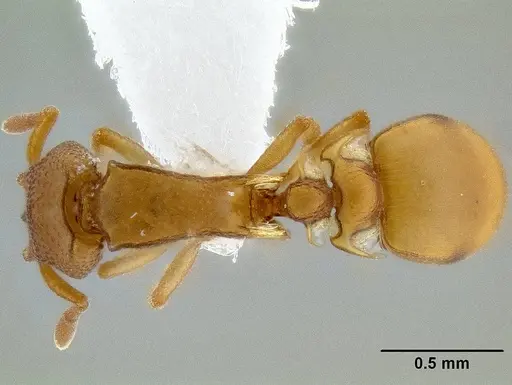
CASENT0900009
View on AntWeb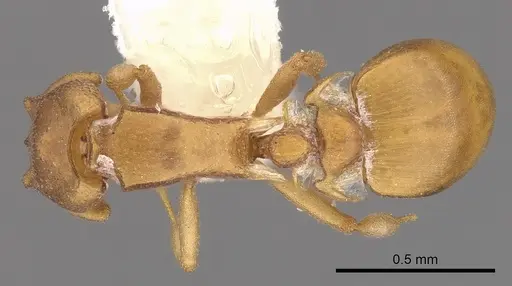
Literature
Loading distribution map...Loading products...