
Cladomyrma aurochaetae
- Sci. Name
- Cladomyrma aurochaetae
- Tribe
- Lasiini
- Subfamily
- Formicinae
- Author
- Agosti <i>et al.</i>, 1999
- Distribution
- Found in 0 countries
Introduction
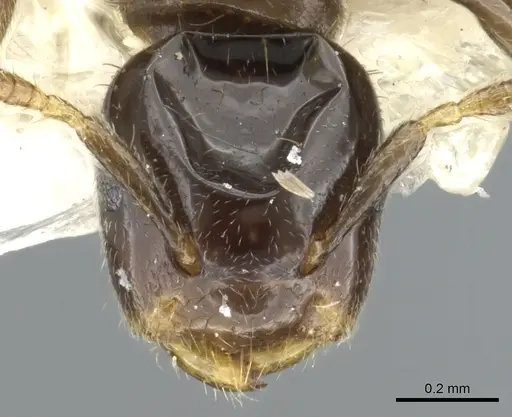
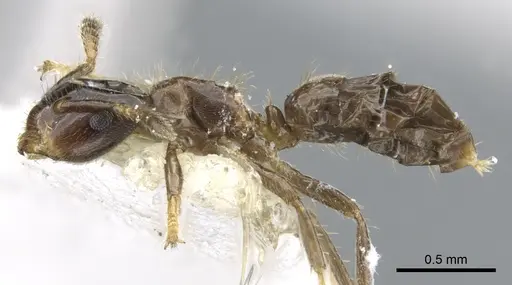
Cladomyrma aurochaetae is a tiny plant-ant species native to Borneo, specifically found in the Hose Mountains of Sarawak, East Malaysia . Workers are extremely small, with an alitrunk (midbody) length under 1.1 mm, and queens are larger with alitrunk length up to 2.72 mm . Queens have a blackish head and alitrunk, a brilliantly shining gaster, and are covered in long golden hairs . This species has an obligate relationship with Neonauclea trees (particularly Neonauclea gigantea), nesting exclusively inside the hollow domatia that these plants produce . The only known colonies collected were very small – just 22 workers – which researchers believe were nanitics (first-generation workers) from an early colony founding phase .
Quick Summary
- Difficulty: Expert
- Origin & Habitat: Tropical rainforest of Borneo (Sarawak, Malaysia) – specifically the Hose Mountains region. This species is an obligate plant-ant that lives inside domatia (hollow structures) of Neonauclea trees [1].
- Colony Type: Colony structure is unknown. Only small colonies (around 22 workers) have ever been documented, and these appear to be early-stage colonies with nanitics [1]. It is not known if colonies are single-queen or multi-queen.
- Size & Growth:
- Queen: Total body length not reported, alitrunk length 2.36–2.72 mm [1].
- Worker: Total body length not reported, alitrunk length: minor workers 0.60–0.68 mm, major worker 1.04 mm [1].
- Colony: Unknown – only documented colony had ~22 workers (likely nanitics) [1].
- Growth: Unknown
- Development: Unknown – no development data exists [1]. (The only collected colonies were extremely small, suggesting either slow growth or that the species naturally maintains small colonies, but this is unclear.)
- Antkeeping:
- Temperature: Tropical species – keep warm at 24–28°C. Based on their Borneo rainforest origin, they likely need consistently warm, humid conditions [1].
- Humidity: High humidity required – these ants live inside plant domatia in humid forest understory. Keep the nest substrate consistently moist but not waterlogged.
- Diapause: Unknown – as a tropical species, they likely do not require true hibernation, but may have seasonal activity patterns tied to wet/dry seasons in Borneo.
- Nesting: This species is an obligate plant-ant and likely cannot survive outside of living Neonauclea domatia. Recreating these structures in captivity is not possible. Captive keeping is not feasible.
- Behavior: These ants are extremely small and likely timid. As plant-ant specialists, they probably have a mutualistic relationship with their host – the ants get shelter while potentially protecting the plant from herbivores [1]. Their tiny size means excellent escape prevention is critical – they can squeeze through gaps invisible to the human eye. No data exists on their sting capability, but given their size, any sting would be negligible. Foraging behavior is unknown, but likely involves tending honeydew-producing insects or collecting plant secretions.
- Common Issues: no captive husbandry information exists – this species has never been kept in captivity [1]., extremely small size makes escape prevention critical and feeding difficult., specialized habitat requirements (plant domatia) cannot be replicated in captivity., only known from a handful of specimens – wild colonies are naturally very small [1]., tropical humidity requirements may be difficult to maintain consistently., species requires a living host plant (Neonauclea) for survival, which is not feasible in captivity [1].
Understanding Cladomyrma aurochaetae
Cladomyrma aurochaetae is one of the most poorly known ant species in the world. It belongs to the Formicinae subfamily within the tribe Plagiolepidini [2], and is part of a genus of specialized plant-ants [1]. This species is extremely specialized – it has only ever been found living inside the domatia (hollow structures) of Neonauclea trees, specifically Neonauclea gigantea [1]. The original type series was collected from a sapling just 0.42 meters tall, living in its first and only domatium [1]. The ants collected were extraordinarily small – just 22 workers – and researchers determined these were likely nanitics, the first workers produced by a founding queen [1]. This suggests either the species naturally maintains very small colonies or that finding established colonies is extremely difficult due to their hidden lifestyle.
Natural History and Host Relationship
This species is an obligate plant-ant, meaning it cannot survive without its host plant [1]. The genus Cladomyrma evolved to live inside specialized hollow structures called domatia that certain plants produce – these are not random holes but actively formed chambers typically found at the base of leaves or in stems [1]. Neonauclea gigantea, a tree in the coffee family (Rubiaceae), produces these domatia as part of a mutualistic relationship. The plant provides shelter, and in return, the ants likely protect against herbivores and may provide nutrients through their waste [1]. This relationship is similar to other plant-ants like those in the genus Crematogaster or Pseudomyrmex. The Hose Mountains in Sarawak, where this species was discovered, is a tropical rainforest region with high humidity year-round – conditions you would need to replicate in captivity. The fact that only this single Neonauclea species has been recorded as a host suggests extreme specialization [1].
Appearance and Identification
Cladomyrma aurochaetae is one of the smallest ant species in the Formicinae subfamily. Workers are extremely small, with minor workers having an alitrunk (midbody) length of 0.60–0.68 mm and major workers 1.04 mm [1]. Queens are larger, with an alitrunk length up to 2.72 mm [1]. The workers have a light brown, shining body [1]. The most distinctive feature of the queen is her covering of long, erect golden hairs [1]. The queen's head and alitrunk are blackish, contrasting sharply with her brilliantly shining gaster [1]. The petiole (the narrow waist) is raised and scale-like [1]. This combination of tiny size, golden hairs, and shining gaster makes the queen relatively distinctive, but observing these features requires significant magnification.
Challenges of Keeping This Species
Cladomyrma aurochaetae is NOT a species for antkeepers. This is not a matter of difficulty – this species has never been kept in captivity by anyone, and there is no information whatsoever on how to maintain them. The fundamental challenge is their obligate relationship with living Neonauclea plants. In the wild, they live inside domatia – specialized hollow structures that the plant actively maintains [1]. Replicating this in captivity would require keeping a live Neonauclea tree with domatia, which is extraordinarily difficult. Additionally, their tiny size (under 1 mm alitrunk length) creates enormous challenges for feeding, escape prevention, and observation. The few colonies ever found were extremely small (22 workers), suggesting this species naturally forms tiny colonies – possibly just a few dozen workers even at maturity [1]. If you are interested in plant-ants, consider more commonly kept species like Crematogaster or certain Pseudomyrmex species that have established captive husbandry protocols.
Why This Species Matters
Even though you cannot keep Cladomyrma aurochaetae, understanding why it matters helps appreciate ant diversity. This species represents an extreme example of mutualistic specialization – it has evolved to live exclusively inside one specific type of plant structure, making it completely dependent on that plant for survival [1]. The discovery of this species in 1999 helped researchers understand the diversity of plant-ant relationships in Southeast Asian rainforests [1]. The Hose Mountains of Sarawak remain one of the most biodiverse regions for ants in Borneo, with many species still being discovered and described [2]. Cladomyrma aurochaetae serves as a reminder that most ant species in the tropics remain completely unknown to science – we have only scratched the surface of understanding their behaviors, colony structures, and requirements. For antkeepers, this species represents a goal for conservation: protecting the rainforests of Borneo protects not just this ant, but the entire ecosystem it depends on.
Frequently Asked Questions
Can I keep Cladomyrma aurochaetae as a pet ant?
No. This species has never been kept in captivity and likely cannot be maintained without its host Neonauclea plant. It is not available in the antkeeping hobby and should not be sought after [1].
Where does Cladomyrma aurochaetae live in the wild?
Only in the Hose Mountains of Sarawak, Borneo (East Malaysia) [2]. They live inside domatia (hollow chambers) of Neonauclea trees, specifically Neonauclea gigantea [1].
How big are Cladomyrma aurochaetae ants?
They are very small. Minor workers have an alitrunk (midbody) length of 0.60–0.68 mm and major workers 1.04 mm. Queens have an alitrunk length of 2.36–2.72 mm [1]. Total body length has not been reported.
What do Cladomyrma aurochaetae eat?
Unknown. As plant-ants, they likely consume honeydew from aphids or scale insects, and possibly plant secretions. No feeding observations have been recorded [1].
How many workers does a Cladomyrma aurochaetae colony have?
Unknown in established colonies. The only documented wild colony had just 22 workers, which researchers believe were nanitics (first workers from a new colony) [1].
Is Cladomyrma aurochaetae endangered?
Its conservation status has not been assessed. However, it has an extremely limited range (only known from one location in Sarawak) and specialized habitat requirements, making it potentially vulnerable to habitat loss [1].
What is a domatium?
A domatium is a hollow structure in a plant that provides shelter for ants or other organisms. Neonauclea trees produce domatia at the base of leaves or in stems. The plant benefits from the ants' protection against herbivores [1].
Are there easier plant-ant species to keep?
Yes. Consider Crematogaster species or Pseudomyrmex species that have established captive protocols. These are more readily available and their care is well-documented in the antkeeping hobby [2].
Why is so little known about this ant?
Because it is extremely rare – only ever found once in the late 1990s. It lives inside hidden plant structures in a remote rainforest region, making it nearly impossible to study [1]. Most tropical ant species remain poorly known for the same reasons.
Report an Issue
The current care sheet is based fully on literature. See inconsistencies, or something that's incorrect? Please , it will be resolved after review from an admin. Contributing to the blogs tab also helps providing information, to make us be able to further improve the caresheets. Thank you for your support!
References

This caresheet is licensed under CC BY-SA 4.0 .
Community Blogs
CASENT0903190
View on AntWeb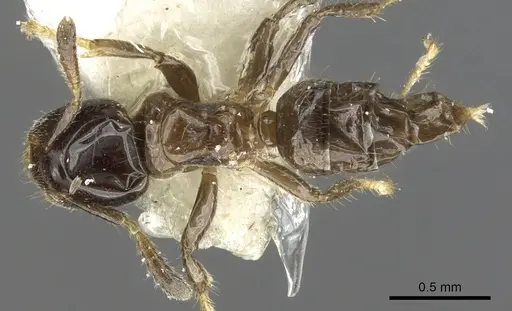
Literature
Loading distribution map...Loading products...