
Carebara villiersi
- Sci. Name
- Carebara villiersi
- Tribe
- Crematogastrini
- Subfamily
- Myrmicinae
- Author
- Bernard, 1953
- Distribution
- Found in 4 countries
Introduction
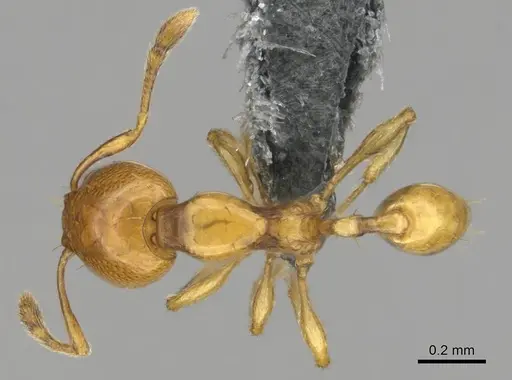
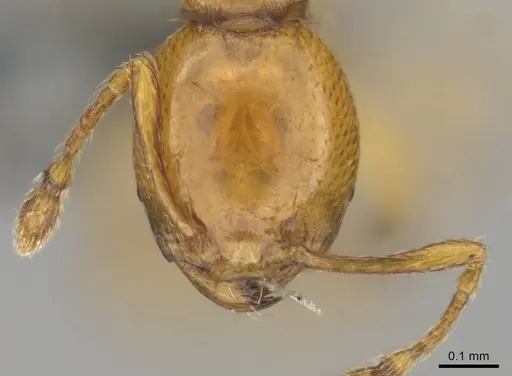
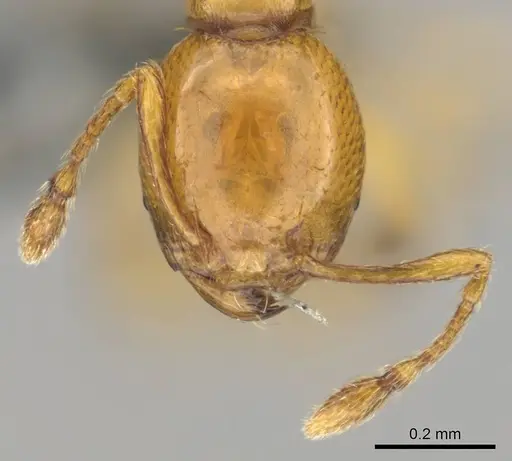
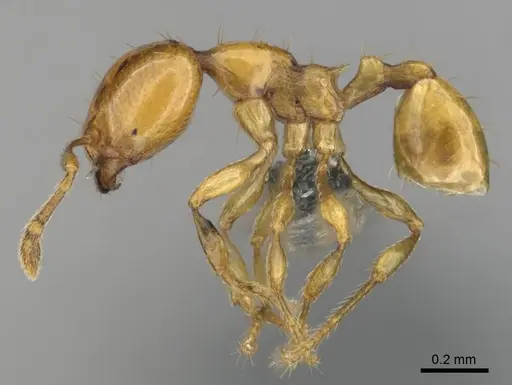
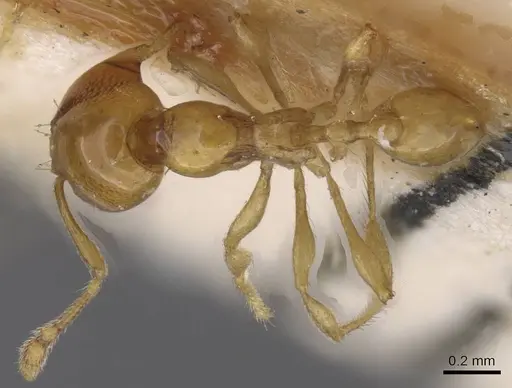
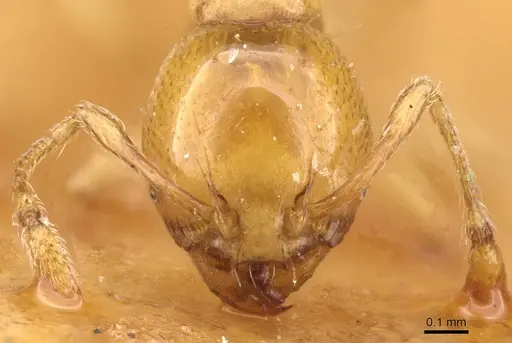
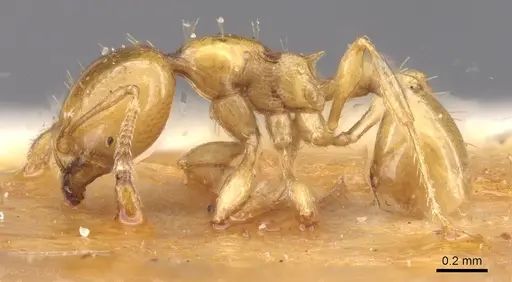
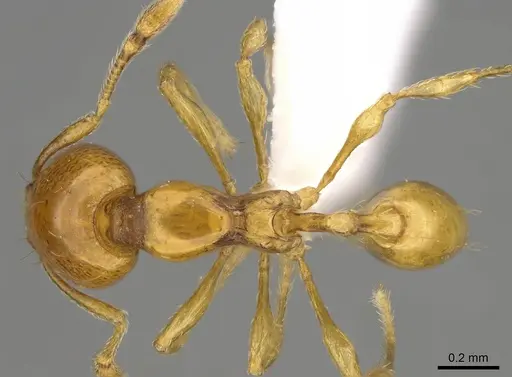
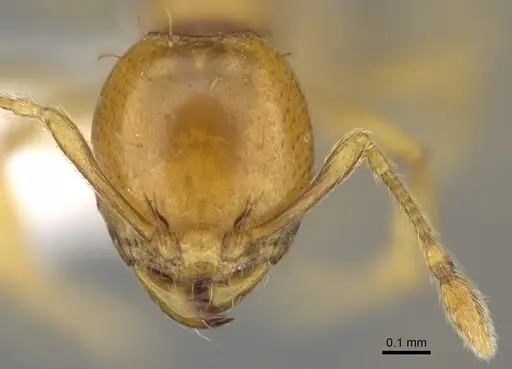
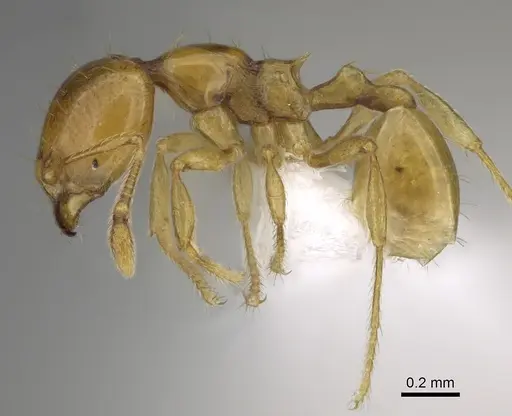
Carebara villiersi is a tiny rainforest ant native to West and Central Africa . Workers are extremely small (head width about 0.44-0.49 mm) with a yellowish‑orange color, a smooth and shiny face, and long propodeal spines that are longer than the distance between their bases . Only minor workers have been documented - major workers either do not exist or have not yet been collected and identified . This species shows features linking the genus Carebara to the former genus Pheidologeton . In the wild, it lives in rainforest leaf‑litter at elevations from 20 to 1470 m, and specimens are collected using Winkler sifting .
Quick Summary
- Difficulty: Expert
- Origin & Habitat: West and Central Africa, Cameroon, Central African Republic, Gabon, Ghana, Guinea, Ivory Coast [1], and possibly Nigeria. Inhabits tropical rainforest leaf‑litter at elevations from 20 to 1470 m [1].
- Colony Type: Unknown, only minor workers have been documented in scientific collections. No queen or colony structure data is available [1].
- Size & Growth:
- Queen: Unknown, queens have not been documented or collected [1]
- Worker: Size data unavailable (head width ~0.44-0.49 mm, but total length not recorded) [1]
- Colony: Unknown, colony size has not been studied
- Growth: Unknown
- Development: Unknown, no development data exists for this species (Any estimates would be pure speculation, no related Carebara lab data is available.)
- Antkeeping:
- Temperature: Based on its tropical rainforest habitat, keep warm and stable, roughly 24-28°C [1]. Provide a gentle gradient so the colony can choose.
- Humidity: High humidity is essential. Keep the nest substrate consistently moist but not waterlogged. Use a water tube and ensure the nest area stays damp, with good ventilation to avoid mold.
- Diapause: Unknown, as a tropical low‑elevation species, true diapause is unlikely, but activity may slow during cooler periods.
- Nesting: Because of their tiny size, test tubes with tightly packed cotton and Y‑tong (AAC) or plaster nests with very small chambers are recommended. Avoid tall open spaces, they prefer confined, leaf‑litter‑like spaces. Extreme escape prevention is mandatory.
- Behavior: Behavior is unstudied. Based on subfamily (Crematogastrini), they have a modified flattened stinger used to smear venom, but their tiny size makes them harmless to humans. They are likely shy and non‑aggressive, foraging individually in leaf‑litter for tiny prey and honeydew. Escape prevention is absolutely critical, they can squeeze through the tiniest gaps.
- Common Issues: escape prevention is the top priority, their tiny size means standard barriers may not contain them, no colony structure has ever been documented, so a purchased colony may lack a functional queen, virtually no captive care information exists, all advice is inferred from habitat and related species, extreme small size makes them vulnerable to stress, desiccation, and accidental escape, high humidity requirements create a mold risk if ventilation is poor
Housing and Escape Prevention
Housing Carebara villiersi is extremely challenging because of their tiny size, workers have a head width of only about 0.44-0.49 mm [1]. Standard test tube setups can work if the cotton is packed extremely tightly. Escape prevention is the most critical concern: these ants can squeeze through gaps that would contain much larger species. Apply fluon or PTFE barrier tape to all edges of the outworld, and seal any connections between nest chambers with cotton or fine mesh. Y‑tong (AAC) or plaster nests with very small chambers work well, as do naturalistic setups with a thin layer of damp substrate. Avoid tall, open spaces, they prefer tight, confined spaces similar to the leaf‑litter where they naturally live [1].
Feeding and Diet
No feeding data exists for this species [1]. Based on the ecology of tiny leaf‑litter Carebara, they likely feed on small live prey such as springtails, micro‑arthropods, and fruit flies, and may also accept honeydew or diluted sugar water. Any prey must be appropriately tiny. Offer small live prey twice a week and provide a constant sugar source. Remove uneaten prey promptly to prevent mold in the humid environment.
Temperature and Humidity
As a tropical rainforest species, Carebara villiersi requires warm, stable conditions. Keep temperatures in the range of 24-28°C with minimal fluctuations [1]. A heating cable on one side of the nest can create a gentle gradient, but avoid overheating a small colony. Humidity should be high, keep the nest substrate consistently moist but not waterlogged. Use a water tube to maintain humidity, and ensure good ventilation to prevent mold. Avoid placing the colony in direct airflow that could dry them out.
Acquiring and Handling
This is one of the rarest ants in the hobby. Only minor workers have ever been documented in scientific collections, no major workers or queens have been described [1][2]. If colonies become available, they would almost certainly be wild‑caught from the native African range. Be extremely skeptical of any claims of captive‑bred colonies, as the complete life cycle has never been observed. If you acquire wild‑caught specimens, quarantine them and watch for parasites, which are common in leaf‑litter ants. Successful captive breeding would be a significant achievement.
Frequently Asked Questions
How long does it take for Carebara villiersi to develop from egg to worker?
Unknown, no development data exists for this species. Any estimate is pure speculation.
Can I keep Carebara villiersi in a test tube?
A test tube can work, but you must use extremely tight‑fitting cotton and excellent escape barriers. Their tiny size means they can escape through gaps that would contain larger ants.
Do Carebara villiersi sting?
Like other Crematogastrini, they have a modified stinger used to smear venom, but due to their tiny size they cannot penetrate human skin. They pose no danger to people.
Are Carebara villiersi good for beginners?
No. This is an expert‑level species because of its extreme small size, complete lack of captive care documentation, and unknown colony structure. Many better‑documented species are available.
What do Carebara villiersi eat?
Not directly documented. Based on Carebara ecology, they likely accept small live prey (springtails, micro‑arthropods) and sugar sources. Offer tiny live prey twice a week and provide a constant sugar source.
Do Carebara villiersi need hibernation?
Unknown, as a tropical low‑elevation species, true hibernation is unlikely, but activity may slow during cooler periods. A deliberate diapause is probably not necessary.
How big do Carebara villiersi colonies get?
Unknown, colony size has not been studied. No data exists to make even an estimated range.
Why are Carebara villiersi so rarely kept?
Only minor workers have ever been documented, no major workers or queens have been scientifically described. This makes acquiring and keeping a colony extremely difficult, and no captive breeding success has been reported [1].
What temperature should I keep Carebara villiersi at?
Keep them warm and stable, roughly 24-28°C, based on their tropical rainforest habitat [1].
Can I keep multiple queens together?
Unknown, no queen of this species has ever been documented, so colony structure is entirely unknown.
Report an Issue
The current care sheet is based fully on literature. See inconsistencies, or something that's incorrect? Please , it will be resolved after review from an admin. Contributing to the blogs tab also helps providing information, to make us be able to further improve the caresheets. Thank you for your support!
References

This caresheet is licensed under CC BY-SA 4.0 .
Community Blogs
Literature
Loading distribution map...Loading products...