
Carebara longiceps
- Sci. Name
- Carebara longiceps
- Tribe
- Crematogastrini
- Subfamily
- Myrmicinae
- Author
- Santschi, 1929
- Distribution
- Found in 0 countries
Introduction
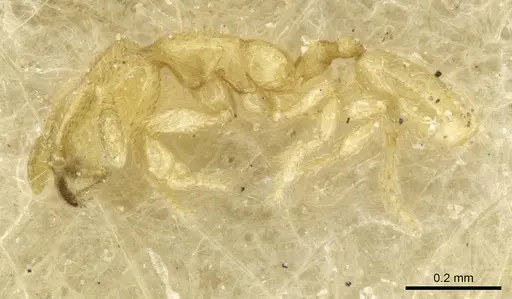
Carebara longiceps is an extremely tiny ant species belonging to the Myrmicinae subfamily. Workers measure just 1.18mm in total length, making them among the smallest ants in the Americas . They belong to the Carebara lignata species complex and have a light yellow coloration with a smooth, shining body . Males are considerably larger at 3.58mm and feature a dark brown body with lighter appendages and distinctive head striations . This species has the most southerly distribution within its species complex, being known only from the Sierras de Córdoba in Argentina . Unfortunately, queens have never been collected, meaning the reproductive biology of this species remains completely unknown [AntWiki].
Quick Summary
- Difficulty: Expert
- Origin & Habitat: Native to the Sierras de Córdoba in Argentina, South America. The specific natural habitat is unknown [1][2].
- Colony Type: Unknown, no queens have ever been collected, so colony structure cannot be determined.
- Size & Growth:
- Queen: Unknown, queens have never been collected [3]
- Worker: 1.18mm total length [1]
- Colony: Unknown, no colony size data available
- Growth: Unknown
- Development: Unknown, no developmental data exists for this species (Queens have never been collected, so founding and development are completely unstudied)
- Antkeeping:
- Temperature: Unknown, no thermal studies exist for this species
- Humidity: Unknown, no humidity data exists for this species
- Diapause: Unknown, no seasonal data exists for this species
- Nesting: Unknown natural nesting preferences, no nesting data exists for this species
- Behavior: No behavioral studies exist for this species. Their tiny size (1.18mm workers) means escape prevention must be excellent, they can squeeze through remarkably small gaps. Handle with extreme care as they are nearly microscopic and easily lost or crushed.
- Common Issues: queen unavailability, queens have never been collected, making captive breeding essentially impossible, tiny size makes them extremely difficult to house and observe, they require fine mesh barriers and careful handling, no established care protocols exist, this species has never been kept in captivity, growth and development are completely unstudied, no timeline guidance available, all environmental requirements are unknown, temperature, humidity, and diet preferences unstudied
Species Overview and Identification
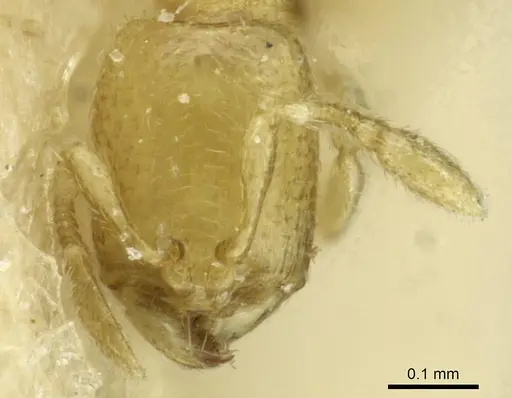
Carebara longiceps is a member of the Carebara lignata species complex, distinguished by its unique frontal lobe configuration, propodeal shape, and notably large metapleural gland bullae [1]. Workers are extremely small at just 1.18mm total length with a light yellow, smooth and shining body. The head is slightly longer than wide with a concave posterior border, and the antennae scapes fail to reach the vertex by about one-third of the head length [1]. Males are dramatically larger at 3.58mm, featuring a dark brown body, strong longitudinal striations on the head, and distinctive genitalia with two large falcate parameres [1]. This species holds the distinction of having the most southerly distribution of any species in the lignata complex, known only from the Sierras de Córdoba region of Argentina [1][2].
Why This Species Is Extremely Difficult to Keep
Carebara longiceps presents extraordinary challenges that make it unsuitable for antkeeping. Most critically, queens have never been collected, the species is only known from workers and a single male collected in 1924 [3][1]. This means there is no documented way to establish a colony, and captive breeding is essentially impossible. Beyond the queen issue, no biological research exists on this species, we have no data on their diet, temperature preferences, humidity needs, founding behavior, or any aspect of their care. The workers are also extremely tiny at just 1.18mm, making them difficult to house, feed, and observe. For all these reasons, this species should be considered a scientific curiosity rather than a viable keeping project.
Inferred Care Requirements from Related Species
Since direct data is unavailable for this species, any care recommendations would be speculative guesses based on related Carebara species. However, without confirmed data, providing specific care advice would be misleading. The complete absence of biological data means no reliable guidance can be offered.
Legal and Ethical Considerations
This species is native only to Argentina and is not established anywhere else in the world. Given how rare and poorly understood this species is, any specimens would be scientifically valuable. Carebara longiceps is best appreciated through scientific literature rather than attempted captivity.
Frequently Asked Questions
Can I keep Carebara longiceps as an antkeeper?
No. This species is not recommended for keeping. Queens have never been collected, meaning there is no way to establish a colony. No biological data exists to guide care, and the workers are so tiny (1.18mm) that they present extreme housing and feeding challenges. This species remains a scientific mystery.
Where does Carebara longiceps live?
Only in the Sierras de Córdoba region of Argentina, South America. It has the most southerly distribution of any species in the Carebara lignata complex [1][2].
How big are Carebara longiceps workers?
Extremely tiny, workers measure just 1.18mm in total length [1]. They are among the smallest ant species in the Americas.
Why are queens not available for this species?
Queens have simply never been collected or documented. The type specimens consist of workers and a single male collected in 1924, and despite over 90 years of subsequent research, no queen has ever been found [3][1].
What do Carebara longiceps eat?
Unknown, no feeding studies exist for this species.
Do Carebara longiceps ants sting?
Unknown, no defensive behavior has been documented for this species.
What temperature should I keep Carebara longiceps at?
No data exists, temperature requirements are completely unknown for this species.
How fast do Carebara longiceps colonies grow?
Unknown, no colony development data exists. Without any queens ever being collected, there is no information on founding, brood development, or colony growth rates.
Are Carebara longiceps good for beginners?
Absolutely not. This species is suitable only for expert myrmecologists conducting scientific research. The complete lack of biological data, absence of queens, and microscopic worker size make it impossible to keep successfully.
Do Carebara longiceps need hibernation?
Unknown, no seasonal data exists for this species.
Report an Issue
The current care sheet is based fully on literature. See inconsistencies, or something that's incorrect? Please , it will be resolved after review from an admin. Contributing to the blogs tab also helps providing information, to make us be able to further improve the caresheets. Thank you for your support!
References

This caresheet is licensed under CC BY-SA 4.0 .
Community Blogs
CASENT0913511
View on AntWeb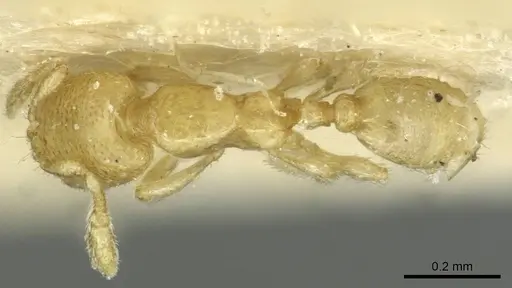
Literature
Loading distribution map...Loading products...