
Cardiocondyla shagrinata
- Sci. Name
- Cardiocondyla shagrinata
- Tribe
- Crematogastrini
- Subfamily
- Myrmicinae
- Author
- Seifert, 2003
- Distribution
- Found in 1 countries
Introduction
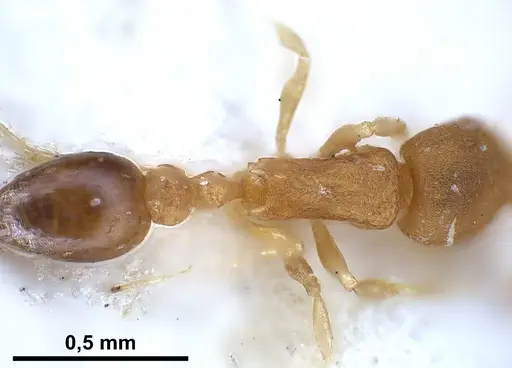
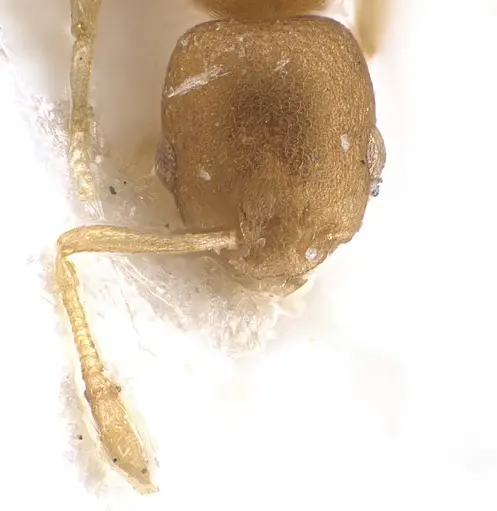
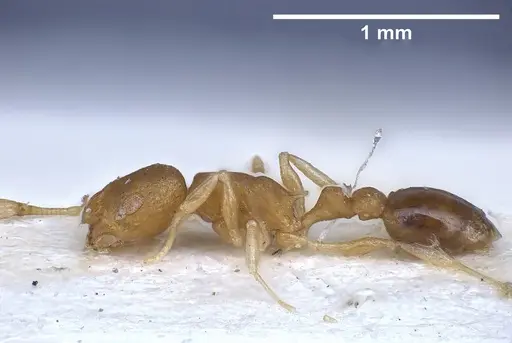
Cardiocondyla shagrinata is an extremely small ant species, among the smallest in the world, with a head width of approximately 0.43mm . Workers have a distinctive rough, grainy texture covering their head and mesosoma, with a dirty yellowish-brown body color and dark brown gaster . This species is only known from three worker specimens collected in the South Konkan region of western India, a coastal tropical area at approximately 100 meters elevation . Scientists have never observed a living colony of this ant. The species is only known from the type series - the three original specimens used to describe the species in 2003 - making it one of the rarest ants on Earth . Unlike its relatives Cardiocondyla wroughtonii and Cardiocondyla obscurior which have spread worldwide, C. shagrinata appears to be a rare endemic found only in the Indian Konkan coast .
Quick Summary
- Difficulty: Expert (Theoretical only)
- Origin & Habitat: South Konkan, India (coastal tropical forests, approximately 100m elevation) [1][2]
- Colony Type: Unknown, colony structure unconfirmed
- Size & Growth:
- Queen: Size data unavailable, no queens have been collected or described
- Worker: ~0.43mm head width, inferred from genus (~1.5-2mm total length typical for Cardiocondyla)
- Colony: Unknown, no colonies have ever been found
- Growth: Unknown
- Development: Unknown (No development data exists for this species)
- Antkeeping:
- Temperature: Likely 24-28°C based on tropical Indian origin, but unconfirmed
- Humidity: Likely high humidity based on coastal forest habitat, but unconfirmed
- Diapause: Probably not required (tropical species)
- Nesting: Unknown, likely soil or leaf litter based on genus patterns
- Behavior: Unknown in life. Presumably slow-moving and cryptic like relatives. Extreme escape risk due to tiny size.
- Common Issues: this species exists only in museums, three worker specimens total, making it unavailable to keepers., extreme escape risk due to tiny size requiring impossible mesh sizes., no captive care data exists, everything would be experimental., collecting would harm a rare endemic species restricted to a small coastal region., queens have never been observed or collected, breeding in captivity is impossible.
The Reality of Rarity
You cannot buy or legally collect Cardiocondyla shagrinata. Scientists have only ever found three worker specimens of this ant, all collected from the South Konkan region of India and now stored in museums [1][3]. The species was described in 2003 from this type series, and no additional collections have been reported in the following decades [1].
This makes C. shagrinata essentially unavailable to antkeepers. Even if you traveled to the type locality in the Konkan coastal region spanning Karnataka, Goa, and Maharashtra, finding a colony would be nearly impossible [2]. The species is endemic to India, meaning it lives nowhere else in the world [2]. Attempting to collect specimens would be unethical and potentially illegal under Indian wildlife protection laws, as it could harm a species we know almost nothing about.
Inferred Care from Relatives
If you somehow obtained C. shagrinata, you would have to base care on its close relatives Cardiocondyla wroughtoniii and Cardiocondyla obscurior, which belong to the same species group [1]. These relatives suggest the species may form small colonies, though colony structure is unconfirmed for C. shagrinata specifically.
Based on its tropical coastal origin at 100 meters elevation, temperatures around 24-28°C and high humidity around 60-80% may be appropriate, but this is purely theoretical [1]. The tiny size suggests they would need minute prey like springtails or fruit flies, and a nest with extremely small chambers. However, no one has ever kept this species, and these parameters are educated guesses based on related ants from similar habitats.
Identification and Similar Species
Cardiocondyla shagrinata looks almost identical to its relatives C. wroughtonii and C. obscurior under casual observation, but experts can tell them apart by examining the texture of the body surface [1]. C. shagrinata has a rough, grainy texture (called shagreened sculpture) covering the head and mesosoma, with pronounced raised corners on the front of the thorax [1].
The color is a dirty yellowish-brown rather than the cleaner yellow of some relatives, and the gaster is dark brown [1]. At just 0.43mm head width, these ants are extremely small, even smaller than the already tiny C. obscurior [1]. You would need a microscope to identify them properly. If you see ants matching this description for sale, they are almost certainly C. obscurior or C. wroughtonii, not the impossibly rare C. shagrinata.
Why This Species Stays in Museums
Most Cardiocondyla species in the wroughtonii group are tramp ants that have spread worldwide through human commerce. Cardiocondyla obscurior, for example, is found on multiple continents and is a common pet species. But C. shagrinata has never been found outside its tiny range in India [2].
This suggests the species has specific habitat requirements or is genuinely rare in the wild. The type locality in South Konkan is a coastal region with tropical forests, but detailed habitat data is absent [1]. Until researchers locate additional colonies and study their biology, this species will remain a scientific curiosity rather than a pet ant.
Frequently Asked Questions
Can I buy Cardiocondyla shagrinata?
No. This species is not available in the ant trade. Only three worker specimens exist in museums, and no one has ever collected this species for the pet trade [1]. Any ants sold under this name are likely misidentified Cardiocondyla obscurior or C. wroughtonii.
How do I care for Cardiocondyla shagrinata?
No one knows. This species has never been kept in captivity. If you somehow obtained them, you would need to experiment based on their close relatives C. obscurior and C. wroughtonii, keeping them warm and humid with tiny prey items. However, you should not attempt to collect this rare species.
Are Cardiocondyla shagrinata invasive?
No. Unlike their relatives C. wroughtonii and C. obscurior which have spread worldwide, C. shagrinata appears to be a rare endemic restricted to a small coastal region of India [2]. There are no records of this species outside its native range.
How big do Cardiocondyla shagrinata colonies get?
Unknown. Scientists have never found a colony. Based on related Cardiocondyla species, colonies likely remain small, but this is purely speculative.
What do Cardiocondyla shagrinata eat?
Unknown. Based on the genus, they likely eat small insects, springtails, and possibly honeydew, but no one has observed their feeding behavior in the wild.
Do Cardiocondyla shagrinata need hibernation?
Probably not. They come from tropical coastal India where temperatures remain warm year-round [1]. However, this is inferred from their origin, not confirmed observation.
Can I keep Cardiocondyla shagrinata in a test tube?
Theoretically yes, but you will never obtain this species. If you did, a standard test tube would be enormous for ants with head width under 0.5mm. You would need a specialized mini-setup with extremely fine barriers to prevent escapes.
Are Cardiocondyla shagrinata good for beginners?
No. Even if available, their extremely small size makes them difficult to contain, and nothing is known about their care requirements. Beginners should start with common species like Lasius niger or Tetramorium immigrans instead.
How long until Cardiocondyla shagrinata gets first workers?
Unknown. No development data exists for this species.
Where can I find Cardiocondyla shagrinata queens?
You cannot. Queens have never been observed or collected. The only known specimens are three workers collected in South Konkan, India [1][3].
Report an Issue
The current care sheet is based fully on literature. See inconsistencies, or something that's incorrect? Please , it will be resolved after review from an admin. Contributing to the blogs tab also helps providing information, to make us be able to further improve the caresheets. Thank you for your support!
References

This caresheet is licensed under CC BY-SA 4.0 .
Community Blogs
ANTWEB1041251
View on AntWeb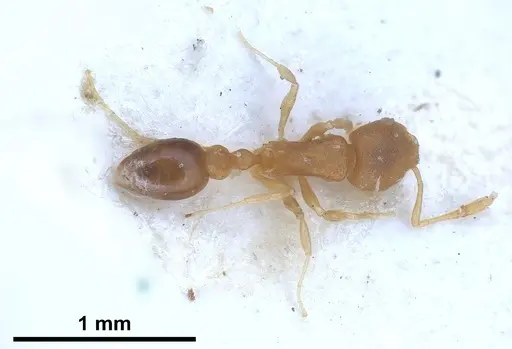
Literature
Loading distribution map...Loading products...