
Cardiocondyla neferka
- Sci. Name
- Cardiocondyla neferka
- Tribe
- Crematogastrini
- Subfamily
- Myrmicinae
- Author
- Bolton, 1982
- Distribution
- Found in 1 countries
Introduction
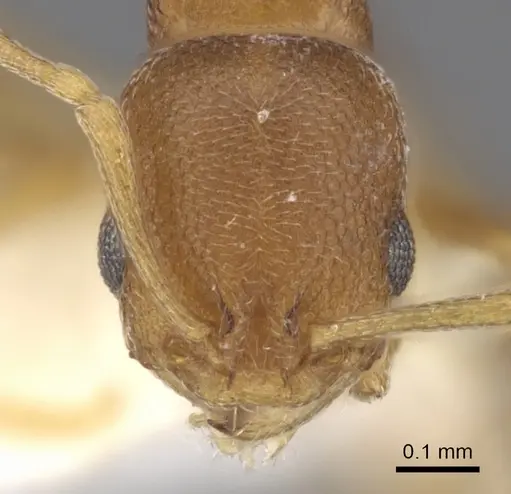
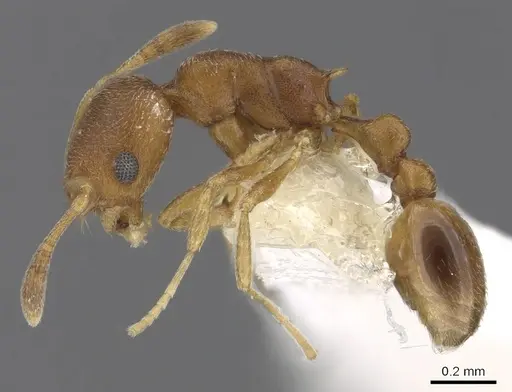
Cardiocondyla neferka is an extremely tiny ant species from West Africa, measuring only about 1.8mm in total length. Workers have a distinctive elongated head and well-developed pronotal shoulders giving them a square-shouldered appearance, along with long narrow propodeal spines. The body is light yellowish brown, with some specimens showing a darker brown to blackish gaster. This species belongs to the Cardiocondyla wroughtonii group and is closely related to Cardiocondyla emeryi. It has been collected in Ghana, Nigeria, Cameroon, Ivory Coast, and Benin, where researchers found it foraging on mango trees. Remarkably, this species is known from only two worker specimens collected in 1969-1970, making it one of the rarest and least studied ants in the world .
Quick Summary
- Difficulty: Unknown, too little data to assess
- Origin & Habitat: West Africa (Ghana, Nigeria, Cameroon, Ivory Coast, Benin). Found on mango trees in Benin, suggesting arboreal or canopy foraging behavior in tropical agricultural settings [3].
- Colony Type: Unknown, only two worker specimens have ever been collected, no colony or queen data exists [1].
- Size & Growth:
- Queen: Undescribed, no queens have been collected [1].
- Worker: 1.8mm total length [2].
- Colony: Unknown, no colony collections exist [1].
- Growth: Unknown, no development data exists.
- Development: Unknown, no development data exists for this species. (This is one of the rarest ant species in the world, known from only two worker specimens. No biological data exists on colony founding, development, or social structure.)
- Antkeeping:
- Temperature: Likely needs warm tropical conditions based on West African distribution, but this is an estimate with no direct data.
- Humidity: Likely prefers moderate to high humidity typical of tropical West Africa, but specific requirements are unconfirmed.
- Diapause: Unlikely, being a tropical species from near the equator, they probably do not require a diapause period.
- Nesting: Unknown. Based on related Cardiocondyla species and the mango tree finding, they may nest in small cavities in wood, under bark, or in arboreal locations.
- Behavior: Behavior is unobserved. Related Cardiocondyla species are typically non-aggressive, generalist foragers that scavenge and tend aphids for honeydew. Their tiny size means they could potentially escape through standard mesh barriers, use fine mesh if keeping this species. No sting is documented, but most Cardiocondyla are too small to penetrate human skin.
- Common Issues: No captive husbandry information exists, this species has never been kept in captivity., Only two specimens exist in museum collections, making wild collection extremely unlikely., No queen or colony has ever been documented, so captive breeding would be impossible even if specimens were obtained., Tiny size may create escape prevention challenges., Unknown dietary requirements, must be inferred from related species.
Species Overview and Rarity
Cardiocondyla neferka is an extraordinarily rare ant species. Despite being described in 1982, it is known from only two worker specimens collected over 50 years ago, one from Ghana in 1970 and one from Nigeria in 1969. This makes it one of the least studied ant species in the world. The species was found on mango trees in Benin in 2018, which represents the only recent observation of this ant. The lack of specimens suggests either very low population densities, highly specialized microhabitats, or both. For antkeepers, this means that obtaining live specimens is essentially impossible, and no captive husbandry information exists whatsoever [1][3].
Identification and Morphology
Workers are tiny at only 1.8mm total length. The most distinctive features are the very elongated head and the conspicuously square-shouldered appearance when viewed from above, caused by well-developed pronotal shoulders forming rounded angles of about 120 degrees. The propodeal spines are notably long and narrow. The body is mostly light yellowish brown, though some specimens have a darker brown to blackish gaster. The species is most easily confused with Cardiocondyla emeryi and Cardiocondyla weserka, but can be separated by the elongated spines and the square-shouldered profile [1][3].
Distribution and Habitat
This species is known from West Africa: Ghana (type locality Mampong), Nigeria (Gambari), Cameroon, Ivory Coast, and Benin. The Benin records from mango trees suggest these ants may be arboreal or at least forage in the canopy. West Africa has a tropical climate with high year-round temperatures and humidity. The region experiences distinct wet and dry seasons, but temperatures remain warm year-round near the coast [3].
Keeping Considerations
This species cannot be recommended for antkeeping at this time. No live specimens have ever been documented in captivity, and no queen or colony has ever been collected. The only known specimens are four workers in museum collections. Even if specimens were somehow obtained, there is no biological information to guide their care, we do not know what they eat, how they nest, what temperature they require, or anything about their colony structure. Related Cardiocondyla species are typically generalist foragers that accept sugar sources and small protein prey, but this cannot be assumed for C. neferka specifically. Anyone interested in keeping Cardiocondyla species should consider more common and well-documented species in this genus [1].
Frequently Asked Questions
Can I keep Cardiocondyla neferka ants?
No. This species has never been kept in captivity and no live specimens are known to exist. Only four worker specimens exist in museum collections worldwide [1].
Where does Cardiocondyla neferka live?
West Africa, specifically Ghana, Nigeria, Cameroon, Ivory Coast, and Benin. The only recent observation was on mango trees in Benin [3].
How big is Cardiocondyla neferka?
Workers are tiny at only about 1.8mm total length. This makes them one of the smaller ant species in the genus Cardiocondyla [2].
What do Cardiocondyla neferka ants eat?
Unknown, no feeding observations exist for this species. Related Cardiocondyla species are generalist foragers that eat honeydew and small insects, but this cannot be confirmed for C. neferka.
Do Cardiocondyla neferka ants sting?
Unknown. Most Cardiocondyla species are too small to penetrate human skin, but this has not been documented specifically for C. neferka.
How many queens does Cardiocondyla neferka have?
Unknown, no queen specimens have ever been collected. The species is only known from worker caste specimens [1].
Does Cardiocondyla neferka need hibernation?
Unlikely. Being a tropical West African species, they probably do not require a diapause period, though this is unconfirmed.
What temperature do Cardiocondyla neferka ants need?
Unknown, no captive observations exist. Based on their West African distribution, they likely prefer warm conditions, but this is an estimate.
Are Cardiocondyla neferka good for beginners?
No. This species is impossible to obtain and has no documented captive care requirements. Even if specimens were available, there would be no guidance for keeping them alive.
How fast do Cardiocondyla neferka colonies grow?
Unknown, no colony has ever been documented. We do not even know if colonies consist of dozens or thousands of workers [1].
Can I find Cardiocondyla neferka in the wild?
Extremely unlikely. Only two workers have been collected in over 50 years of ant research in West Africa. They appear to be either very rare or have highly specialized habits that make them nearly impossible to find [1].
Is Cardiocondyla neferka endangered?
Unknown, the species has been too rarely observed to assess population status. The IUCN does not list this species, and there is insufficient data to determine its conservation status.
Report an Issue
The current care sheet is based fully on literature. See inconsistencies, or something that's incorrect? Please , it will be resolved after review from an admin. Contributing to the blogs tab also helps providing information, to make us be able to further improve the caresheets. Thank you for your support!
References

This caresheet is licensed under CC BY-SA 4.0 .
Community Blogs
CASENT0901747
View on AntWeb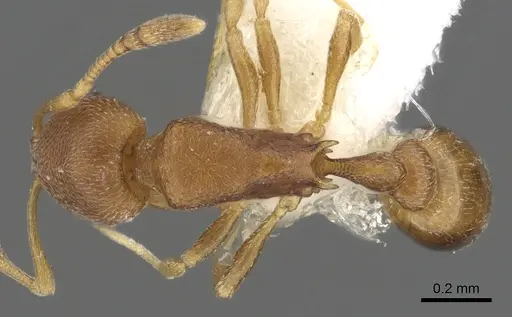
Literature
Loading distribution map...Loading products...