
Camponotus dorycus
- Sci. Name
- Camponotus dorycus
- Subgenus
- Tanaemyrmex
- Tribe
- Camponotini
- Subfamily
- Formicinae
- Author
- Smith, 1860
- Distribution
- Found in 3 countries
Introduction
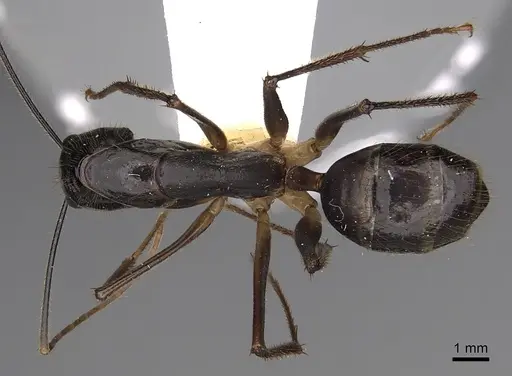
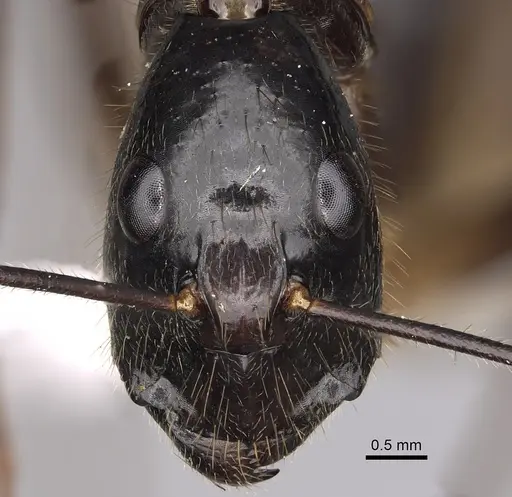
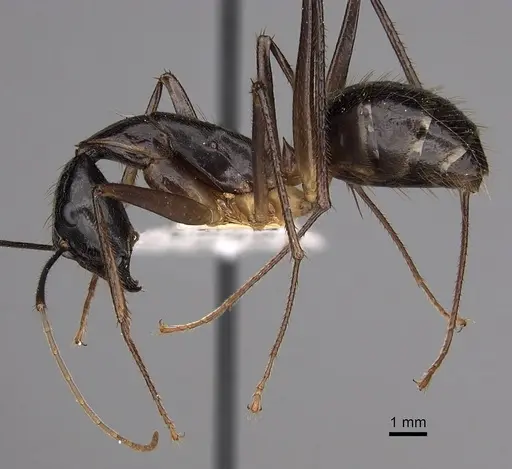
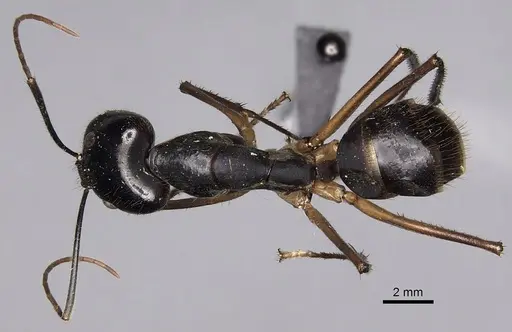
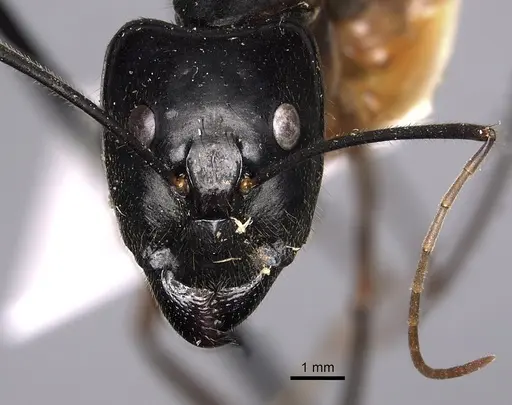
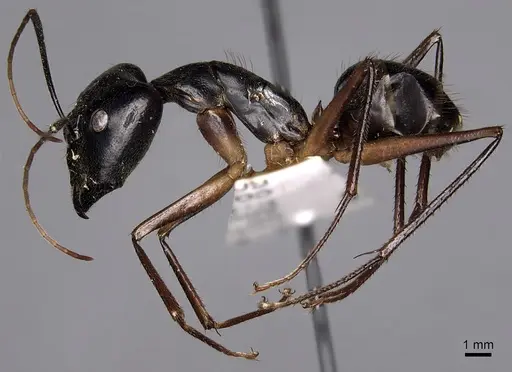
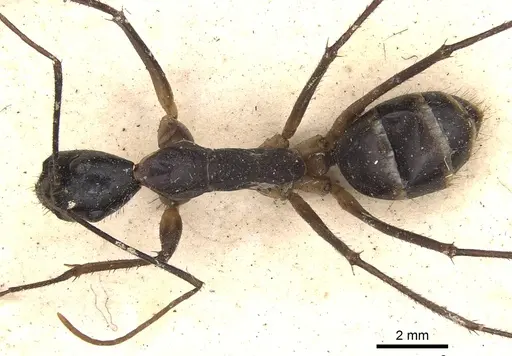
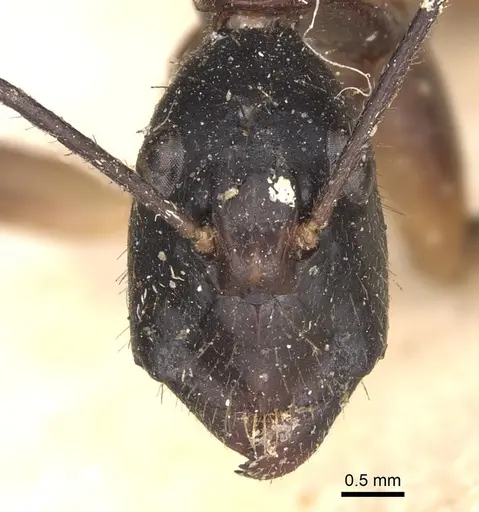
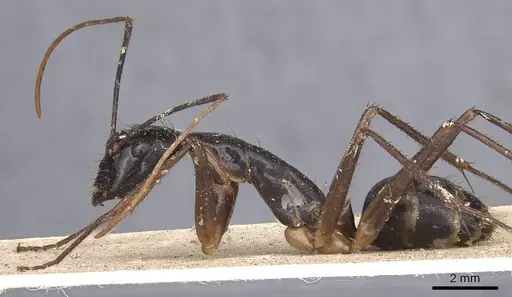
Camponotus dorycus is a large carpenter ant native to the Indo-Pacific region, including New Guinea, Indonesia (Irian Jaya, Waigeu), Papua New Guinea, and Hainan Island, China . Workers reach approximately 12 mm in total length, making them one of the larger ant species . They are black, smooth, and shining, with an elongated head that narrows abruptly behind the eyes, forming a distinct neck-like constriction. Their legs are slender and reddish-brown, and the petiole (segment connecting the abdomen to the thorax) is wedge-shaped and pointed on top . Unlike many carpenter ants that nest in wood, this species is strictly arboricolous, living in the forest canopy. They nest in aerial soil accumulations on tree trunks and inside abandoned termite nests . All documented nests have been found in primary rainforest (none in secondary forest), at elevations from 200 m to 1800 m . They are nocturnal foragers, with research showing they harvest food bodies from the plant Ryparosa kurrangii at night . The species belongs to the subfamily Formicinae and tribe Camponotini, and as such lacks a functional sting; instead, it bites and sprays formic acid from an acidopore into the wound.
Quick Summary
- Difficulty: Medium
- Origin & Habitat: Indo-Pacific region: New Guinea, Indonesia (Irian Jaya, Waigeu), Papua New Guinea, Australia (subspecies C. dorycus confusus), and Hainan Island, China [1][2][3]. Found strictly in tropical rainforests, only in primary forest, at elevations from 200 m to 1800 m. They are arboricolous, nesting in aerial soil and inside termite nests on tree trunks [5][6].
- Colony Type: Colony structure is not documented in available research. No information on queen number or founding behavior is known.
- Size & Growth:
- Queen: No measurements available in the literature. Original description records only workers, queens are presumed larger but unmeasured.
- Worker: ~12 mm (total length, based on 6 lines) [4]
- Colony: Unknown, no colony size data has been published.
- Growth: Unknown, no data on development speed.
- Development: Unknown, specific development time is not reported. Temperatures typical for tropical Camponotus (24-28°C) would likely produce first workers in 6-10 weeks, but this is an inference. (No species‑specific data, timeline is an estimate based on related tropical Camponotus.)
- Antkeeping:
- Temperature: As a tropical rainforest species, keep consistently warm,24-28°C. Provide a temperature gradient so workers can self‑regulate. Avoid temperatures below 20°C for extended periods. [5][6]
- Humidity: Maintain high humidity appropriate for an arboricolous tropical ant. Keep nest substrate consistently moist but not waterlogged. Provide good ventilation to prevent mold. No specific percentage is published, aim for a substrate that feels damp to the touch.
- Diapause: No diapause required. This is a tropical species from a stable warm climate, maintain year‑round warmth.
- Nesting: Arboricolous. Use a Y‑tong (AAC) or plaster nest with chambers sized for 12 mm workers. Provide climbing structures (cork bark, branches) in the outworld. They occupy pre‑existing cavities (aerial soil, termite nests) and do not excavate wood. [5][1]
- Behavior: Generally calm and not aggressive. Nocturnal foragers, most active at night. They lack a sting, when threatened, they bite and spray formic acid. They are excellent climbers, adapted for life in the canopy. Escape risk is moderate, their large size makes gaps easier to spot, but they can still squeeze through small openings. [1]
- Common Issues: tropical species may struggle in cool, dry environments, maintain stable warmth and humidity., arboricolous nature means they need vertical climbing structures and canopy‑style housing to feel secure., nocturnal activity may limit daytime observation, most foraging happens at night., rarely available in the hobby, wild‑caught colonies may carry parasites or diseases., as a large species, they need spacious outworlds and ample foraging area.
Natural History and Distribution
Camponotus dorycus was originally described by Frederick Smith in 1860 from specimens collected in Dory, New Guinea (now Indonesia) [4]. The species ranges across New Guinea, Indonesia (Irian Jaya, Waigeu), Papua New Guinea, and Hainan Island, China [1][2][3]. A subspecies, C. dorycus confusus, is also recorded from Australia [8][9]. Phylogenetic studies place C. dorycus in Clade I of the Indo‑Pacific Camponotus radiation, which likely originated in North America (58% probability) or New Guinea (31% probability) [9][10]. Ecologically, this species is strictly arboricolous, nesting in aerial soil accumulations on tree trunks and inside abandoned termite nests [5]. Nest abundance studies show a clear preference for primary forest: all seven nests documented in a New Guinea rainforest were in primary forest, none in secondary forest [5]. They occur across an elevation gradient from 200 m (7 nests) to 900 m (1 nest) and 1800 m (5 nests) [6]. No phragmosis (head‑plugging behavior) has been observed [5].
Nest Preferences and Housing
In captivity, provide housing that reflects their natural arboreal lifestyle. Use a Y‑tong (AAC) or plaster nest with chambers sized appropriately for 12 mm workers, snug but not cramped. They prefer pre‑existing cavities and do not excavate wood like some Camponotus. In the outworld, provide climbing structures such as cork bark, branches, or artificial plants. Maintain a water source (test tube or water feeder) and keep nest substrate consistently moist but not waterlogged. Good ventilation is essential to prevent mold while maintaining humidity. Avoid overly wet conditions [5][1].
Feeding and Diet
Camponotus dorycus is omnivorous. In the wild, they have been observed harvesting food bodies from the plant Ryparosa kurrangii exclusively at night, confirming nocturnal foraging [7]. In captivity, provide a constant sugar source (sugar water or honey) and offer protein insects (mealworms, crickets, roaches) 2-3 times per week. Remove uneaten prey after 24-48 hours to prevent mold. Their large size allows them to handle larger prey items. Expect most foraging activity in the evening and night hours [7].
Temperature and Seasonal Care
As a tropical rainforest species from New Guinea and surrounding regions, C. dorycus requires consistently warm conditions. Maintain nest temperature at 24-28°C for optimal brood development. Temperatures below 20°C may slow metabolism and development. Use a heating cable or mat placed on the side or top of the nest (not underneath, to avoid drying out the substrate) to create a temperature gradient. Because they come from a climate with minimal seasonal variation, they do not require a true diapause. Keep conditions stable year‑round, slight winter temperature drops in a heated home are tolerable but avoid prolonged cool periods. Monitor colony activity, if workers become sluggish, increase warmth [5][6][1].
Behavior and Temperament
Camponotus dorycus is generally calm and not aggressive. Workers are robust, long‑legged, and move with deliberate, steady purpose. They are nocturnal, so most activity occurs at night. They are excellent climbers, adapted for moving on tree bark and canopy surfaces. As a formicine ant, they lack a sting, when threatened, they bite and spray formic acid into the wound, a defense typical of the subfamily Formicinae. They are not known to be defensive toward keepers under normal conditions. Escape risk is moderate: although large (12 mm), they can still squeeze through small gaps, so ensure tight‑fitting lids and sealed connections. The species is rarely kept, so individual colony personality may vary, but published observations report a peaceful nature [4][1].
Frequently Asked Questions
How long does it take for Camponotus dorycus to produce first workers?
No species‑specific data is available. Based on typical tropical Camponotus development, first workers likely emerge 6-10 weeks after egg‑laying at 24-28°C, but this is only an estimate.
What size nest should I use for Camponotus dorycus?
Use a Y‑tong or plaster nest with chambers scaled for 12 mm workers, moderately snug but with room for movement. Avoid oversized chambers, ants feel more secure in appropriately sized spaces.
Are Camponotus dorycus good for beginners?
They are rated medium difficulty. While their large size makes them easier to observe than tiny species, their specific requirements (warmth, humidity, climbing structures, nocturnal habits) and rarity in the hobby make them better suited for keepers with some experience.
What do Camponotus dorycus eat?
They are omnivorous. Offer sugar water or honey as a constant energy source, and protein (insects like mealworms, crickets) 2-3 times per week. They are nocturnal foragers, so feeding activity is highest in the evening.
Do Camponotus dorycus need hibernation?
No. As a tropical species from New Guinea and surrounding regions, they do not require diapause. Maintain warm temperatures (24-28°C) year‑round.
How big do Camponotus dorycus colonies get?
Colony size is not documented in the literature. Given their large size and arboreal lifestyle, they likely form moderate‑sized colonies, but this is speculation.
Can I keep multiple Camponotus dorycus queens together?
Colony structure is unconfirmed. No evidence of polygyny exists in the literature. It is not recommended to combine unrelated queens without documented proof of multiple‑queen tolerance.
Why is my Camponotus dorycus colony not growing?
Check that temperatures are warm (24-28°C), humidity is adequate (substrate damp but not soggy), and that protein and sugar are available regularly. Tropical species are sensitive to cool conditions. If all conditions are met, lack of growth may be due to queen health or stress from handling.
Where does Camponotus dorycus live in the wild?
They are native to the Indo‑Pacific region: New Guinea, Indonesia (Irian Jaya, Waigeu), Papua New Guinea, and Hainan Island, China. They live in tropical rainforests, nesting in aerial soil and termite nests on tree trunks in primary forest, at elevations from 200 m to 1800 m [5][6][1].
Report an Issue
The current care sheet is based fully on literature. See inconsistencies, or something that's incorrect? Please , it will be resolved after review from an admin. Contributing to the blogs tab also helps providing information, to make us be able to further improve the caresheets. Thank you for your support!
References

This caresheet is licensed under CC BY-SA 4.0 .
Community Blogs
Literature
Loading distribution map...Loading products...