
Camponotus cyrtomyrmodes
- Sci. Name
- Camponotus cyrtomyrmodes
- Subgenus
- Thlipsepinotus
- Tribe
- Camponotini
- Subfamily
- Formicinae
- Author
- Donisthorpe, 1941
- Distribution
- Found in 1 countries
Introduction
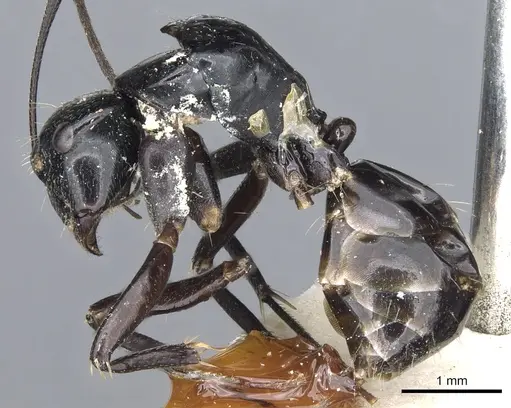
Camponotus cyrtomyrmodes is a small, distinctive ant species endemic to Papua New Guinea. Minor workers have an unusual flattened 'shield' shape extending from their head across the pronotum and mesosoma - a trait shared with some Polyrhachis ants through convergent evolution. Their coloration is red-black with yellow-red legs, and they have very few erect hairs on the body. This species belongs to the Camponotus aureopilus species group and was originally described by Donisthorpe in 1941 . This is a rarely kept species in captivity with very limited scientific data. The genus Camponotus is one of the largest ant genera globally, known for carpenter ants, but C. cyrtomyrmodes stands out for its unusual body shape. Colony structure and development data remain unconfirmed for this species.
Quick Summary
- Difficulty: Expert
- Origin & Habitat: Papua New Guinea, specifically the Wharton Range (Mafulu at 4000 ft elevation) and Northern District near Kokoda. Found in montane forest habitats [1][3].
- Colony Type: Unconfirmed, no direct observations of colony structure exist for this species.
- Size & Growth:
- Queen: Size data unavailable, no documented queen measurements for this species.
- Worker: Size data unavailable, the context provides head and mesosoma measurements but not total body length. Minor workers have approximately 1.4mm head length [1][2].
- Colony: Unknown, no colony size data available.
- Growth: Unknown, no development data exists.
- Development: Unconfirmed, no direct measurements exist for this species. (Development timeline is unconfirmed.)
- Antkeeping:
- Temperature: Inferred: Based on Papua New Guinea's tropical montane climate, aim for 22-26°C. Provide a temperature gradient allowing workers to self-regulate.
- Humidity: Inferred: Montane forest habitat suggests moderate to high humidity needs. Keep nest substrate consistently moist but not waterlogged.
- Diapause: Unknown, Papua New Guinea has no true winter, so hibernation requirements are unconfirmed.
- Nesting: Inferred: Likely nests in rotting wood or under stones in nature. In captivity, a Y-tong (AAC) nest or plaster nest works well for Camponotus.
- Behavior: Temperament is unconfirmed but Camponotus species are typically docile, they are more likely to flee than bite. Workers are very small so escape prevention is critical. Their tiny size means they can squeeze through small gaps, so fine mesh barriers are recommended.
- Common Issues: very limited availability, this species is rarely collected even by scientists, no established captive breeding protocols, escape prevention is critical due to tiny worker size, lack of species-specific care information means keepers must rely on genus-level guidance, unknown exact temperature and humidity requirements, trial and observation required
Appearance and Identification
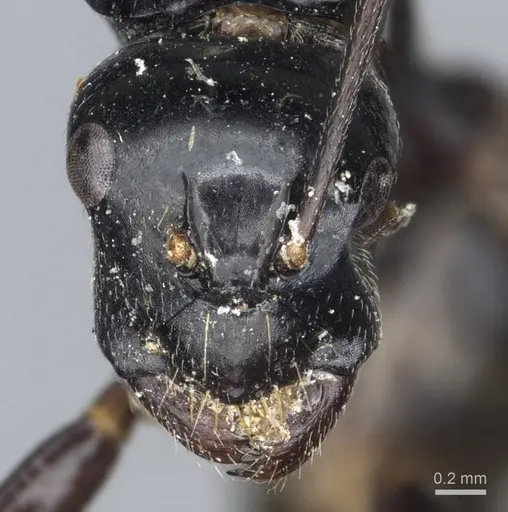
Camponotus cyrtomyrmodes is a small but distinctive ant. Minor workers have a head length of approximately 1.4mm, making them among the smaller Camponotus species. Their most striking feature is the flattened 'shield' shape formed by the flat surface between the head ridges extending onto the pronotum and anterior mesonotum. The head has a strongly concave posterolateral margin with a prominent ridge running between the eye and the back corner. The antennal scapes are notably long. Coloration is red-black with yellow-red legs, and the body has very few erect hairs, typically just 2-4 on the pronotum, mesonotum, propodeum, and petiole. This species was originally described by Donisthorpe in 1941 and later redescribed by Shattuck in 2005 as part of the Camponotus aureopilus species group [1][2][3].
Natural Distribution and Habitat
This species is endemic to Papua New Guinea, known only from a few specimens collected in the mountainous interior. Type specimens came from the Wharton Range at Mafulu (around 4000 feet elevation) collected in 1933-1934 by L.E. Cheesman. Additional specimens have been collected from the Northern District near Kokoda. The limited distribution and few records suggest this is either a rare species or one that is difficult to collect. The montane forest habitat at moderate elevation indicates preference for warm but not hot conditions with moderate humidity. The original description noted the workers superficially resemble Polyrhachis (Cyrtomyrma) ants, a remarkable case of convergent evolution where unrelated ants develop similar body shapes [1][3].
Housing and Nesting
Since this species has never been kept in captivity documented in scientific literature, housing recommendations must be inferred from genus patterns and natural history. Camponotus cyrtomyrmodes likely nests in rotting wood or under stones in nature, similar to other Camponotus species. For captivity, a Y-tong (AAC) nest or plaster formicarium works well, these provide the dark, humid conditions these ants prefer. The nest should have chambers scaled appropriately for their small worker size. Keep the nest substrate consistently moist but avoid waterlogging. A small outworld for foraging completes the setup. Escape prevention is important, their tiny size means they can squeeze through standard barriers, so fine mesh or fluon on container edges is recommended.
Feeding and Diet
Diet is unconfirmed for this specific species, but Camponotus ants are typically omnivorous. They likely consume honeydew from aphids and scale insects, plus small insects for protein. In captivity, you can offer sugar water or honey as a constant energy source, plus protein sources like small mealworms, fruit flies, or other tiny insects. Feed protein 1-2 times per week and keep sugar water available. Start with small amounts and observe what the colony accepts. Given their small size, prey items should be appropriately sized.
Temperature and Seasonal Care
Temperature requirements are not documented for this species. The natural habitat in Papua New Guinea's montane regions suggests they prefer warm conditions but not extreme heat. A starting point of 22-26°C is reasonable, with a temperature gradient allowing workers to choose their preferred zone. Most room temperatures in heated homes may be suitable. Watch colony behavior, if workers cluster consistently in warmer areas, increase slightly, if they avoid heated areas, reduce temperature. Papua New Guinea lacks a winter season, so true hibernation is likely not required. However, slight reduction in activity during cooler months may occur naturally.
Challenges and Considerations
This is an expert-level species to keep primarily because of its extreme rarity in the antkeeping hobby and complete lack of species-specific captive care information. Finding a colony or queen for sale is extremely unlikely, most specimens would need to be wild-caught in Papua New Guinea, which presents significant legal and practical challenges. The limited scientific data means keepers must rely on genus-level assumptions rather than proven species-specific protocols. Additionally, their tiny worker size requires excellent escape prevention. For these reasons, Camponotus cyrtomyrmodes is not recommended for beginners or even intermediate antkeepers. Those interested should consider more established Camponotus species that have proven captive protocols.
Frequently Asked Questions
How big do Camponotus cyrtomyrmodes workers get?
Minor workers have a head length of approximately 1.4mm. Queen size is unknown as no queens have been documented in scientific literature [1][2].
Where does Camponotus cyrtomyrmodes live?
This species is endemic to Papua New Guinea, known only from montane forest habitats in the Wharton Range and Northern District areas at elevations around 4000 feet [1][3].
Is Camponotus cyrtomyrmodes good for beginners?
No. This is an expert-level species due to extreme rarity in the hobby, complete lack of captive care documentation, and the need to rely on genus-level assumptions.
What do Camponotus cyrtomyrmodes ants eat?
Diet is unconfirmed for this species, but likely similar to other Camponotus ants, honeydew and small insects. In captivity, offer sugar water or honey plus small protein sources like fruit flies or tiny mealworms.
What temperature do Camponotus cyrtomyrmodes need?
Temperature is unconfirmed but based on Papua New Guinea montane habitat, 22-26°C is a reasonable starting point. Provide a temperature gradient and adjust based on colony behavior.
How long does it take for Camponotus cyrtomyrmodes to develop from egg to worker?
Development timeline is unconfirmed for this species, no direct measurements exist.
Can I keep multiple Camponotus cyrtomyrmodes queens together?
Colony structure is unconfirmed for this species. Based on typical Camponotus patterns, single-queen colonies are most likely. Combining unrelated queens is not recommended without species-specific data.
Do Camponotus cyrtomyrmodes need hibernation?
Hibernation is likely not required, Papua New Guinea lacks a true winter. However, slight seasonal slowing may occur naturally.
Why is this species so rarely kept?
Camponotus cyrtomyrmodes has extremely limited distribution in Papua New Guinea's montane forests and has rarely been collected even by scientists. It is not documented in the antkeeping hobby, and finding colonies for sale is extremely unlikely [1][3].
Report an Issue
The current care sheet is based fully on literature. See inconsistencies, or something that's incorrect? Please , it will be resolved after review from an admin. Contributing to the blogs tab also helps providing information, to make us be able to further improve the caresheets. Thank you for your support!
References

This caresheet is licensed under CC BY-SA 4.0 .
Community Blogs
CASENT0903560
View on AntWeb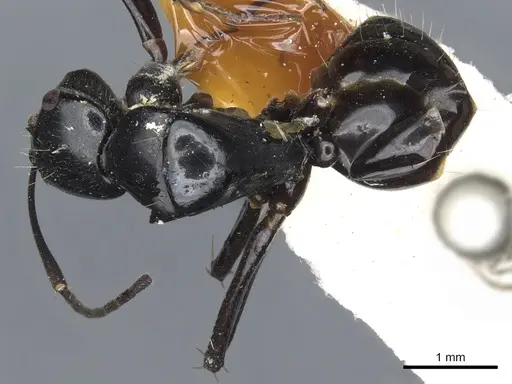
Literature
Loading distribution map...Loading products...