
Calyptomyrmex retrostriatus
- Sci. Name
- Calyptomyrmex retrostriatus
- Tribe
- Crematogastrini
- Subfamily
- Myrmicinae
- Author
- Shattuck, 2011
- Distribution
- Found in 1 countries
Introduction
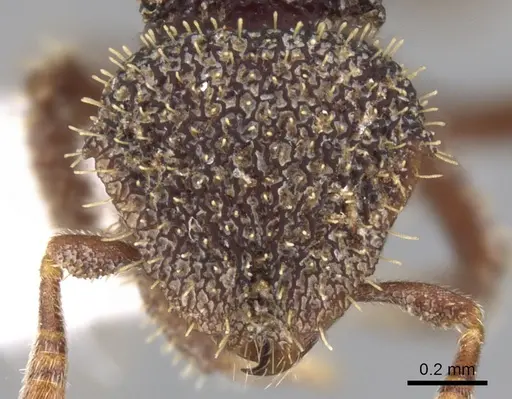
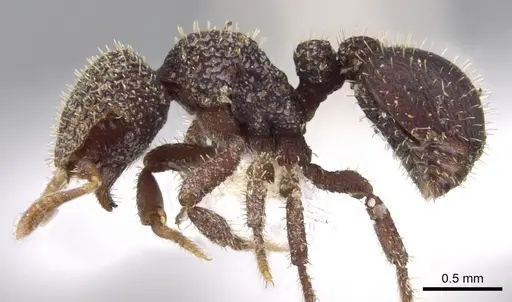
Calyptomyrmex retrostriatus is an exceptionally rare tiny ant species described in 2011 from specimens collected in the submontane forests of Sarawak, Borneo . Workers are minute - measuring approximately 2-3mm in total length - with a distinctive red-brown coloration and a gaster covered in widely spaced longitudinal striations . Their most notable feature is the layer of soil that often coats their bodies, held in place by enlarged spatulate hairs that serve as camouflage . This species is part of a genus known for its cryptic, soil-dwelling lifestyle, making them rarely encountered even in their native rainforest habitat.
Quick Summary
- Difficulty: Expert
- Origin & Habitat: Borneo (Sarawak, Malaysia), submontane rainforest at approximately 800m elevation near Kuching [1][2]
- Colony Type: Unconfirmed, colony structure has not been documented in scientific literature
- Size & Growth:
- Queen: Unknown, no queen specimens have been described [1]
- Worker: approximately 2-3mm total length, inferred from Calyptomyrmex genus patterns [1]
- Colony: Unknown, no colony size data exists
- Growth: Unknown
- Development: Unknown, no development data exists for this species (Given the extremely limited data, all timelines are speculative. Related Calyptomyrmex species suggest development may take several months.)
- Antkeeping:
- Temperature: Likely 24-28°C based on tropical rainforest origin, start in this range and observe colony activity
- Humidity: High humidity required, rainforest species that nests in rotting wood or soil [2]. Keep substrate consistently moist but not waterlogged.
- Diapause: Unknown, no data on seasonal behavior. Borneo has minimal temperature variation, so diapause may not be required.
- Nesting: Nests in rotten wood or directly in soil in nature [2]. In captivity, a small test tube setup or miniature ytong nest with moist substrate works well. Their tiny size means chambers must be appropriately scaled.
- Behavior: Extremely cryptic and rarely seen. Workers forager singly or in small numbers across the rainforest floor [2]. Their soil-covered camouflage makes them nearly invisible in their natural habitat. Escape risk is extremely high due to their minute size, they can squeeze through gaps invisible to the naked eye. Temperament is likely non-aggressive given their cryptic lifestyle. No sting data available, but given their tiny size, any sting would be negligible to humans.
- Common Issues: escape prevention is critical, their minute size allows them to pass through standard barrier setups, virtually no biological data exists, keepers are essentially pioneering captive husbandry, colony size is unknown, expect very small colonies even at maturity, feeding behavior is unconfirmed, small prey items must be offered, wild-caught colonies may be extremely difficult to locate and obtain
Discovery and Rarity
Calyptomyrmex retrostriatus was only described in 2011 by Steven Shattuck during his revision of the genus in Southeast Asia and Oceania [1]. The species is known from only a handful of specimens collected in the 1990s from two locations in Sarawak, Borneo, Mount Matang near Kuching and a site 20km west of Kuching at 800m elevation [1]. This makes it one of the rarest ant species in the hobby, with virtually no captive colonies in existence. The original collectors, I. Löbl and D. Burckhardt, found these ants in submontane forest during biodiversity surveys, and the species has not been collected or studied since [1]. For antkeepers, this means that any information about captive care must be inferred from related species and general Calyptomyrmex biology rather than direct observation of this specific species.
Identification and Appearance
This species is distinguished by several unique morphological features. Workers measure approximately 2-3mm in total length, making them among the smallest ants in the world [1]. Their body is red-brown with slightly lighter antennae and legs. The gaster (the rear portion of the ant) has distinctive widely spaced longitudinal striations, parallel lines running front to back [1]. The body is covered in thin, erect hairs that are uniform in diameter with either sharp or blunt tips. A particularly notable feature is the propodeum (the section behind the mesosoma) which has spines reduced to almost nothing, just broad convexities rather than proper spines [1]. The most practical identification feature for keepers is the combination of tiny size, striated gaster, and the soil-retention behavior where workers deliberately collect and carry soil particles on their bodies using enlarged spatulate hairs [2].
Natural History
Almost nothing is known about the biology of Calyptomyrmex retrostriatus specifically. What we do know comes from general observations of the genus Calyptomyrmex as a whole. These ants are associated with rainforest habitats and are typically found in rotten wood or directly in soil [2]. Workers forage singly or in small numbers across the rainforest floor, making them extremely difficult to locate despite their possible abundance [2]. The soil-camouflage behavior is particularly interesting, workers have enlarged, spatula-shaped hairs that help them retain a layer of dirt on their bodies, making them nearly invisible against the forest floor substrate [2]. This is likely a defense mechanism against predators. No information exists on their diet, colony size, queen behavior, nuptial flights, or any other aspect of their biology. This species represents a genuine frontier in antkeeping knowledge.
Housing and Escape Prevention
Given their minute size, housing Calyptomyrmex retrostriatus presents unique challenges. Standard test tube setups will work but require exceptional escape prevention measures. These ants can easily pass through gaps that would contain larger species, so cotton barriers should be tightly packed, and any connections between outworld and nest must be sealed with appropriate barriers like fluon. A small ytong nest with appropriately scaled chambers would be ideal, but such small chambers are rarely commercially available. For the outworld, consider using a small container with smooth walls and a secure lid. The nesting area should contain moist soil or rotting wood pieces to mimic their natural substrate. Because so little is known about their requirements, observation of colony behavior is critical, watch where workers cluster and adjust humidity accordingly. [2]
Feeding and Diet
The diet of Calyptomyrmex retrostriatus has not been documented, but related species in the genus are likely generalist foragers that consume small invertebrates and likely tend aphids or collect honeydew. Because workers are so tiny, any prey items must be appropriately sized, very small insects like fruit fly larvae, pinhead crickets, or tiny springtails would be appropriate. Given their cryptic foraging behavior in nature (foraging singly or in small numbers), they may not readily discover large food sources. Offer small amounts of sugar water or honey as well, though acceptance is uncertain. Feed small prey items every few days and remove any uneaten food promptly to prevent mold. The key is patience and careful observation, these ants may take very small prey items that larger species would ignore. [2]
Temperature and Humidity
As a species from the tropical rainforests of Borneo, Calyptomyrmex retrostriatus almost certainly requires warm, humid conditions. Based on their origin in Sarawak, aim for temperatures in the 24-28°C range with humidity around 70-80%. The submontane location (800m elevation) suggests they may tolerate slightly cooler conditions than lowland Borneo species, but this is speculative. Use a small heat source if room temperature falls below this range, but always provide a temperature gradient so the colony can choose its preferred zone. Humidity is particularly important given their soil-nesting behavior, the substrate should remain consistently moist but never waterlogged. A small water reservoir connected to the nest area helps maintain stable humidity. Monitor condensation levels as an indicator of humidity balance. [1][2]
Frequently Asked Questions
How long does it take for Calyptomyrmex retrostriatus to develop from egg to worker?
The egg-to-worker development timeline is completely unknown for this species, no scientific data exists. Based on typical patterns for small Myrmicinae ants in tropical conditions, development likely takes several months, possibly 3-6 months. Patience is essential with this species.
Are Calyptomyrmex retrostriatus good for beginners?
No. This species is not suitable for beginners. Almost nothing is known about their captive care requirements, they are extremely small (escape risk is extreme), and they are virtually unavailable in the antkeeping hobby. This is an expert-level species for those interested in pioneering husbandry of poorly studied species.
What do Calyptomyrmex retrostriatus eat?
Their specific diet has not been documented. Based on related species, they likely accept small live prey (tiny insects and arthropods) and may also collect honeydew or sugar sources. Offer appropriately sized prey items and sugar water, but acceptance is uncertain due to lack of data.
How big do Calyptomyrmex retrostriatus colonies get?
Colony size is unknown. Based on their tiny worker size and cryptic lifestyle, colonies are likely small, possibly under 100 workers even at maturity. This is speculative as no colony size data exists.
Do Calyptomyrmex retrostriatus ants sting?
Stinging behavior has not been documented for this species. Given their extremely small size, any sting would likely be negligible to humans, too weak to penetrate skin. However, their defensive behaviors remain unstudied.
Can I keep multiple queens together?
Queen behavior and colony structure are completely unconfirmed for this species. No data exists on whether they are single-queen (monogyne) or multi-queen (polygyne), or whether multiple foundresses can be combined. Do not attempt without specific guidance.
What temperature should I keep Calyptomyrmex retrostriatus at?
Based on their origin in tropical Borneo, aim for 24-28°C. The submontane origin (800m elevation) suggests they may tolerate slightly cooler conditions, but this is an estimate rather than confirmed data. Provide a temperature gradient so the colony can self-regulate.
Do Calyptomyrmex retrostriatus need hibernation?
Diapause requirements are unknown. As a species from tropical Borneo where temperatures remain warm year-round, hibernation is likely not required. However, slight seasonal slowdowns may occur. Do not force hibernation without specific data.
Why are my Calyptomyrmex retrostriatus escaping?
Their minute size means they can escape through gaps invisible to the human eye. Standard barrier methods often fail. Use tightly packed cotton, fine mesh barriers, and seal all connections. Consider that any gap larger than approximately 0.3mm may allow escape.
Where can I get Calyptomyrmex retrostriatus?
This species is virtually unavailable in the antkeeping hobby. It is known only from a handful of museum specimens collected in the 1990s in Sarawak, Borneo. No captive colonies are documented to exist. Obtaining this species would require field collection in Borneo, which presents significant practical and legal challenges.
Report an Issue
The current care sheet is based fully on literature. See inconsistencies, or something that's incorrect? Please , it will be resolved after review from an admin. Contributing to the blogs tab also helps providing information, to make us be able to further improve the caresheets. Thank you for your support!
References

This caresheet is licensed under CC BY-SA 4.0 .
Community Blogs
CASENT0900997
View on AntWeb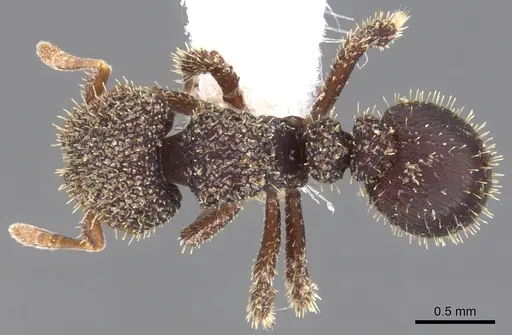
Literature
Loading distribution map...Loading products...