
Axinidris tridens
- Sci. Name
- Axinidris tridens
- Tribe
- Tapinomini
- Subfamily
- Dolichoderinae
- Author
- Arnold, 1946
- Distribution
- Found in 1 countries
Introduction
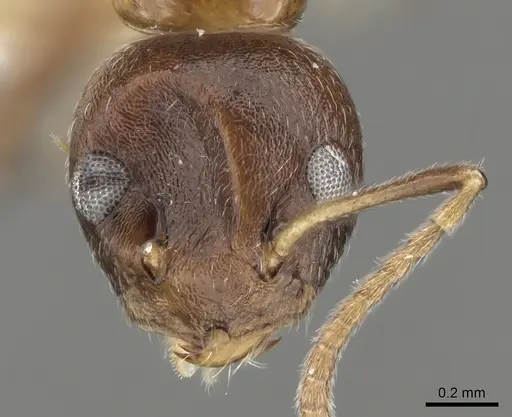
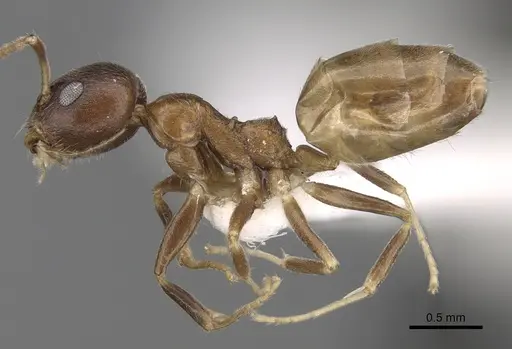
Axinidris tridens is a tiny, reddish-yellow ant native to the forests of Malawi and South Africa. Workers are extremely small - size data is limited to head measurements (head width 0.81-0.88mm), and the species is known only from the worker caste - no queens have ever been scientifically described . These ants inhabit primary forest where they have been found foraging on partially decayed trees, suggesting an arboreal lifestyle in rotting wood . Their complete absence of documented queens makes them one of the most challenging species to keep in captivity. What makes this species particularly unusual is that science has never found a queen, male, or pupa. All museum collections consist solely of adult workers . This means captive breeding is currently impossible, and the species exists in antkeeping only as wild-caught colonies of completely unknown structure and size. For antkeepers, this represents a frontier species where basic biology remains undiscovered.
Quick Summary
- Difficulty: Expert
- Origin & Habitat: Primary forests of Malawi (Mulanje) and South Africa (St. Lucia Estuary, Natal) [1][2]
- Colony Type: Unknown, only workers documented, queen morphology undescribed [1]
- Size & Growth:
- Queen: Unknown, no queens described [1]
- Worker: Size data unavailable, only head measurements exist (head width 0.81-0.88mm). Likely very small (~3-4mm) based on genus patterns but unconfirmed.
- Colony: Unknown, only individual workers collected [1]
- Growth: Unknown
- Development: Unknown, no brood stages documented (Development timeline cannot be estimated without queen or brood observations)
- Antkeeping:
- Temperature: Likely tropical warmth around 24-26°C based on Afrotropical distribution, but unconfirmed. Start at warm room temperature and adjust based on activity.
- Humidity: High humidity likely needed based on primary forest habitat, keep nest substrate damp like rotting wood but not waterlogged [2]
- Diapause: Likely not required as a tropical species, but unconfirmed
- Nesting: Arboreal, requires rotting wood or vertical cavities mimicking tree nests [1][2]
- Behavior: Unknown temperament due to rarity, extremely small size means escape prevention must be excellent. Uses smear defense with anal gland secretions rather than stinging.
- Common Issues: no queens have been scientifically described, making captive colony founding impossible., arboreal nesting requirements in rotting wood are difficult to replicate in standard formicaria., extremely small worker size requires perfect escape prevention., virtually unknown biology means captive care is completely experimental and likely to fail., wild-caught colonies may be impossible to replace if they die, given the species' rarity.
Natural History and the Missing Queen
Axinidris tridens remains one of the most mysterious ants in Africa. Despite being described in 1946,science has never found a queen, male, or pupa, only adult workers [1]. This makes the species essentially impossible to keep using standard antkeeping methods, which rely on founding colonies from single queens.
The species inhabits primary forest in Malawi and the St. Lucia Estuary area of South Africa [1]. Workers forage on partially decayed trees, suggesting an arboreal lifestyle in rotting wood cavities [2]. Their reddish-yellow coloration and tiny size make them distinctive, but their social structure remains completely mysterious [1].
Without knowledge of the queen or colony structure, we cannot predict colony size, growth rate, or even whether this species maintains single-queen or multiple-queen colonies. For antkeepers, this means any captive colony represents an experiment with unknown parameters and high risk of failure.
Housing and Arboreal Requirements
In nature, Axinidris tridens lives in trees. Workers have been collected from partially decayed wood in primary forest, indicating they nest in rotting branches or tree cavities rather than soil [2]. This arboreal habit makes them challenging to house in standard ground-based formicaria.
If attempting to keep a wild-caught colony, provide vertical or angled wood nests rather than soil setups. Rotting hardwood or softwood blocks with pre-made tunnels may replicate their natural cavities. The nest must maintain high humidity, think damp forest interior, not dry room air, while providing adequate ventilation to prevent mold in the decaying wood environment.
Because workers are extremely small, escape prevention must be perfect. Standard barriers may be insufficient, fine mesh and tight-fitting lids are essential [1].
Feeding and Diet
The natural diet of Axinidris tridens is unknown. As members of the subfamily Dolichoderinae, they may share the generalist tendencies of related genera, accepting both sweet liquids and small insects, but this is speculation based on family patterns, not direct observation.
If maintaining a colony, offer a variety of foods: sugar water or honey for carbohydrates, and tiny live prey such as springtails or fruit flies for protein. Observe acceptance carefully, as their true dietary needs are undocumented. Do not rely on any single food type until preferences are established through observation.
Given their arboreal foraging on decayed trees, they may feed on honeydew from scale insects or other sap-sucking bugs living in the wood, or on small organisms inhabiting the rotting material. This is inference, not confirmed biology. [2]
Temperature and Environmental Needs
Coming from tropical Malawi and subtropical South Africa, Axinidris tridens likely prefers warm conditions. Based on their Afrotropical distribution, start with temperatures around 24-26°C and observe activity levels. If workers appear sluggish, increase slightly, if they avoid heat sources, reduce temperature.
High humidity appears necessary given their primary forest habitat. Keep the nest substrate consistently moist, mimicking the damp interior of decaying forest wood. However, ensure good airflow to prevent stagnant conditions that could promote mold in wood-based nests.
Given their tropical origins, they likely do not require hibernation (diapause), but this is unconfirmed. If the colony slows down seasonally, a cooler period around 18-20°C for a few weeks may be beneficial, but winter rest is probably unnecessary for this species. [2]
Frequently Asked Questions
Can I keep Axinidris tridens in a test tube?
No. Test tubes are designed for founding queens, and no queens have ever been described for this species [1]. Additionally, their arboreal nature and need for rotting wood make test tubes unsuitable even for worker colonies. This species requires specialized vertical wood nesting setups [2].
How do I found an Axinidris tridens colony?
You cannot. Since science has never documented a queen, founding behavior is unknown and impossible to achieve in captivity. The only way to keep this species would be to collect an existing wild colony, which is not recommended due to ecological concerns and the species' rarity [1].
What do Axinidris tridens eat?
Their diet is unknown. Based on related Dolichoderinae ants, they may accept sugar water and small insects, but this is speculation. Offer a variety of foods including sugar water, honey, and tiny live prey like springtails, but observe carefully as preferences are undocumented [2].
What temperature do Axinidris tridens need?
Likely tropical warmth around 24-26°C based on their distribution in Malawi and South Africa, but this is inferred from habitat, not directly studied. Start at warm room temperature (22-24°C) and adjust based on activity levels.
Do Axinidris tridens need hibernation?
Probably not. As a tropical species from the Afrotropical region, they likely remain active year-round. However, this is unconfirmed. If you attempt to keep them, maintain stable warm temperatures rather than forcing a winter rest [2].
How big do Axinidris tridens colonies get?
Unknown. Only individual workers have been collected, no colony size estimates exist in scientific literature. Colonies could contain dozens or thousands of workers, we simply do not know [1].
Are Axinidris tridens dangerous?
No. They are tiny ants and pose no threat to humans. They lack the size to bite effectively, and as members of the Dolichoderinae subfamily, they lack a functional sting. Their defense mechanism is smearing sticky, foul-smelling substances from an anal gland.
Why are there no queens described for Axinidris tridens?
This remains a scientific mystery. Either queens are extremely rare, morphologically unusual and overlooked by collectors, or the species may reproduce through mechanisms not yet understood. All collections to date have yielded only workers, making this one of the most enigmatic ant species [1].
Are Axinidris tridens good for beginners?
Absolutely not. This species is suitable only for expert researchers or highly experienced antkeepers willing to experiment with a species of completely unknown biology. The inability to found colonies, unknown care requirements, and rarity of the species make it inappropriate for beginners [1][2].
Report an Issue
The current care sheet is based fully on literature. See inconsistencies, or something that's incorrect? Please , it will be resolved after review from an admin. Contributing to the blogs tab also helps providing information, to make us be able to further improve the caresheets. Thank you for your support!
References

This caresheet is licensed under CC BY-SA 4.0 .
Community Blogs
CASENT0281999
View on AntWeb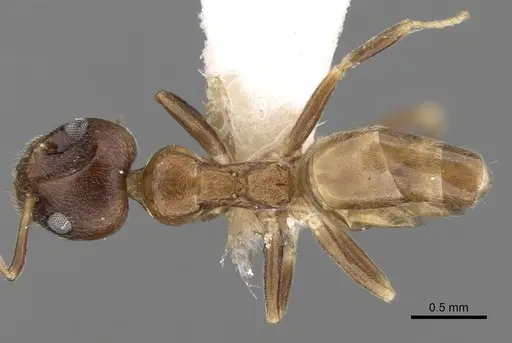
Literature
Loading distribution map...Loading products...