
Axinidris mlalu
- Sci. Name
- Axinidris mlalu
- Tribe
- Tapinomini
- Subfamily
- Dolichoderinae
- Author
- Snelling, 2007
- Distribution
- Found in 2 countries
Introduction
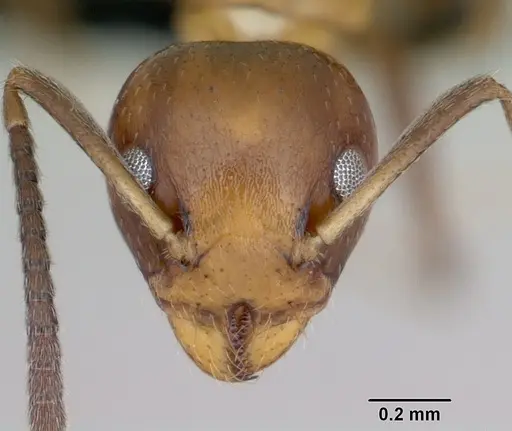
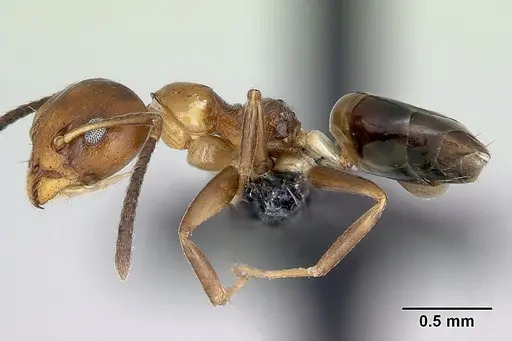
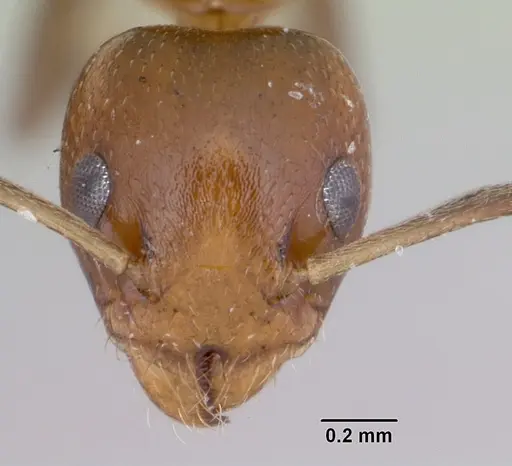
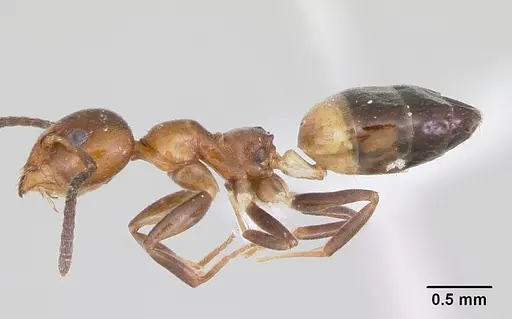
Axinidris mlalu is a tiny arboreal ant from the rainforests of Central African Republic. Only workers have ever been collected, so almost nothing is known about their colony structure or biology . Workers are small - head width is 0.74 mm and head length is 0.86 mm - with a total body length around 3-4 mm inferred from the genus Axinidris . You can recognize them by their striking two-toned abdomen: the first gastral segment is bright yellow while segments 2-4 are dark brown, creating a sharp contrast against their light brownish body . Unlike many ants, they lack standing hairs on their antennae, mesosoma, and gaster . They live in rainforest trees and shrubs, as the only known specimens came from beating low vegetation at 360 meters elevation in Dzanga-Ndoki National Park . This species belongs to the tribe Tapinomini within the subfamily Dolichoderinae . Dolichoderine ants lack a functional sting and instead use defensive chemical sprays to deter predators. Since scientists have never found a queen or colony nest, we can only guess at their social structure and habits based on related species.
Quick Summary
- Difficulty: Expert (currently impossible to keep)
- Origin & Habitat: Central African Republic, specifically Dzanga-Ndoki National Park rainforest at 360m elevation [1]
- Colony Type: Unknown, only individual workers have been collected, no queens or nests observed [1]
- Size & Growth:
- Antkeeping:
- Temperature: Likely 24-28°C based on tropical rainforest habitat, but unconfirmed [1]
- Humidity: High humidity required, they come from rainforest where moisture is constant [1]
- Diapause: Unknown, likely not needed for tropical species [1]
- Nesting: Arboreal, likely nest in vegetation or twigs based on collection method [1]
- Behavior: Unknown temperament. Small size means escape prevention must be excellent.
- Common Issues: no queens have been described, making captive founding impossible currently., unknown dietary requirements and colony structure., small size means standard mesh barriers may be too large., wild-caught workers cannot establish colonies without a queen.
Discovery and What We Know
Scientists discovered Axinidris mlalu in May 2000 by beating low vegetation in the rainforest of Dzanga-Ndoki National Park in Central African Republic [1]. The type specimen came from vegetation at 360 meters elevation [1]. This collection method tells us they likely live in shrubs and small trees rather than on the forest floor.
The species name comes from an arbitrary combination of letters treated as a noun in apposition [1]. We know workers have smooth, shiny bodies without standing hairs on most of the body, and they possess the distinctive yellow-and-brown two-toned abdomen that separates them from other Axinidris species [1]. Beyond these physical traits and the single collection location, their biology remains a mystery.
Why This Species Is Not Currently Keepable
You cannot currently keep Axinidris mlalu in captivity because no one has ever found a queen [1]. Without queens, you cannot start a colony. Workers alone cannot reproduce or establish a nest, they will simply live out their individual lifespans and die.
Even if queens were discovered tomorrow, we would still face huge gaps in knowledge. We do not know what they eat, how they found colonies, what temperature triggers brood development, or how large their colonies grow [1]. This makes them unsuitable for captive keeping until researchers document the basic biology of living colonies.
Housing Challenges
If queens were available, housing would present major challenges. At roughly 3-4 mm in length, these ants are small enough to squeeze through gaps in standard formicarium setups [1]. You would need extremely fine mesh or perfect silicone seals to prevent escapes.
Their arboreal nature suggests they need vertical space with twigs, branches, or cork bark to climb [1]. A standard soil nest would likely be inappropriate. Instead, you would need a naturalistic setup mimicking rainforest vegetation with high humidity and good ventilation to prevent mold.
Feeding
We have no direct observations of what Axinidris mlalu eats in the wild [1]. As members of the subfamily Dolichoderinae and tribe Tapinomini, they likely feed on honeydew from sap-sucking insects like aphids and scale insects, plus small prey items [2]. Related Axinidris species are generalist foragers.
If you somehow obtained a colony, you would need to experiment with sugar water, honeydew sources, and tiny live prey like springtails or fruit flies. However, without knowing their specific needs, feeding would be guesswork.
Frequently Asked Questions
Can I buy Axinidris mlalu for my ant farm?
No. This species is not available in the ant trade. Only a handful of worker specimens exist in scientific collections, and no one has ever found a queen [1].
How do I found an Axinidris mlalu colony?
You cannot currently. Founding behavior is completely unknown because scientists have never collected a queen [1]. Even if you found a wild colony, we do not know if queens found nests alone (claustral) or need to forage (semi-claustral).
How big are Axinidris mlalu workers?
Workers are small, approximately 3-4 mm total body length, with a head width of 0.74 mm [1]. This makes them smaller than a grain of rice.
What do Axinidris mlalu eat?
Unknown. Based on their relatives in the Dolichoderinae subfamily, they likely eat honeydew and small insects, but no one has observed their feeding behavior [1][2].
Where do Axinidris mlalu live?
They live in the rainforest of Central African Republic, specifically in Dzanga-Ndoki National Park [1]. They appear to be arboreal, living in vegetation rather than on the ground.
Are Axinidris mlalu good for beginners?
No. They are unsuitable for keeping at all currently because no queens are known, and their biology is completely undocumented [1].
Can I keep Axinidris mlalu workers without a queen?
No. Workers cannot reproduce or start colonies. Without a queen, workers will simply die of old age.
What temperature do Axinidris mlalu need?
Unknown specifically, but likely warm tropical temperatures around 24-28°C based on their rainforest habitat in Central African Republic [1].
Do Axinidris mlalu need hibernation?
Unknown, but likely not. They come from tropical rainforest where temperatures stay warm year-round [1].
Report an Issue
The current care sheet is based fully on literature. See inconsistencies, or something that's incorrect? Please , it will be resolved after review from an admin. Contributing to the blogs tab also helps providing information, to make us be able to further improve the caresheets. Thank you for your support!
References

This caresheet is licensed under CC BY-SA 4.0 .
Community Blogs
CASENT0090706
View on AntWeb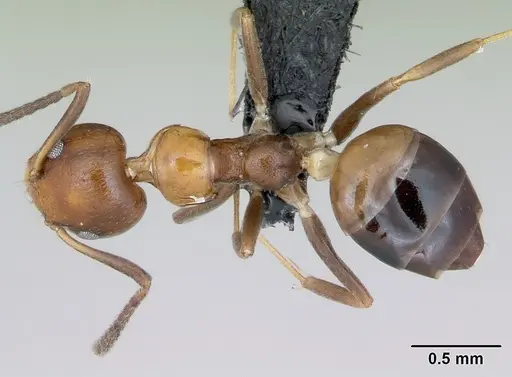
CASENT0403547
View on AntWeb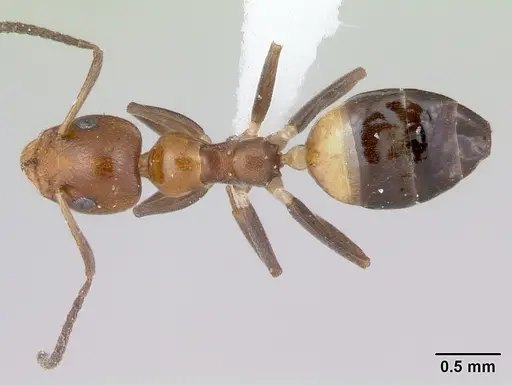

Literature
Loading distribution map...Loading products...