
Axinidris acholli
- Sci. Name
- Axinidris acholli
- Tribe
- Tapinomini
- Subfamily
- Dolichoderinae
- Author
- Weber, 1941
- Distribution
- Found in 1 countries
Introduction
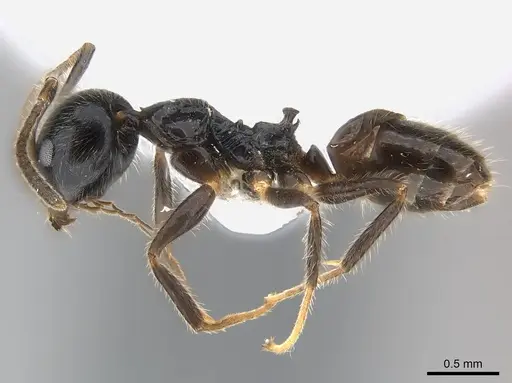
Axinidris acholli are small reddish-brown ants from the rainforests of East Africa. Workers measure roughly 3-4mm in total length with distinctive axe-head-shaped structures on their propodeum and abundant long, white hairs covering their bodies . These ants live high above the ground, nesting exclusively inside hollow plant stems and rotten wood in dense forests from South Sudan to Kenya and Rwanda . Despite being discovered in 1941,scientists have only ever found worker ants - no queens or males have ever been collected, making them one of the more mysterious species in antkeeping . They lack a functional sting and defend themselves by smearing sticky, foul-smelling compounds from an anal gland.
Quick Summary
- Difficulty: Expert
- Origin & Habitat: East African rainforests (Kenya, South Sudan, Rwanda) at elevations around 1550-1600m in dense forest [1][2][3]
- Colony Type: Unknown, only the worker caste has been scientifically described [3]
- Size & Growth:
- Antkeeping:
- Temperature: Tropical moist forest conditions, aim for 22-26°C with stable warmth [2]
- Humidity: High humidity required, keep nest substrate damp to mimic moist rainforest conditions [2]
- Diapause: No, tropical species does not hibernate
- Nesting: Arboreal, provide hollow stems, bamboo tubes, or rotten wood rather than soil nests [1][2]
- Behavior: Arboreal foragers that run on vines and vegetation above ground level, omnivorous diet [2][3]. Small size requires excellent escape prevention. These ants lack a functional sting and defend themselves by smearing sticky, foul-smelling compounds from an anal gland.
- Common Issues: only workers are scientifically known, so founding a colony from a queen is currently impossible., arboreal nesting requirements make standard ground-based formicarium setups unsuitable., tropical moisture needs require constant monitoring to prevent dangerous drying out., extremely small size means escape prevention must be perfect with tight-fitting lids and fine mesh.
Natural History and Identification
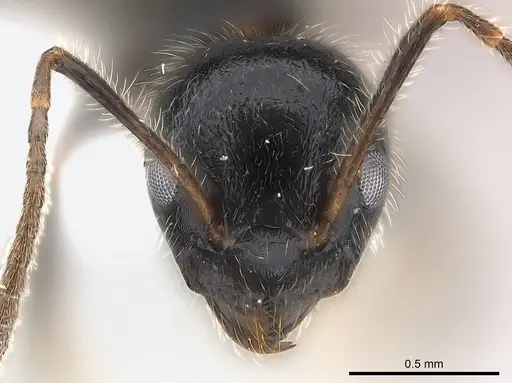
Axinidris acholli workers are instantly recognizable by their bizarre propodeal structures, the medial carina expands dorsally into an axe-head shape that is taller than it is long [1]. Their bodies are covered in abundant long, slender white hairs, and they have 8-10 coarse ridges (rugae) on their pronotal disc that diverge toward the back [1]. The ants are reddish-brown with lighter mandibles and antennae [3].
In the wild, these ants inhabit dense East African rainforests from South Sudan to Kenya and Rwanda [1][2]. They are strictly arboreal, meaning they live in vegetation above ground level, running on vines and occasionally foraging in leaf litter [1]. They nest exclusively within hollow plant stems (both living and dead) and in rotten wood [1][2]. This specialized arboreal lifestyle means they require very specific housing in captivity.
Housing for Arboreal Species
Standard dirt-filled formicaria will not work for Axinidris acholli. You need to replicate their natural hollow-stem nesting sites. Use bamboo tubes, hollow twigs, or create artificial hollow stems using acrylic or wood with drilled cavities [1]. The nest should be positioned vertically or at an angle to mimic their natural vine-running behavior.
Because they are small (roughly 3-4mm), escape prevention is critical. Use fine mesh (less than 1mm holes) for ventilation, and ensure all joints are sealed with silicone or tight-fitting connections. Fluon or other barriers are essential on the outworld walls [1].
Provide plenty of climbing surfaces in the outworld, sticks, vines, or mesh, since these ants forage above ground and may become stressed if forced to stay on flat surfaces [1].
Feeding and Diet
Axinidris acholli are omnivorous, feeding on both plant and animal matter in their rainforest habitat [2]. In captivity, offer small amounts of sugar water or honey dew, plus protein sources like fruit flies, springtails, or tiny pieces of mealworms.
Because they are small ants, offer food in tiny portions to prevent mold growth in their humid nest. Remove uneaten food within 24 hours to maintain cleanliness in the hollow stem nests [2].
Temperature and Humidity Requirements
These ants come from moist tropical rainforests at elevations around 1550-1600m [1][3]. Keep them warm and stable, roughly 22-26°C, with a gentle gradient if possible. They do not require hibernation as they are a tropical species.
Humidity is critical, the nest substrate should feel damp to the touch, mimicking the moist conditions of rotting wood and rainforest stems [2]. However, ensure adequate ventilation to prevent mold while maintaining moisture. Check the nest regularly and rehydrate when the substrate surface starts drying, rather than on a fixed schedule.
The Challenge of Unknown Queens
The biggest obstacle to keeping Axinidris acholli is that scientists have never found a queen or male, only workers have been collected [3]. This means we do not know how colonies are founded, how large they grow, or even what the queen looks like.
If you attempt to keep this species, you would need to collect an entire wild colony (where permitted by law) and hope it contains a queen. However, without knowing the queen's morphology, you cannot identify her among the workers.
For this reason, Axinidris acholli is not recommended for captive keeping until the reproductive castes are discovered and described.
Frequently Asked Questions
Can I keep Axinidris acholli in a test tube?
No, test tubes are unsuitable for these arboreal ants. They need vertical or angled hollow stems like bamboo tubes to mimic their natural nesting sites in vegetation [1].
How big do Axinidris acholli colonies get?
Colony size is unknown. Scientists have only collected individual workers or small groups, and no studies have documented mature colony sizes [3].
What do Axinidris acholli eat?
They are omnivorous, feeding on both plant and animal matter in their rainforest habitat [2]. In captivity, offer sugar water and small insects like fruit flies or springtails.
Do Axinidris acholli need a queen?
Yes, like all ants they need a queen to produce new workers. However, no queens have ever been scientifically described for this species, making captive breeding impossible currently [3].
How long until Axinidris acholli get their first workers?
The egg-to-worker timeline is unknown. No development studies exist for this species.
What temperature do Axinidris acholli need?
Keep them at roughly 22-26°C to match their tropical rainforest habitat. They do not need cooling or hibernation [2].
Do Axinidris acholli need hibernation?
No, they are a tropical species from East African rainforests and remain active year-round.
Are Axinidris acholli good for beginners?
No. They are an expert-level species due to their unknown biology, arboreal requirements, and the fact that only workers have been described, making colony founding impossible [3].
Where do Axinidris acholli nest?
They nest exclusively in hollow plant stems (living or dead) and rotten wood above ground level in dense forests [1][2].
How big are Axinidris acholli workers?
Workers measure roughly 3-4mm in total length [1].
Report an Issue
The current care sheet is based fully on literature. See inconsistencies, or something that's incorrect? Please , it will be resolved after review from an admin. Contributing to the blogs tab also helps providing information, to make us be able to further improve the caresheets. Thank you for your support!
References

This caresheet is licensed under CC BY-SA 4.0 .
Community Blogs
CASENT0217121
View on AntWeb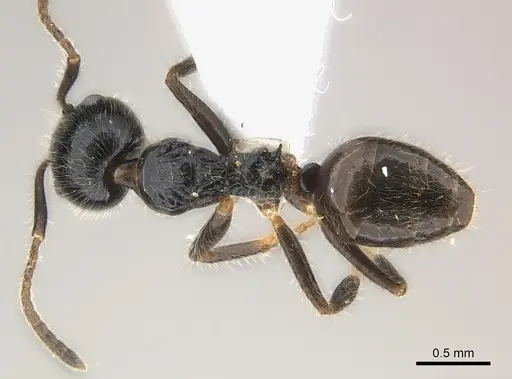
Literature
Loading distribution map...Loading products...