
Aphaenogaster depressa
- Sci. Name
- Aphaenogaster depressa
- Tribe
- Stenammini
- Subfamily
- Myrmicinae
- Author
- Bolton, 1995
- Distribution
- Found in 0 countries
Introduction
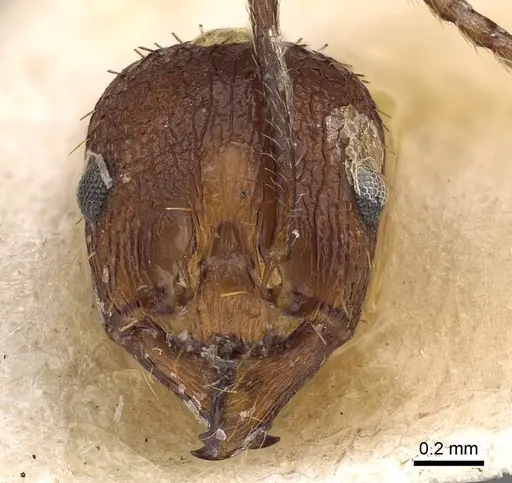
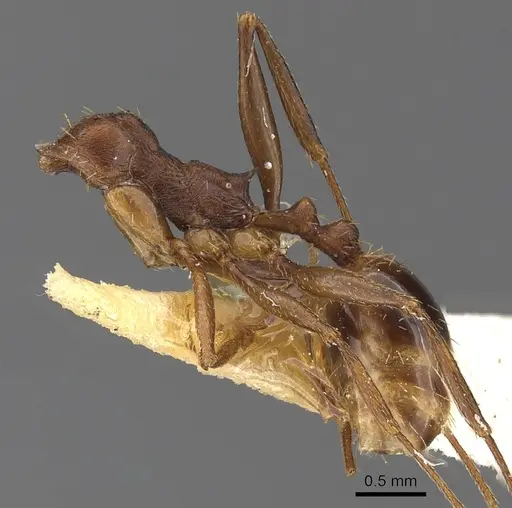
Aphaenogaster depressa is one of the most mysterious ants in the world, known only from five worker specimens collected in Gaziantep, Turkey in 1949 . Originally described as Ceratopheidole perganderi by Donisthorpe, Bolton renamed it in 1995 to fix a naming conflict with another species . Recent research shows it does not belong to the subterranea species group, and its exact position within the genus remains uncertain . No one has ever collected queens, males, or observed living colonies.
Quick Summary
- Difficulty: Expert
- Origin & Habitat: Endemic to Turkey, specifically the Gaziantep region in south-central Turkey [1][4]. The type locality sits at approximately 37°N latitude in a semi-arid continental climate zone [5].
- Colony Type: Unknown, only worker specimens exist in collections. Whether colonies have one queen or multiple queens is completely unconfirmed [3].
- Size & Growth:
- Queen: Unknown, no queens have ever been collected.
- Worker: Unknown, no measurements of type specimens are available in the literature.
- Colony: Unknown, no living colonies have ever been studied.
- Growth: Unknown
- Development: Unknown (No development data exists for this species.)
- Antkeeping:
- Temperature: Unknown. Based on the extratropical Turkish origin at 37°N latitude, start around 20-25°C with a gradient and observe colony response [5].
- Humidity: Unknown. Provide moderate humidity with a moisture gradient, allowing the ants to choose between slightly damp and drier areas.
- Diapause: Unknown. The temperate Palearctic origin suggests hibernation may be needed, but this remains completely unconfirmed [5].
- Nesting: Unknown. Based on general Aphaenogaster patterns, soil or rotting wood setups might work, but this is purely speculative.
- Behavior: Unknown. No behavioral observations have been published for this species.
- Common Issues: no care data exists, keeping this species would be completely experimental., taxonomic uncertainty means typical Aphaenogaster care patterns may not apply., extreme rarity in collections makes acquisition nearly impossible., unknown founding behavior creates high risk of colony failure if queens were ever obtained.
Taxonomic History and Uncertainty
The story of Aphaenogaster depressa starts with Donisthorpe describing Veromessor pergandei in 1950 from Turkish specimens [1]. He later corrected the spelling to pergandei, but this name was already taken by another ant species, forcing Bolton to create the replacement name Aphaenogaster depressa in 1995 [2]. For decades, its position within the genus remained unclear. Recent morphological studies using photographs of the type specimen revealed that this species does not belong to the subterranea species group, a major group within Aphaenogaster [3]. Schifani and colleagues noted in 2022 that Turkish Aphaenogaster species require further investigation to clarify their positions, and this species remains one of the most problematic [3].
Distribution and Collection History
This species has one of the most restricted known ranges in ant taxonomy. Every known specimen comes from Gaziantep, Turkey, collected on August 25,1949 by C. Kosswig [1]. The five syntype workers reside in the Natural History Museum in London (BMNH) [2]. Despite extensive ant surveys in Turkey and surrounding regions, no one has reported this species since the original collection, suggesting it is either extremely rare, cryptic, or potentially misidentified in the field [4]. The type locality sits at roughly 37°N latitude, placing it in the Palearctic region with a continental climate [5].
Experimental Care Guidelines
No one has ever kept Aphaenogaster depressa in captivity, so any care guidelines are purely theoretical. If you obtained these ants, you would be conducting the first captive study ever. Based on the Turkish origin, treat them as a temperate species, avoid tropical heat, and consider that they might need a winter rest period. General Aphaenogaster care suggests they might accept a mix of seeds and insects, but without knowing their specific diet, founding behavior, or colony structure, success would be unlikely. This species belongs in scientific collections and research, not home formicariums, until basic biology is documented. [5]
Frequently Asked Questions
What is Aphaenogaster depressa?
Aphaenogaster depressa is a poorly known Turkish ant species known only from five worker specimens collected in 1949. Its exact identity and placement within the genus remain uncertain [3].
Can I keep Aphaenogaster depressa as a pet?
No. This species has never been kept in captivity, no queens are available, and its care requirements are completely unknown. It is not appropriate for the pet trade.
Where does Aphaenogaster depressa come from?
Only from the Gaziantep region of south-central Turkey. All known specimens came from a single collection event in 1949 [1][5].
How big do Aphaenogaster depressa colonies get?
Unknown. No one has ever studied a living colony of this species.
What does Aphaenogaster depressa eat?
Unknown. While related Aphaenogaster species are omnivorous, the specific diet of this species has never been observed.
Does Aphaenogaster depressa need hibernation?
Unknown. Given its origin in temperate Turkey, hibernation is likely, but this has never been confirmed [5].
Is Aphaenogaster depressa good for beginners?
Absolutely not. This is an expert-level species due to complete lack of care data and unavailability in the hobby.
Why is Aphaenogaster depressa so rare?
It appears genuinely rare or possibly cryptic, known only from the original 1949 collection. Taxonomic confusion may also mean some specimens have been misidentified in collections [3].
Report an Issue
The current care sheet is based fully on literature. See inconsistencies, or something that's incorrect? Please , it will be resolved after review from an admin. Contributing to the blogs tab also helps providing information, to make us be able to further improve the caresheets. Thank you for your support!
References

This caresheet is licensed under CC BY-SA 4.0 .
Community Blogs
CASENT0900460
View on AntWeb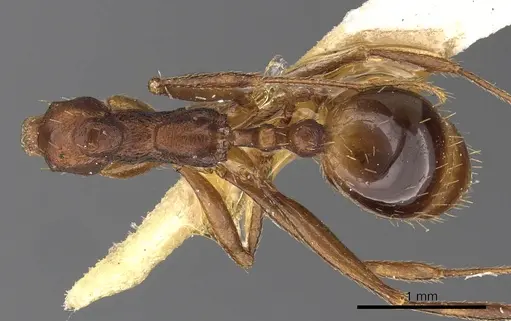
Literature
Loading distribution map...Loading products...