
Desert Funnel Ant
Aphaenogaster barbigula
- Sci. Name
- Aphaenogaster barbigula
- Tribe
- Stenammini
- Subfamily
- Myrmicinae
- Author
- Wheeler, 1916
- Common Name
- Desert Funnel Ant
- Distribution
- Found in 1 countries
Introduction
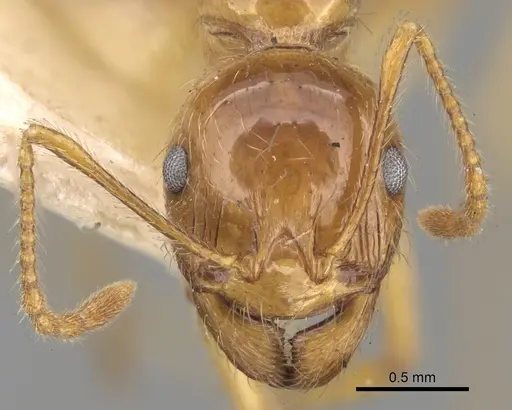
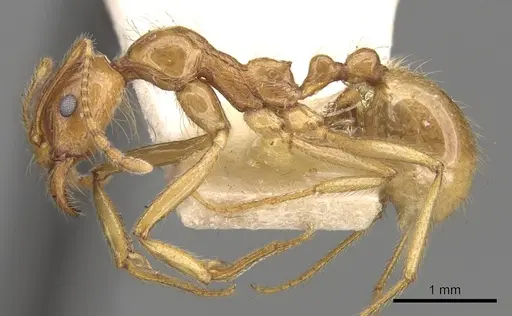
Aphaenogaster barbigula is a medium-small ant with workers reaching roughly 4-6mm in length. They sport a distinctive "beard" of hairs called a psammophore on the underside of their heads, along with relatively small eyes and short antennae segments . These ants inhabit semi-arid regions across eastern South Australia, south-central Queensland, western New South Wales, and north-western Victoria, where they specialize in sandy soils beneath Callitris woodlands, mulga forests, and mallee scrub . What makes these ants truly stand out is their remarkable engineering. They construct conspicuous funnel-shaped craters around their nest entrances that can reach 4cm across and 30cm deep . These funnels aren't just for show - they act as passive traps for surface-dwelling arthropods that tumble in and become food, and they channel rainwater deep into the soil at rates four times faster than surrounding ground . They also maintain underground "farms" of root-feeding aphids, tending them for honeydew while rarely venturing far from the nest entrance .
Quick Summary
- Difficulty: Medium
- Origin & Habitat: Semi-arid eastern Australia (South Australia, Queensland, New South Wales, Victoria), inhabiting sandy soils in Callitris and mulga woodlands, mallee, and savannah grasslands [1][2].
- Colony Type: Unconfirmed, likely single-queen colonies based on typical Aphaenogaster patterns, but specific studies are lacking.
- Size & Growth:
- Queen: Size data unavailable, queen measurements not documented in available research.
- Worker: Approximately 4-6mm, inferred from Aphaenogaster genus [1].
- Colony: Unknown, densities in nature can reach 88,000 nest entrances per hectare, but individual colony sizes are unstudied [4].
- Growth: Unknown, likely moderate based on semi-arid lifestyle.
- Development: Unknown, no specific development data available for this species. (Development speed likely depends on temperature and food availability.)
- Antkeeping:
- Temperature: Warm and stable, approximately 25-28°C with a gentle gradient. They inhabit semi-arid regions with warm conditions year-round [1][8].
- Humidity: Moderate humidity with well-draining substrate. Nest chambers should feel lightly damp but never waterlogged, sandy soils dry quickly but their natural nests channel water efficiently [4][2].
- Diapause: Likely not required. As a semi-arid species, they remain active through mild winters, though they may slow down if temperatures drop below 20°C [2].
- Nesting: Deep soil nests only. They require substantial depth (30cm+) to construct their characteristic funnel entrances and underground chambers [3][4]. Standard formicaria with shallow cavities will not suffice.
- Behavior: Defensive but not aggressive. Workers rarely forage far from nest entrances, preferring to stay near their funnel openings [3]. They will defend the nest when disturbed but are not prone to attacking distant threats. Their small size makes escape prevention essential [1].
- Common Issues: escape prevention is critical, workers are small enough to squeeze through tiny gaps in lids and tubing., shallow nest setups will stress the colony, they need deep substrate to build their characteristic funnel entrances., they rarely forage far from the nest, so food placed too distant may be ignored., wild-caught colonies may struggle without their natural root aphid symbionts that provide honeydew.
Nest Preferences and Soil Engineering
In nature, Aphaenogaster barbigula always nests in soil, creating distinctive funnel-shaped craters around their entrances that can measure up to 4cm across and 30cm deep [3][4]. These aren't simple holes, they construct torus-like mounds of loose soil around active entrances, with the funnel acting as both a water channel and a pitfall trap for prey [5][4].
In captivity, you must replicate this deep soil requirement. A standard test tube or shallow formicarium will not work. Use a deep container (at least 30cm) filled with sandy, well-draining soil or a sand-loam mix. The substrate should be firm enough to hold tunnels but loose enough for the ants to excavate their characteristic vertical shafts and horizontal chambers [4]. Provide a starter hole or depression to encourage funnel construction near the surface.
Keep the soil slightly damp but not saturated. Their natural nests show that while they live in semi-arid regions, they engineer their environment to capture and retain moisture efficiently [6]. A water source at the bottom of the container with a gradient toward the surface works well.
Feeding and Underground Agriculture
These ants have a fascinating dual feeding strategy. They tend aphids on the roots of plants underground, "farming" them for honeydew much like other ants farm aphids above ground [5][7][3]. This means they obtain sugar primarily from root systems rather than foraging for nectar on the surface.
They also consume arthropod prey. Their funnel-shaped nest entrances act as passive traps, insects walking near the rim tumble in and are captured by workers waiting below [3][5]. You can replicate this by offering small live prey like springtails, fruit flies, or tiny crickets placed directly at the nest entrance. They rarely forage more than a few centimeters from the entrance, so place food items right at the funnel opening [3].
Offer sugar sources like honey water or sugar water in small quantities near the entrance, though they may ignore it if they have established aphid "farms." Protein should be offered 2-3 times weekly in small amounts, as they do not store large food caches.
Temperature and Environmental Care
Coming from semi-arid regions of southern Australia, Aphaenogaster barbigula prefers warm, stable conditions. Aim for 25-28°C in the nest area with a slight gradient allowing cooler retreat areas around 22°C [1][2]. They tolerate dry air reasonably well but need access to moisture in their substrate.
Heating should be applied to one side of the nest area, preferably from above rather than below to avoid creating condensation that floods lower chambers. A heating cable or mat covering one-third of the setup works well. Monitor the colony, if workers cluster near the heat source, increase temperature slightly, if they avoid it, reduce heat.
These ants likely do not require hibernation (diapause). Their native range experiences mild winters, and colonies remain active year-round, though growth may slow if temperatures drop below 20°C for extended periods. If your room temperature drops below 15°C in winter, provide a gentle heat source to maintain activity.
Behavior and Temperament
Aphaenogaster barbigula shows a unique behavioral profile. They are not aggressive ants, you won't see them charging out to attack en masse like some species [3]. However, they will defend their nest when disturbed, with small numbers of workers emerging to bite or spray formic acid at intruders.
Their foraging behavior is highly localized. Unlike many ants that send workers on long trails, funnel ants keep most activity concentrated at the nest entrance [3]. Workers spend much of their time maintaining the funnel structure, tending underground aphids, or waiting at the entrance rim to capture prey that falls in.
This means your colony may appear less "active" than other species, don't mistake this for poor health. They are simply efficient homebodies. You will rarely see workers exploring the outworld unless food is placed very close to the entrance. Keep disturbances minimal, as they are sensitive to vibrations and light, quickly retreating deep into their tunnels when threatened.
The Funnel Trap Mechanism
The most remarkable aspect of this species is their architectural hunting strategy. The funnel-shaped crater around the nest entrance isn't just structural, it's a sophisticated passive trap [5][3]. Surface-dwelling arthropods walking near the loose soil rim lose footing and tumble into the shaft, where waiting workers dispatch them.
This adaptation allows them to capture food without expending energy on long foraging trips, which is advantageous in the harsh semi-arid environment where surface activity risks desiccation and predation [7]. The funnel also serves a hydrological function, channeling rare rainfall directly to the nest chambers rather than letting it run off, a critical adaptation for surviving in dry climates [4][6].
In captivity, you can observe this behavior by placing small prey items near the funnel rim. The ants will quickly drag anything that falls in down into their chambers. Keep the funnel rim clear of debris, as the ants will constantly maintain and repair this structure.
Frequently Asked Questions
Can I keep Aphaenogaster barbigula in a test tube?
No, test tubes are unsuitable. These ants need deep soil (30cm+) to construct their characteristic funnel-shaped nest entrances and underground chambers. Use a deep container with sandy substrate instead [3][4].
How long is the egg to worker timeline for Aphaenogaster barbigula?
The exact timeline is unconfirmed. No specific development data is available for this species.
Do Aphaenogaster barbigula need hibernation?
Likely not. As a semi-arid Australian species, they remain active year-round in mild winters. However, they may slow down if temperatures drop below 20°C. Keep them above 15°C in winter [2].
What do Aphaenogaster barbigula eat?
They tend aphids on plant roots for honeydew underground, and capture small arthropods that fall into their funnel-shaped nest entrances. Offer small live prey like springtails or fruit flies placed directly at the nest entrance [5][3].
How big do Aphaenogaster barbigula colonies get?
Colony size is unknown from scientific studies. In nature, nest entrance densities can reach 88,000 per hectare, but this represents many small colonies rather than massive single nests [4].
Are Aphaenogaster barbigula aggressive?
They are defensive but not aggressive. They rarely attack unless the nest is disturbed, and even then only small numbers emerge to defend. They do not forage far from the nest [3].
Why are they called funnel ants?
They construct large, deep funnel-shaped craters around their nest entrances. These funnels trap prey and channel water into the nest, making them distinctive landscape features in their semi-arid habitat [9][3][4].
What temperature do Aphaenogaster barbigula need?
Keep them warm at 25-28°C with a gentle gradient. They come from warm, semi-arid regions and prefer stable warmth [1][2].
Can I keep multiple Aphaenogaster barbigula queens together?
Not recommended. While the natural colony structure is unconfirmed, combining unrelated queens of this species has not been documented and likely leads to fighting.
Why is my Aphaenogaster barbigula colony not foraging?
This is normal behavior. They rarely forage far from the nest, preferring to capture prey in their funnel entrance or tend underground aphids. Place food directly at the entrance rather than across the outworld [3].
Report an Issue
The current care sheet is based fully on literature. See inconsistencies, or something that's incorrect? Please , it will be resolved after review from an admin. Contributing to the blogs tab also helps providing information, to make us be able to further improve the caresheets. Thank you for your support!
References

This caresheet is licensed under CC BY-SA 4.0 .
Community Blogs
CASENT0280943
View on AntWeb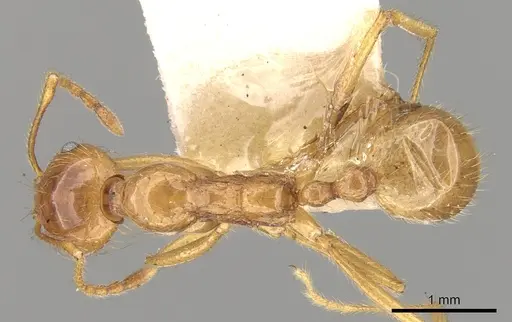
Literature
Loading distribution map...Loading products...