
Anochetus pangantihoni
- Sci. Name
- Anochetus pangantihoni
- Tribe
- Ponerini
- Subfamily
- Ponerinae
- Author
- Zettel, 2012
- Distribution
- Found in 0 countries
Introduction
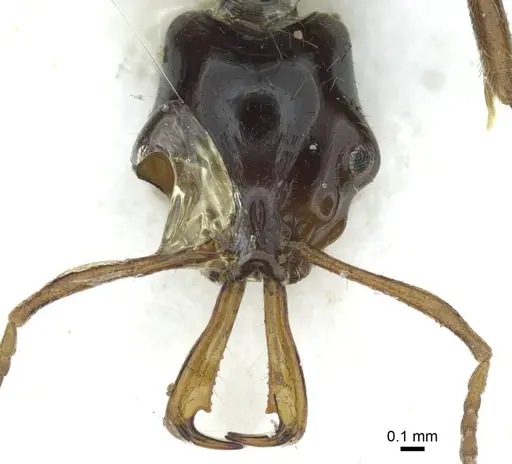
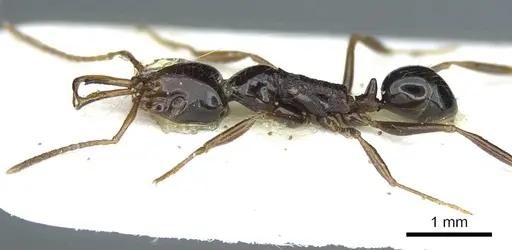
Anochetus pangantihoni is a small trap-jaw ant known only from Leyte Island in the Philippines. Workers measure 4.7-4.9 mm in total length and are very dark brown to almost black, with pale brown mandibles and antennae . The species was described in 2012 from 14 worker specimens collected from riverbank slopes at 50-100 meters elevation on Mount Pangasugan . Like all Anochetus species, they possess elongated trap-jaw mandibles capable of snapping shut at high speeds to capture prey. No queens, males, or brood have ever been collected, and no biological data exists beyond the original type description .
Quick Summary
- Difficulty: Expert
- Origin & Habitat: Leyte Island, Philippines, tropical riverbank slopes at 50-100m elevation near the Calbiga-a River [1]
- Colony Type: Unknown, only worker specimens have been described [1]
- Size & Growth:
- Antkeeping:
- Temperature: Unknown, likely tropical room temperature (22-28°C) based on origin
- Humidity: Unknown, likely high humidity given the riverbank collection site
- Diapause: No, tropical species from the Philippines does not require hibernation
- Nesting: Unknown, likely soil or rotten wood based on genus patterns
- Behavior: Trap-jaw predation behavior is expected based on mandible structure, but specific behaviors remain unstudied. As a Ponerinae ant, they possess a functional stinger [1].
- Common Issues: the species exists only as 14 museum specimens and is completely unavailable in the antkeeping trade., no queens have ever been described, making it impossible to establish a colony with current knowledge., no captive care guidelines exist due to complete lack of biological data beyond the type description., collecting additional specimens would require permits and access to the specific type locality in the Philippines.
Taxonomy and Rarity
Anochetus pangantihoni is what antkeepers call a 'paper species', known only from scientific descriptions and museum specimens. Herbert Zettel described this species in 2012 based on 14 worker ants collected from a single location on Leyte Island in the Philippines [1]. The type series consists of one holotype and 13 paratypes, all workers, collected from riverbank slopes behind Leyte State University in March 2005 [1]. No additional collections have been reported since the original description. The species name honors Clister V. Pangantihon, who assisted with the collection [1]. For antkeepers, this means the species is effectively unavailable and impossible to obtain through legal trade or collection.
Morphology and Identification
Workers of Anochetus pangantihoni are small but distinctive. They measure 4.7-4.9 mm in total length with a very dark brown to black body and contrasting pale brown mandibles and antennae [1]. The head shows a deeply emarginated vertex and longitudinal striation restricted to stripes medial of the frontal carinae [1]. Their mandibles are moderately long with a mandible index of 65-68,featuring a smooth dorsal edge and minutely serrate ventral edge [1]. The petiole has a narrow node with a slightly concave anterior face, and the propodeum displays 20-25 transverse costulae [1]. These features place them in the A. risii species group, intermediate between A. modicus and A. brevis [1].
Natural History and Biology
The biology of Anochetus pangantihoni remains completely unknown [2]. The type specimens were collected from the banks of the Calbiga-a River at 50-100 meters elevation on the slopes of Mount Pangasugan, suggesting a tropical lowland habitat near water [1]. As a member of the trap-jaw ant genus Anochetus, they possess the ability to snap their elongated mandibles shut at high speeds to capture small prey, but this has never been observed in this species. Colony size, social structure, reproductive strategies, and developmental timelines are all unstudied. No queens, males, or brood have ever been collected [1].
Frequently Asked Questions
Can I keep Anochetus pangantihoni as a pet?
No. This species is known only from 14 museum specimens collected in 2005. No live colonies exist in captivity, and the species is not available through any legal trade. Additionally, no queens have ever been described, so even if you could obtain workers, you could not establish a breeding colony.
Where does Anochetus pangantihoni come from?
This species is known only from Leyte Island in the Philippines, specifically from the slopes of Mount Pangasugan near the Calbiga-a River in Baybay Province [1].
How big are Anochetus pangantihoni workers?
Workers measure 4.7-4.9 mm in total length, making them relatively small ants [1].
What do Anochetus pangantihoni eat?
Their diet is unknown. Based on their trap-jaw mandible structure, they likely prey on small arthropods like other Anochetus species, but this has never been observed.
Do Anochetus pangantihoni need hibernation?
No. They come from a tropical climate in the Philippines and do not require hibernation.
Can I buy Anochetus pangantihoni?
No. The only known specimens are housed in museums (USCC, HSZC, and NHMW). The species is not commercially available and collecting additional specimens would require permits and access to the specific type locality in the Philippines.
Are Anochetus pangantihoni dangerous?
Unknown. They possess trap-jaw mandibles and have a stinger as is typical for the subfamily Ponerinae, but their venom potency and temperament are unstudied. At less than 5 mm, they are small ants.
Why is there no care information for Anochetus pangantihoni?
Scientists have only collected 14 workers of this species once in 2005. No one has ever observed a colony, nest, queen, or brood. Without basic biological data like colony size, founding behavior, or diet, specific care guidelines cannot be created.
Report an Issue
The current care sheet is based fully on literature. See inconsistencies, or something that's incorrect? Please , it will be resolved after review from an admin. Contributing to the blogs tab also helps providing information, to make us be able to further improve the caresheets. Thank you for your support!
References

This caresheet is licensed under CC BY-SA 4.0 .
Community Blogs
CASENT0915891
View on AntWeb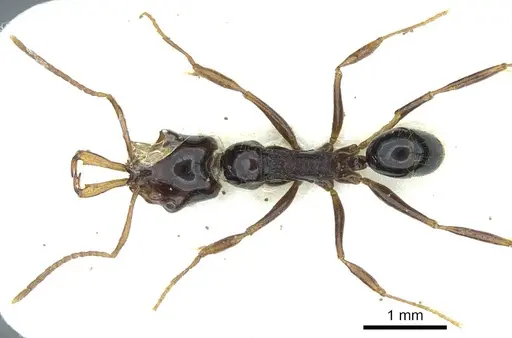
Literature
Loading distribution map...Loading products...