
Anochetus madaraszi
- Sci. Name
- Anochetus madaraszi
- Tribe
- Ponerini
- Subfamily
- Ponerinae
- Author
- Mayr, 1897
- Distribution
- Found in 1 countries
Introduction
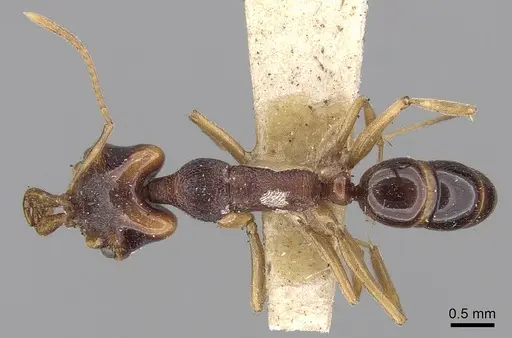
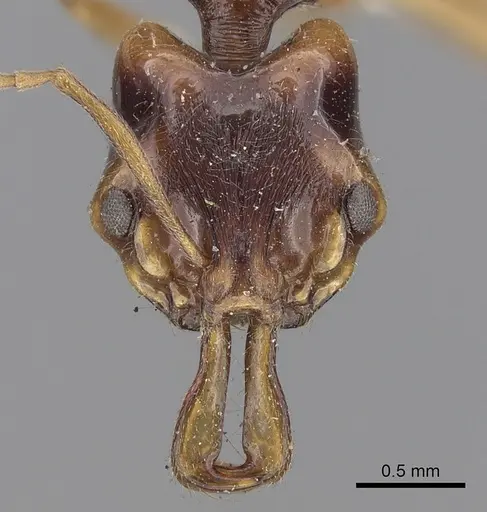
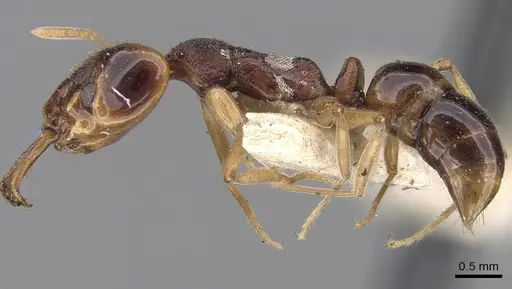
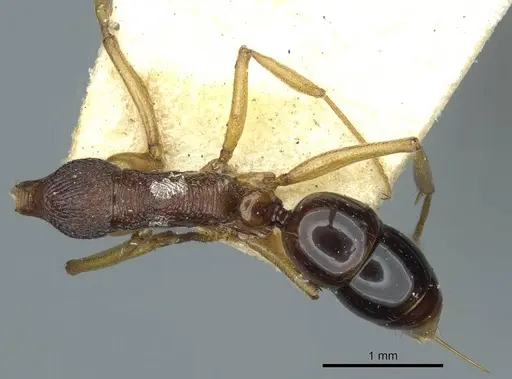
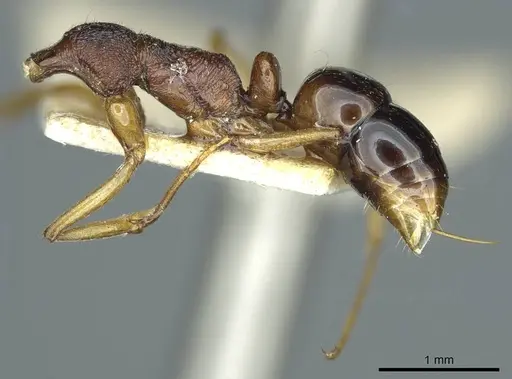
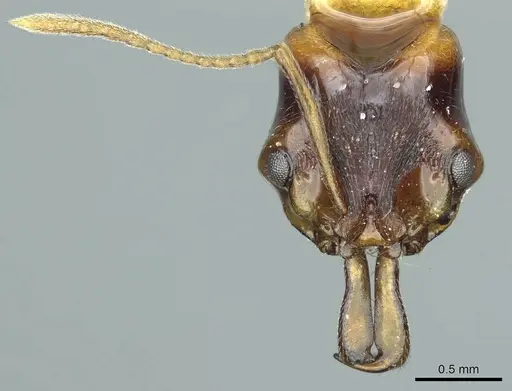
Anochetus madaraszi is a trap-jaw ant from South Asia with workers measuring about 5.1 to 5.4 millimeters total length . They have dark brown to blackish brown bodies with yellowish-brown legs and antennae, and their most striking feature is the pair of long, linear mandibles ending in three sharp teeth that snap shut at incredible speeds to catch prey . You can find them across India, Sri Lanka, Bangladesh, Bhutan, and into southern China (Yunnan, Guangxi, Hainan) where they inhabit tropical and subtropical forests at low to mid elevations . These ants nest at the base of trees in soil or leaf litter, though workers actively forage up on the tree trunks . Their first abdominal segment is smooth and shiny, which helps distinguish them from similar species like Anochetus graeffei . As part of the sedilloti species group, they represent the classic trap-jaw hunting lifestyle but with more ground-associated nesting habits than some of their tree-dwelling relatives .
Quick Summary
- Difficulty: Medium
- Origin & Habitat: South Asia including India, Sri Lanka, Bangladesh, Bhutan, and southern China (Yunnan, Guangxi, Hainan) in tropical and subtropical forests, typically at low to mid elevations (299-700m) [1][2][4][3].
- Colony Type: Colony structure is unconfirmed for this species.
- Size & Growth:
- Queen: Unknown, no specific measurements available.
- Worker: 5.1-5.4 mm total length [1].
- Colony: Colony size data unavailable.
- Growth: Growth rate is unconfirmed.
- Development: Approximately 6-10 weeks at 25-28°C. (Timeline is estimated based on related tropical Ponerinae species, actual development time is unconfirmed for this species.)
- Antkeeping:
- Temperature: 24-28°C year-round. These tropical ants need stable warmth and will not tolerate cold temperatures.
- Humidity: Moderate to high humidity. Keep nest substrate moist but not waterlogged, similar to the damp leaf litter at forest edges.
- Diapause: No, this is a tropical species that remains active year-round.
- Nesting: In nature they nest in soil and leaf litter at tree bases [5][8]. In captivity, use naturalistic setups with soil, leaf litter, and bark, or plaster nests with narrow chambers and humidity gradients.
- Behavior: Predatory trap-jaw hunters that use their snapping mandibles to catch small prey. Workers forage on tree trunks and the ground. They possess a sting but are generally not aggressive toward humans. Their 5mm size requires good escape prevention.
- Common Issues: trap-jaw mandibles can be damaged if they strike hard surfaces, use soft prey and avoid hard acrylic nest materials., require small live prey like springtails or fruit flies, they may reject dead insects or prey that is too large., tropical species need consistent heat, colony failure if temperatures drop below 20°C for extended periods., slow growth means beginners often overfeed or disturb the colony too frequently., specific nesting needs, they prefer soil-based nests over bare test tubes or open spaces.
Nest Preferences
In the wild, Anochetus madaraszi nests at the base of trees in soil and leaf litter, though workers are frequently seen foraging on the tree trunks above [5]. Researchers have collected them by sifting soil and leaf litter, confirming their ground-nesting habits [8]. They have been found in various habitats including abandoned agricultural land and warm broadleaved forests at elevations from 299 meters in Hainan to 700 meters in Bhutan [3][4].
For captive care, recreate these conditions with a naturalistic setup containing soil, leaf litter, and pieces of bark or flat stones. They will also accept plaster nests or Y-tong (autoclaved aerated concrete) with narrow chambers that maintain humidity. Provide a humidity gradient with one side moist and one side slightly drier so the colony can choose their preferred conditions.
Feeding and Diet
As trap-jaw ants, Anochetus madaraszi are specialized predators that hunt small arthropods. Their long mandibles with three distinct teeth at the tip snap shut at high speed to capture prey [1]. In captivity, feed them small live insects such as springtails, fruit flies, or pinhead crickets. They may accept honey water or sugar water occasionally, but protein from live prey is essential for colony growth.
Be careful with their mandibles, the trap-jaw mechanism can be damaged if the ants strike hard surfaces like acrylic or glass. This is one reason naturalistic soil nests or soft plaster are preferable to hard plastic formicaria. Offer prey that is small enough for them to handle easily, as they may struggle with large insects.
Temperature and Care
Coming from tropical South Asia, these ants require warm temperatures between 24-28°C year-round. They do not require hibernation (diapause) and will remain active throughout the year. Keep the nest away from air conditioning vents or cold windowsills.
Use a heating cable or heat mat on one side of the nest to create a gentle temperature gradient, but place the heating element on top or side rather than underneath to avoid creating condensation that floods the nest. Monitor the colony's response, if workers cluster near the heat, they may want it slightly warmer, if they avoid the heated area, reduce the temperature. [1][2]
Behavior and Temperament
Anochetus madaraszi workers are predatory hunters that use their trap-jaw mandibles both for capturing prey and as a defensive mechanism. When trigger hairs on the mandibles touch a target, the jaws snap shut in a fraction of a second. They are generally not aggressive toward humans and will typically flee rather than sting, though they can sting if handled roughly.
Workers are known to forage on tree trunks while their nest remains at the base, suggesting they are comfortable both on vertical surfaces and the ground [5]. They are not particularly fast-moving compared to some other trap-jaw species, but their small size means you must use excellent escape prevention such as tight-fitting lids and fine mesh barriers.
Colony Founding
Founding behavior for Anochetus madaraszi has not been directly documented in scientific studies. If you attempt to found a colony, provide a small founding chamber with soil or plaster, and offer small amounts of food regularly to be safe. Do not disturb the queen frequently, as trap-jaw ants are sensitive to vibrations and light during the founding stage.
Frequently Asked Questions
Can I keep Anochetus madaraszi in a test tube?
Test tubes are not ideal for the long term because these ants prefer soil or substrate to nest in. However, for founding, you can use a test tube with a soil plug or small container attached to provide a more natural environment. Move them to a naturalistic setup or plaster nest once the colony grows.
What do Anochetus madaraszi eat?
They are predatory trap-jaw ants that need small live prey. Feed them springtails, fruit flies, or tiny crickets. They may occasionally accept sugar water or honey, but live protein is essential for the colony to develop.
How long until Anochetus madaraszi get their first workers?
The exact timeline is unknown, but based on similar tropical trap-jaw ants, expect approximately 6-10 weeks at temperatures around 25-28°C.
Do Anochetus madaraszi need hibernation?
No, they are a tropical species from South Asia and remain active year-round. Do not cool them down for hibernation as this can kill the colony.
Can I keep multiple Anochetus madaraszi queens together?
Not recommended. Based on typical patterns for this genus, they are likely single-queen. Combining multiple unrelated queens will likely result in fighting and death.
Are Anochetus madaraszi good for beginners?
They are medium difficulty. While they are not extremely aggressive, they require live food, consistent tropical temperatures, and specific nesting conditions (soil-based). Beginners might find easier success with species like Lasius or Camponotus.
Why are my Anochetus madaraszi dying?
Common causes include temperatures that are too low (they need 24-28°C), lack of appropriate small live prey, or damage to their mandibles from striking hard surfaces. Also check that the nest has adequate humidity without being waterlogged.
Report an Issue
The current care sheet is based fully on literature. See inconsistencies, or something that's incorrect? Please , it will be resolved after review from an admin. Contributing to the blogs tab also helps providing information, to make us be able to further improve the caresheets. Thank you for your support!
References

This caresheet is licensed under CC BY-SA 4.0 .
Community Blogs
Literature
Loading distribution map...Loading products...