
Anochetus kempfi
- Sci. Name
- Anochetus kempfi
- Tribe
- Ponerini
- Subfamily
- Ponerinae
- Author
- Brown, 1978
- Distribution
- Found in 1 countries
Introduction
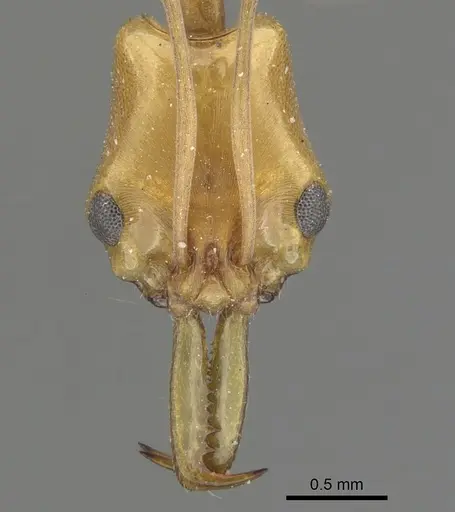
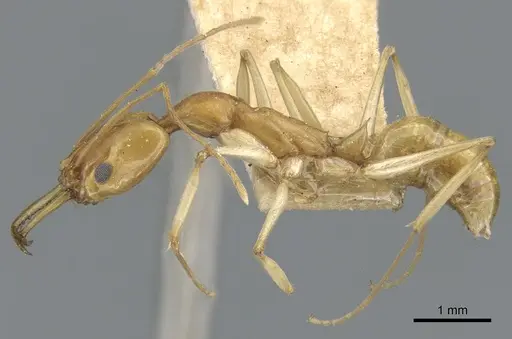
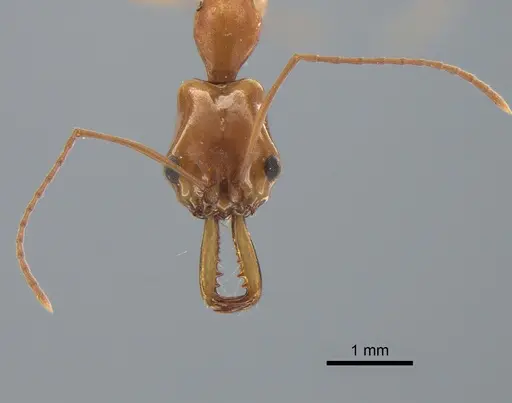
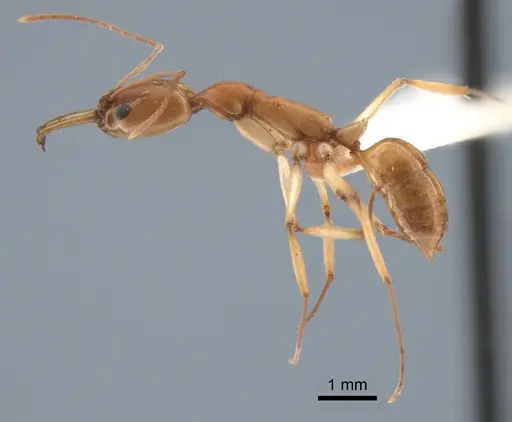
Anochetus kempfi is a trap-jaw ant native to Puerto Rico and the Virgin Islands, found in habitats ranging from dry forest to rainforest . Workers are medium-sized at 7.4-8.4 mm, ferruginous yellow in color with pale yellow appendages, and possess the characteristic long mandibles of the genus . This species is remarkable for being the first Anochetus documented as polygyne (multi-queen), housing 2-4 ergatoid (wingless) queens per colony . Queens are slightly smaller than workers at 6.97-7.22 mm and lack wings entirely, meaning new colonies form by budding or fission rather than nuptial flights . Workers constantly carry eggs in their mandibles in packets and never allow them to touch the nest floor - a behavior unique among ants . They are strictly nocturnal, cryptic hunters that use their trap-jaw mandibles to capture prey and can launch themselves through the air when threatened .
Quick Summary
- Difficulty: Hard
- Origin & Habitat: Puerto Rico and the Virgin Islands (British and U.S.), found in habitats ranging from dry forest and sandy beaches to rainforest, moist forest, and urban woodland [1][2].
- Colony Type: Polygyne colonies containing 2-4 ergatoid (wingless) queens, colonies form by budding or fission rather than single-queen founding [1].
- Size & Growth:
- Antkeeping:
- Temperature: Warm and stable, roughly 24-28°C based on tropical Caribbean habitat, they tolerate brief exposure to 45°C for approximately 9-10 minutes but should not be kept at such high temperatures continuously [3].
- Humidity: Moderate to high, substrate should be damp but not waterlogged, reflecting their range from dry forest to rainforest habitats [1].
- Diapause: No, this is a tropical species that remains active year-round [1].
- Nesting: Naturalistic soil nests or decomposing wood, loose soil substrate is required for larvae to spin cocoons and pupate successfully [1].
- Behavior: Strictly nocturnal and cryptic, workers forage alone with no recruitment or alarm pheromones [1]. They hunt using trap-jaw mandibles to capture and immediately sting prey, and can jump by mandibular clicking when threatened [1]. Trophallaxis is uncommon and cooperation is minimal [1].
- Common Issues: larvae require loose soil particles to spin cocoons or they will fail to pupate., workers attack and kill supernumerary queens after two to three weeks in artificial nests., males cannot emerge from cocoons without worker assistance and die if neglected., strictly nocturnal activity makes observation and feeding timing difficult.
Nest Preferences and Soil Requirements
In nature, Anochetus kempfi nests in soil, decomposing wood, beneath stones, and even under coconut seeds [1]. For captive colonies, a naturalistic setup with a soil mix is essential. The most critical requirement is that larvae need loose soil particles to form their pupal cocoons [1]. Without access to appropriate substrate, larvae will fail to pupate and die. Provide a nest area with chambers in damp soil or plaster with soil inclusions, ensuring the substrate remains loose enough for the larvae to gather particles. The nest should have areas of varying moisture but avoid waterlogging.
Feeding and Hunting Behavior
These ants are strictly predatory and nocturnal hunters. Workers forage alone and do not recruit nestmates to food sources [1]. They capture prey with their trap-jaw mandibles and immediately sting it, which usually causes immediate paralysis [1]. They have been observed feeding on termites and likely take various small insects [1]. When feeding, workers preferentially grasp prey in their forelegs and hold it off the ground [1]. Trophallaxis is uncommon in this species, and groups of three to five workers may feed on the same large prey item simultaneously, though each found it independently [1]. Offer small live prey such as fruit flies, springtails, or tiny crickets at night.
Temperature and Tropical Care
As a Caribbean species, Anochetus kempfi requires warm, stable temperatures year-round. Research shows they can tolerate 45°C for approximately 9-10 minutes, indicating adaptation to warm conditions [3]. Maintain colonies at roughly 24-28°C with minimal fluctuation. They do not require and should not receive a winter diapause or cooling period [1]. A heating cable on one side of the nest can provide a gentle gradient, but ensure the nest does not overheat, as these cryptic ants prefer stable conditions.
Nocturnal Activity and Observation
Anochetus kempfi is strictly nocturnal, making them challenging to observe [1]. Workers are active at night and remain hidden during daylight hours. For observation, use dim red lighting, as they are less sensitive to red wavelengths. Feed them in the evening or at night when they are active. Their cryptic behavior means they will spend much of the day in dark chambers, so provide plenty of cover and avoid disturbing the nest during daytime hours.
Colony Founding and Queen Biology
You cannot start an Anochetus kempfi colony from a single queen. Queens are ergatoid, meaning they are wingless and worker-like in appearance [1]. New colonies are established by budding or fission, where a queen leaves with workers from an established nest [1]. In captivity, you must start with an established colony or a colony fragment containing multiple queens and workers. Be aware that in artificial nests, after two to three weeks, workers may attack and kill supernumerary queens, with up to 16 workers participating in the execution [1]. Virgin queens are also attacked and ejected [1].
The Unique Egg-Carrying Behavior
This species displays a unique behavior not observed in other ants: workers constantly carry eggs in their mandibles and never allow them to lie on the nest chamber floor [1]. Eggs are held in packets, sometimes by up to five workers simultaneously, including newly eclosed callow workers [1]. Transfers of egg packets between workers can be reluctant and sometimes require force [1]. Queens lay eggs that are immediately picked up by workers and added to these carried clusters [1]. This permanent egg-carrying means you will never see eggs resting on the substrate.
Male Care and Colony Reproduction
Males of Anochetus kempfi are unable to free themselves from their pupal cocoons due to their reduced, vestigial mandibles [1]. Workers must assist males by opening the cocoons, and up to three workers may help a single male eclose [1]. Once emerged, males are cleaned by up to five workers and may be carried between chambers [1]. Males that do not leave the nest within two weeks are killed by workers, sometimes eaten, and males have been observed dying as soon as four days after eclosion if not assisted [1]. Colonies produce many more males than queens [1].
Frequently Asked Questions
Can I keep Anochetus kempfi with just one queen?
No. These ants are polygyne (multi-queen) and their queens are ergatoid (wingless). New colonies form by budding or fission from existing colonies, not by single queens founding alone. You need to start with an established colony or colony fragment containing multiple queens and workers [1].
How many queens should I keep together in an Anochetus kempfi colony?
Natural nests contain 2-4 queens [1]. However, in artificial nests, workers may attack and kill extra queens after two to three weeks, so you may need to separate queens if aggression begins [1].
Why won't my Anochetus kempfi larvae pupate?
Larvae need loose soil particles to form their cocoons. Without access to appropriate soil substrate, they cannot pupate and will die [1].
Are Anochetus kempfi nocturnal?
Yes, they are strictly nocturnal. Workers forage at night and remain hidden during the day. Use red light if you need to observe them [1].
Do Anochetus kempfi ants sting?
Yes. They belong to the Ponerinae subfamily and have a functional stinger. Workers capture prey with their trap-jaw mandibles and immediately sting it, which causes paralysis [1].
How big do Anochetus kempfi colonies get?
Colonies remain relatively small, reaching up to about 100 workers [1].
What do Anochetus kempfi eat?
They are predatory ants that hunt small live insects. They have been observed feeding on termites and capture prey using their trap-jaw mandibles followed by stinging [1].
Do Anochetus kempfi need hibernation?
No, they are a tropical species from the Caribbean and remain active year-round without a diapause period [1].
Can Anochetus kempfi jump?
Yes, like other trap-jaw ants, they can launch themselves through the air by mandibular clicking when threatened [1].
Why are my male Anochetus kempfi dying in their cocoons?
Males cannot open their own cocoons due to their reduced mandibles. Workers must help them emerge. If males are not assisted by workers, they will die trapped in their cocoons [1].
Report an Issue
The current care sheet is based fully on literature. See inconsistencies, or something that's incorrect? Please , it will be resolved after review from an admin. Contributing to the blogs tab also helps providing information, to make us be able to further improve the caresheets. Thank you for your support!
References

This caresheet is licensed under CC BY-SA 4.0 .
Community Blogs
CASENT0902430
View on AntWeb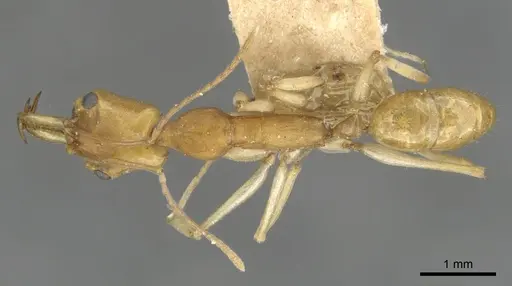
LACMENT542503
View on AntWeb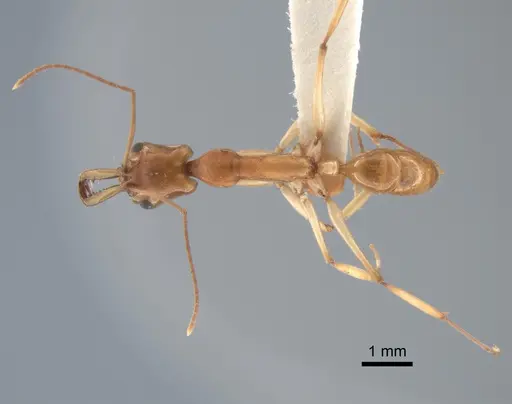
Literature
Loading distribution map...Loading products...