
Aenictus villiersi
- Sci. Name
- Aenictus villiersi
- Subfamily
- Dorylinae
- Author
- Bernard, 1953
- Distribution
- Found in 1 countries
Introduction
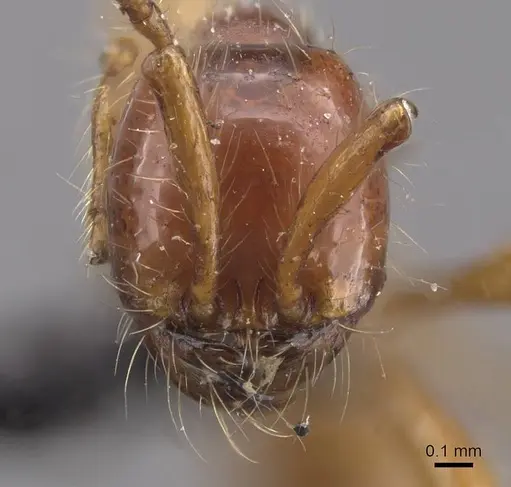
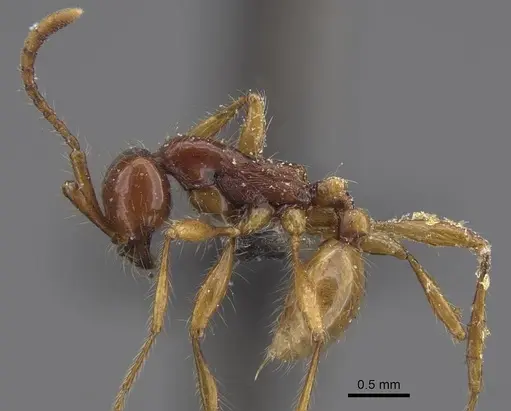
Aenictus villiersi is a tiny army ant from the mountains of West Africa. Workers measure 3 to 3.2 millimeters in total length and show a striking color pattern: their head and thorax are reddish, while the abdomen and legs are dark yellow . They possess the longest antennae relative to body size of any Afrotropical Aenictus species, with a scape index around 100 . Scientists know this ant only from four specimens collected in 1946 on the northeast slope of Mount Nimba in Guinea, at 700 meters elevation in forest habitat . No queen has ever been found, and the species has never been kept in captivity. This species belongs to the Aenictus decolor group within the army ant subfamily Dorylinae. Army ants live differently from typical garden ants. They do not build permanent nests. Instead, they form temporary living structures called bivouacs and move constantly to raid for prey. This nomadic lifestyle makes them impossible to keep in standard ant farms.
Quick Summary
- Difficulty: Expert
- Origin & Habitat: Mount Nimba, Guinea, West Africa, montane forest at 700m elevation [2][1]
- Colony Type: Unknown, only worker caste documented [1]
- Size & Growth:
- Antkeeping:
- Temperature: Likely 24-28°C based on tropical montane habitat, but unconfirmed. Start with stable room temperature around 25°C and observe.
- Humidity: High humidity expected for forest floor habitat, keep substrate moist but not waterlogged.
- Diapause: No, tropical species from Guinea do not hibernate [1]
- Nesting: Army ants form temporary bivouacs (living nests made of ant bodies), not permanent structures. Standard formicaria are unsuitable.
- Behavior: Nomadic army ant raiding behavior, highly mobile predators that hunt in groups. They likely raid other ant nests and termites. Extremely small size (3mm) means escape prevention would be nearly impossible with standard equipment.
- Common Issues: species not available in the ant trade, known only from four specimens collected in 1946., no queens known, making colony founding impossible., nomadic lifestyle requires massive foraging areas impossible in home setups., tiny worker size (3mm) means escapes are inevitable in standard enclosures., army ant biology requires specialized care facilities unavailable to hobbyists.
Why You Cannot Keep This Species
Aenictus villiersi is not available in the ant trade and cannot be kept as a pet. Scientists have collected only four specimens, all in 1946 from Mount Nimba, Guinea [2][1]. No queen has ever been found, meaning you cannot start a colony even if you obtained workers. Additionally, this is an army ant species. Army ants do not live in permanent nests like Lasius or Camponotus. Instead, they form temporary bivouacs and move constantly. They require massive foraging territories to raid for prey, making them impossible to house in standard formicaria.
Army Ant Biology
Aenictus villiersi belongs to the army ant subfamily Dorylinae. Army ants are nomadic predators that hunt in groups. They typically reproduce by colony fission, where the colony splits into two parts, each with a queen. This differs from typical ant keeping, where you start with a single queen. Army ant colonies contain thousands or tens of thousands of workers. They require high humidity and warm temperatures year-round. Without specialized facilities spanning many square meters, you cannot maintain the raiding columns and bivouac formations these ants need to survive. [1]
What We Know About Aenictus villiersi
This species is distinguished by its extremely long antennae, the longest relative to body size among Afrotropical Aenictus [2]. The subpetiolar process (a small projection under the waist) is uniquely shaped like a quarter-ellipse with the flat side facing forward [2]. Workers have reddish heads and thoraxes with yellowish-brown abdomens and legs [1]. They were collected in montane forest at 700 meters elevation, suggesting they prefer cool, humid tropical conditions compared to lowland army ants [2].
Morphological Details
Workers measure 3-3.2mm in total length [1]. They have the longest antennae relative to body size of any Afrotropical Aenictus species [2]. The petiole (narrow waist segment) has small dorsolateral ridges that form a flat platform when viewed from above [2]. The body is smooth and shiny except for the sides of the thorax, which are matte and shagreened [1].
Frequently Asked Questions
Can I buy Aenictus villiersi?
No. This species is not sold by any ant dealers. It is known only from four specimens collected in 1946 in Guinea and is not available in the pet trade [2][1].
How do I found a colony of Aenictus villiersi?
You cannot. No queens have ever been collected for this species. Army ants typically reproduce by colony splitting rather than single-queen founding, making traditional founding methods impossible.
What size tank do I need for Aenictus villiersi?
Army ants require enormous spaces, often rooms or large outdoor enclosures, to maintain their raiding behavior. Standard ant farms are completely unsuitable for army ants.
Do Aenictus villiersi sting?
Like most army ants, they likely possess a stinger and powerful mandibles, but specific defense data is unconfirmed for this species.
What do Aenictus villiersi eat?
Army ants in the genus Aenictus typically raid other ant nests, termites, and other arthropods. They are specialized predators that require live prey in large quantities.
How fast do Aenictus villiersi grow?
Growth rate is unknown for this specific species. Army ants generally have cyclic brood production with rapid development in warm conditions, but no timeline exists for A. villiersi.
Do Aenictus villiersi need hibernation?
No. They come from tropical Guinea and do not experience cold winters or require hibernation.
Why are my Aenictus villiersi dying?
If you somehow obtained these ants, they are likely dying because army ants cannot survive in standard ant-keeping setups. They require specialized care, massive spaces, and specific prey items impossible to provide in captivity without research-grade facilities.
Are Aenictus villiersi good for beginners?
No. This species is unsuitable for any ant keeper because it is not available, has never been kept successfully, and requires facilities beyond what hobbyists can provide.
Report an Issue
The current care sheet is based fully on literature. See inconsistencies, or something that's incorrect? Please , it will be resolved after review from an admin. Contributing to the blogs tab also helps providing information, to make us be able to further improve the caresheets. Thank you for your support!
References

This caresheet is licensed under CC BY-SA 4.0 .
Community Blogs
CASENT0915327
View on AntWeb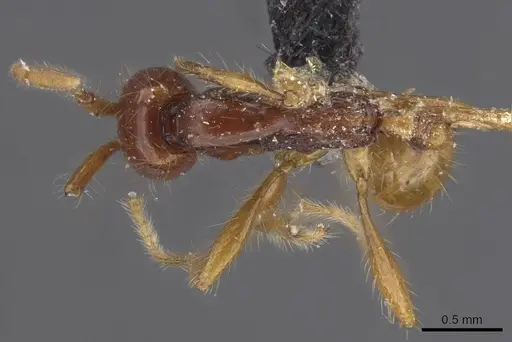
Literature
Loading distribution map...Loading products...