
Aenictus vaucheri
- Sci. Name
- Aenictus vaucheri
- Subfamily
- Dorylinae
- Author
- Emery, 1915
- Distribution
- Found in 2 countries
Introduction
Aenictus vaucheri is a small army ant species found in Morocco and Algeria in the Palaearctic region . First described by Emery in 1915 from a queen collected in Morocco, workers were later described by Santschi in 1936 . The species can be identified by its distinctly transverse postpetiole - the second waist segment appears wide and short when viewed from above - which distinguishes it from similar species like Aenictus rhodiensis that have an elongated postpetiole . Very little is known about the specific biology of this species.
Quick Summary
- Difficulty: Expert
- Origin & Habitat: Morocco and Algeria in North Africa. Considered fairly common in the Koumch region of Morocco [4][1][2].
- Colony Type: Unconfirmed. Based on typical Aenictus genus patterns, likely large colonies with a single queen, but specific colony structure has not been documented.
- Size & Growth:
- Queen: Size data unavailable, no measurements in available sources.
- Worker: Size data unavailable, no measurements in available sources. Based on Aenictus genus patterns, workers are typically small (around 2-5 mm).
- Colony: Unknown, no specific data. Based on typical Aenictus patterns, likely large colonies.
- Growth: Unknown
- Development: Unknown. (Based on Aenictus genus patterns, colony reproduction likely occurs via fission rather than traditional founding.)
- Antkeeping:
- Temperature: Unknown, no specific data. Based on North African distribution, likely tolerates warm conditions.
- Humidity: Unknown, no specific data.
- Diapause: Unknown, seasonal activity patterns have not been studied.
- Nesting: Based on typical Aenictus patterns, likely nomadic without permanent nests. Standard captive nest types do not apply.
- Behavior: Based on typical Aenictus genus patterns, likely group predators with nomadic behavior. Escape risk would be high due to small size and active foraging.
- Common Issues: this species has never been documented in captive keeping., colony space requirements would likely be massive due to nomadic lifestyle., dietary needs are unknown but likely specialized predators., attempting to collect wild colonies may be difficult due to nomadic behavior.
Taxonomy and Identification
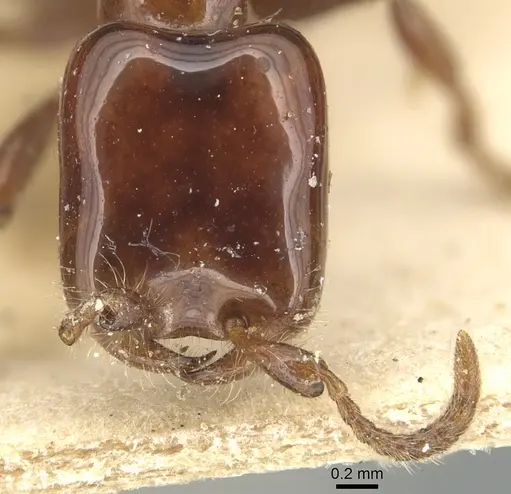
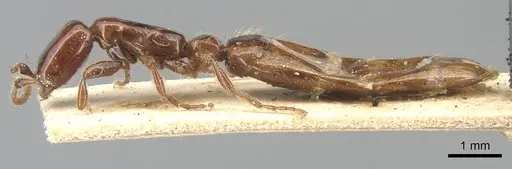
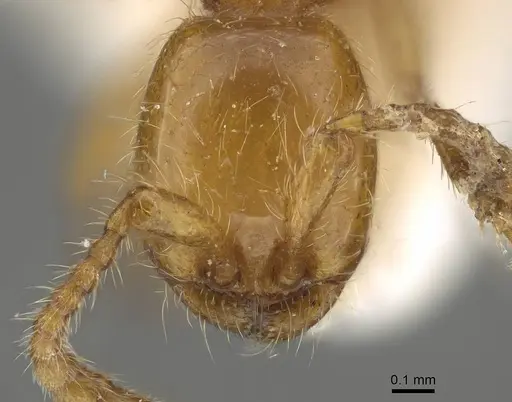
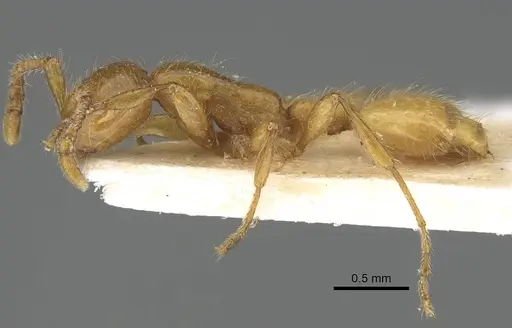
Aenictus vaucheri was first described by Emery in 1915 from a queen collected at Es-Sfemf, Morocco on January 5,1896 [2]. Workers were described later by Santschi in 1936 based on material from Ito, Morocco collected in May 1929 [3]. The species can be recognized by its transverse postpetiole, when viewed from above, the second waist segment appears distinctly wide and short compared to related species like Aenictus rhodiensis and Aenictus dlusskyi, which possess an elongated postpetiole [3]. The type specimen is housed in the Museo Civico di Storia Naturale, Genoa [2].
Natural History
Very little is known about the specific biology of Aenictus vaucheri. The species is considered fairly common in the Koumch region of Morocco [4], but no studies have documented their nesting habits, diet, colony size, or reproductive behavior. Based on the Aenictus genus, they likely prey on termites or other soft-bodied insects through cooperative group hunting. The genus is known for nomadic behavior and lack of permanent nests.
Distribution
Aenictus vaucheri is found in the Palaearctic region, specifically in Algeria and Morocco [1][2]. The species was described from Morocco and has been recorded in multiple locations including the Koumch region.
Frequently Asked Questions
Can I keep Aenictus vaucheri in a test tube?
No. This is an army ant species with likely specialized requirements that standard ant keeping equipment cannot provide. No captive keeping methods have been documented for this species.
How long until first workers for Aenictus vaucheri?
Unknown. Based on typical Aenictus patterns, colony reproduction may occur via fission rather than single queens raising first workers from eggs.
What do Aenictus vaucheri eat?
Unknown specifically, but based on the Aenictus genus, they are likely specialized predators of termites or other ant brood.
How big do Aenictus vaucheri colonies get?
Unknown, no specific data available. Based on typical Aenictus patterns, colonies may reach thousands of workers.
Can I keep multiple Aenictus vaucheri queens together?
Unknown. Specific colony structure has not been documented. Combining unrelated queens is not recommended.
Do Aenictus vaucheri need hibernation?
Unknown. While they live in North Africa where temperatures moderate seasonally, specific diapause requirements are unstudied.
Are Aenictus vaucheri good for beginners?
No. This species is not recommended for captive keeping with current knowledge and technology.
Report an Issue
The current care sheet is based fully on literature. See inconsistencies, or something that's incorrect? Please , it will be resolved after review from an admin. Contributing to the blogs tab also helps providing information, to make us be able to further improve the caresheets. Thank you for your support!
References

This caresheet is licensed under CC BY-SA 4.0 .
Community Blogs
CASENT0903754
View on AntWeb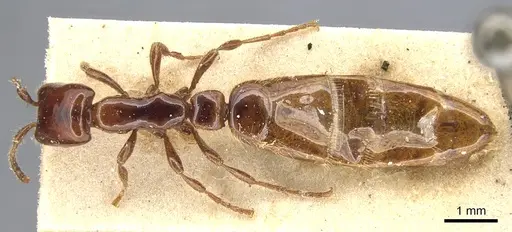
XE00204-2
View on AntWeb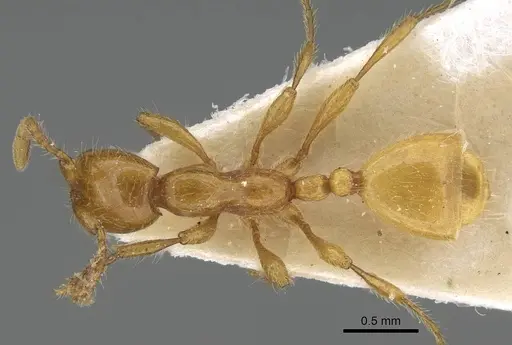
Literature
Loading distribution map...Loading products...