
Aenictus popeyei
- Sci. Name
- Aenictus popeyei
- Subfamily
- Dorylinae
- Author
- Gómez, 2022
- Distribution
- Found in 2 countries
Introduction
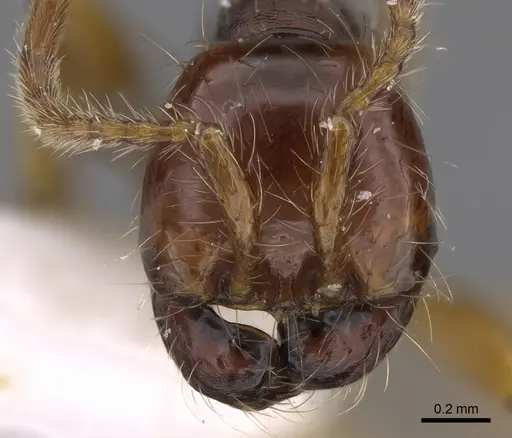
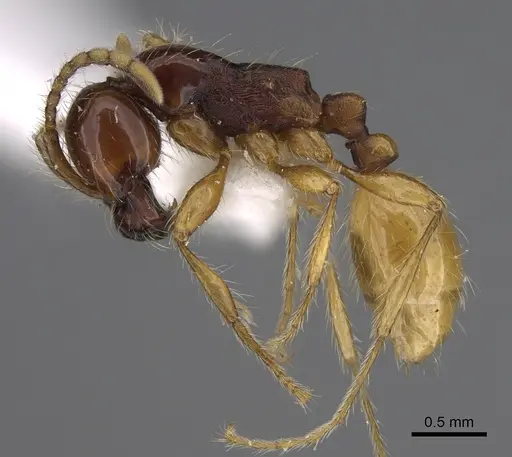
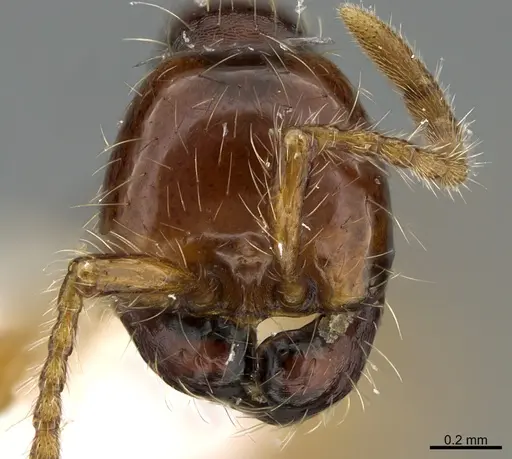
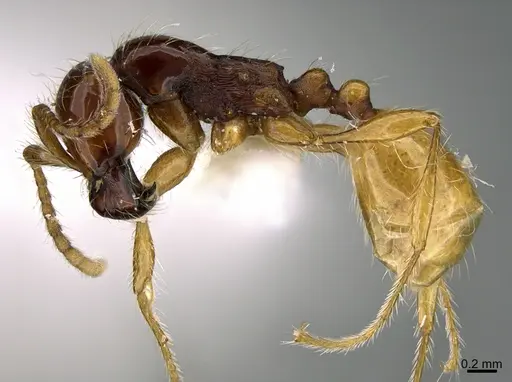
Aenictus popeyei is a tiny army ant from Central Africa. Workers are named for their massive, Popeye-like mandibles that take up nearly half the head . The body is dark reddish-brown with yellow to yellowish-brown antennae, legs, and gaster . This species is known only from Cameroon and Nigeria . Scientists have never observed a queen, male, nest, or any living colony - the entire biology remains completely unknown . As a member of the army ant subfamily Dorylinae, it belongs to a specialized predatory lineage, but no behavioral studies exist .
Quick Summary
- Difficulty: Expert, Not suitable for captive keeping
- Origin & Habitat: Cameroon and Nigeria in Central Africa [1][2]. The collection locality suggests tropical forest habitat, but specific preferences are unknown.
- Colony Type: Unknown. No queen has ever been observed [2].
- Size & Growth:
- Antkeeping:
- Temperature: Unknown. The tropical Cameroon collection site suggests warm conditions, but no specific data exists.
- Humidity: Unknown. Likely requires high humidity based on tropical forest origin, but unconfirmed.
- Diapause: No. Tropical species do not hibernate.
- Nesting: Unknown. Army ants typically form nomadic colonies, but this species has never been observed nesting [2].
- Behavior: Unknown. The massive mandibles suggest specialized predatory behavior, possibly targeting other social insects, but this is unconfirmed [1]. Workers are extremely small and would escape standard enclosures easily.
- Common Issues: species is only known from 6 museum specimens collected in 1949, no living colonies exist in captivity., biology completely unknown, no care protocol exists., no queens have ever been found, colony founding is impossible., massive mandibles suggest specialized predatory needs that cannot be met in standard setups., extremely small size means escape is likely with standard barriers.
The Mystery of Aenictus popeyei
Aenictus popeyei was described in 2022 from just six worker specimens collected in Cameroon in 1949 [1][2]. Despite being an army ant (subfamily Dorylinae) [1], absolutely nothing is known about how this species lives. Scientists have never found a queen, male, nest, or foraging column [2]. The species exists only as preserved specimens in museum collections. This makes it impossible to provide care guidelines, there are no observations of what they eat, how they nest, or how their colonies are structured.
Identification: Popeye's Mandibles
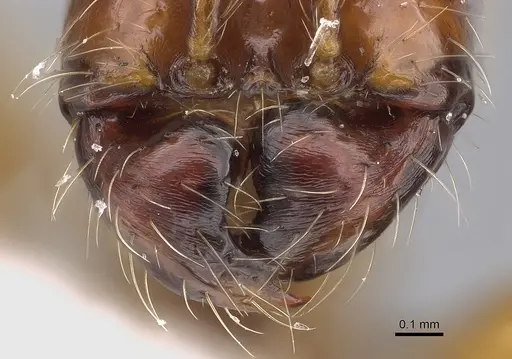
This species is instantly recognizable by its massive mandibles. In Aenictus popeyei, the upper half of the mandibles is hemispherical, rounded, and smooth [1][3]. This differs from the similar Aenictus brutus, which has flat, rough-textured mandibles with an excavated central section [3]. Aenictus popeyei is also smaller than A. brutus [1][3]. The head is wider than long, widest at the mandible insertions [1]. The body is dark reddish brown with the antennae, gaster, coxae, and legs colored yellow to yellowish brown [1].
Why This Species Cannot Be Kept
This species is not available for ant keeping. It exists only as six museum specimens collected 75 years ago [2]. Even if specimens were available, army ants require specialized facilities with large foraging areas, constant humidity and temperature control, and enormous amounts of live prey. No queen has ever been found, so colony founding is impossible [2]. The biology is completely unknown, we do not know what they eat, how they nest, or what conditions they require. This species should be considered unavailable for ant keeping.
Frequently Asked Questions
Can I keep Aenictus popeyei in a test tube?
No. This species is only known from six museum specimens collected in 1949 and has never been kept in captivity. It is not commercially available [2].
How do I found an Aenictus popeyei colony?
You cannot. No queen has ever been found for this species [2].
What do Aenictus popeyei eat?
Unknown. Their diet has never been observed. As army ants, they likely prey on other social insects, but this is unconfirmed [2].
How big do Aenictus popeyei colonies get?
Unknown. Colony size has never been studied. Army ant colonies typically range from thousands to millions of workers, but this specific species could differ [2].
Are Aenictus popeyei good for beginners?
No. This species is not available in the trade, has never been kept successfully, and its biology is completely unknown [2].
Do Aenictus popeyei need hibernation?
No. They are native to tropical Africa and do not require winter rest [1].
Why are my Aenictus popeyei dying?
If you somehow possess these ants, they are likely dying because they are extremely rare specimens removed from their natural context. No care guidelines exist because the species has never been studied alive [2].
Where can I buy Aenictus popeyei?
You cannot. This species was described in 2022 from historical specimens and is not sold commercially [2].
How fast do Aenictus popeyei grow?
Unknown. Development time from egg to worker has never been measured [2].
Report an Issue
The current care sheet is based fully on literature. See inconsistencies, or something that's incorrect? Please , it will be resolved after review from an admin. Contributing to the blogs tab also helps providing information, to make us be able to further improve the caresheets. Thank you for your support!
References

This caresheet is licensed under CC BY-SA 4.0 .
Community Blogs
CASENT0810234
View on AntWeb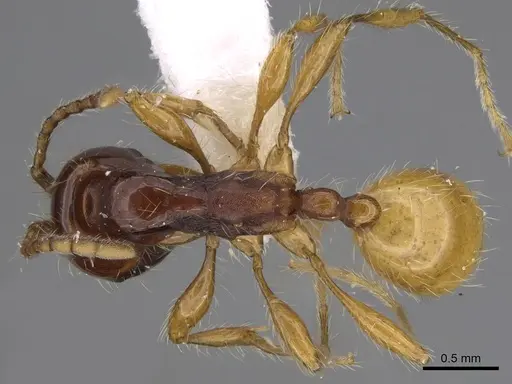
CASENT0840003
View on AntWeb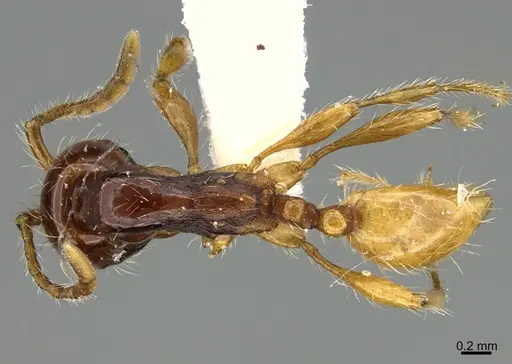
Literature
Loading distribution map...Loading products...