
Aenictus formosensis
- Sci. Name
- Aenictus formosensis
- Subfamily
- Dorylinae
- Author
- Forel, 1913
- Distribution
- Found in 0 countries
Introduction
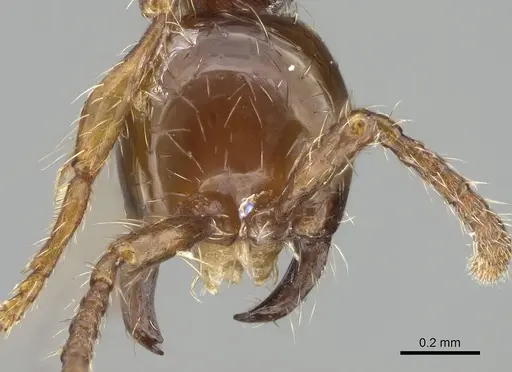
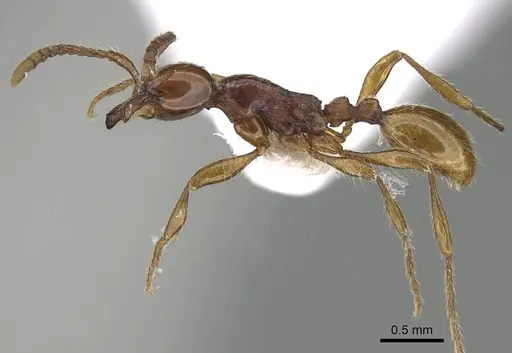
Aenictus formosensis is a tiny army ant found in Taiwan and eastern China. Workers measure 2.05-2.95 mm in total length and have a reddish-brown head and body with a lighter yellowish-brown gaster . You can recognize them by their four-toothed mandibles and a distinct rectangular subpetiolar process - the little plate underneath the waist segment . They closely resemble Aenictus ceylonicus but differ in having four mandible teeth instead of three and a more developed subpetiolar process . These ants live in lowland secondary forests and mixed evergreen broad-leaved woodland, where collectors have found them in pitfall traps on the forest floor . As an army ant in the subfamily Dorylinae, they likely live as nomadic predators with frequent colony movements, though specific behavior remains unstudied for this species. Only workers have ever been collected - no queens or males have been documented, which is typical for many army ant species that reproduce by colony fission . This makes them extremely challenging, if not impossible, to maintain using standard ant-keeping methods.
Quick Summary
- Difficulty: Expert
- Origin & Habitat: Taiwan and Zhejiang Province, China, found in lowland secondary forest and mixed evergreen broad-leaved forest at approximately 413m elevation [1][2]
- Colony Type: Unknown, only worker caste documented [3]
- Size & Growth:
- Antkeeping:
- Temperature: Likely 20-25°C based on subtropical forest habitat, but specific requirements unconfirmed [1][2]
- Humidity: Likely high humidity based on forest floor habitat, but specific requirements unconfirmed [1]
- Diapause: Probably not required, subtropical distribution with mild winters, but specific requirements unconfirmed
- Nesting: Army ants do not build permanent nests. They require extremely large enclosures with soil for temporary bivouacs. Standard formicaria and test tubes are unsuitable.
- Behavior: Raiding predators that forage in groups. Highly active with potentially large foraging ranges. Workers are tiny (under 3mm) and can escape through minute gaps [1].
- Common Issues: extreme difficulty meeting the space and food requirements of army ants in captivity., tiny worker size (under 3mm) allows escapes through the smallest gaps in mesh or lids., continuous predatory food requirements difficult to sustain without constant supply of live prey., unknown colony reproduction method makes it impossible to start or maintain colonies through standard queen founding.
How to Identify Aenictus formosensis
Aenictus formosensis belongs to the Aenictus ceylonicus species group and looks very similar to its relatives. You can tell it apart from Aenictus ceylonicus by counting the teeth on the mandibles: A. formosensis has four teeth while A. ceylonicus has only three [1]. Also look at the subpetiolar process, the little plate underneath the petiole. In A. formosensis this is well-developed and rectangular with sharp corners, whereas in A. ceylonicus it is weakly developed [1]. The postpetiole (the second waist segment) is almost as long as it is high in A. formosensis, but very short in A. ceylonicus [1]. Workers are small, measuring 2.05-2.95 mm in total length, with smooth shiny bodies and relatively dense standing hairs on the head and thorax [1].
Natural History and Army Ant Lifestyle
Aenictus formosensis is an army ant in the subfamily Dorylinae, which means they likely live as nomadic predators. Army ants do not build permanent nests like other ants. Instead, they form temporary living structures called bivouacs using their own bodies and any available debris [3]. Colonies probably move frequently to exploit new foraging areas and prey sources. Only worker ants have ever been found for this species, no winged queens or males have been documented [3]. This suggests colonies reproduce by colony fission, where a large colony splits into two or more daughter colonies, rather than through single queens founding new nests after mating flights.
Why These Ants Are Not Suitable for Standard Ant Keeping
You should know that Aenictus formosensis presents extreme challenges for captive keeping. As army ants, they require vast foraging areas far larger than any standard formicarium or ant farm can provide. They need a constant supply of live prey to support their predatory lifestyle, and they do not use permanent nest chambers that you can observe [3]. Their small size means they can escape through gaps that would contain much larger ants. Additionally, since no queens have ever been documented, we do not know how colonies reproduce or how to start a colony in captivity. These factors make them unsuitable for beginners and extremely difficult even for experts.
Housing Requirements
If you attempt to keep these ants, you must provide an enormous enclosure, think large terrariums or modified aquariums rather than standard formicaria. They need deep substrate for bivouac formation and extensive open areas for raiding. Test tubes are completely unsuitable. The enclosure needs excellent escape prevention using fine mesh (fine enough to stop 2mm ants) and barriers like Fluon or talcum powder on vertical surfaces. Maintain high humidity by keeping the substrate damp but not waterlogged, mimicking the moist forest floor where they naturally occur [1].
Temperature and Environment
Based on their collection from lowland forests in Taiwan and Zhejiang at around 413m elevation, these ants likely prefer moderate temperatures around 20-25°C [1][2]. Start at 20-22°C and observe activity levels. They probably do not require hibernation given their subtropical distribution, but this remains unconfirmed. Keep humidity high by using damp substrate and limiting ventilation to prevent drying, while ensuring some air exchange to prevent mold.
Frequently Asked Questions
Can I keep Aenictus formosensis in a test tube?
No. Test tubes are completely unsuitable for army ants. They require large enclosures with extensive foraging areas and substrate for bivouac formation. Their nomadic behavior and space requirements make standard test tube setups impossible.
How long does Aenictus formosensis take from egg to worker?
The egg-to-worker timeline is unknown for this species. Army ant development timelines are generally longer than many other ants, but without specific research or documented captive rearing, we cannot provide an estimate.
What do Aenictus formosensis eat?
As army ants, they are specialized predators that hunt other insects and arthropods. In captivity, they would require a constant supply of live prey such as termites, small crickets, or other insects. They do not accept dead insects or sugar water reliably.
Can I keep multiple Aenictus formosensis queens together?
This question cannot be answered because queens have never been documented for this species. Army ants typically have one queen per colony or reproduce by colony fission, but specific colony structure for A. formosensis remains unknown.
Do Aenictus formosensis need hibernation?
Probably not. They come from subtropical Taiwan and eastern China where winters are mild. However, specific diapause requirements are unconfirmed.
Why are my Aenictus formosensis dying?
This species is extremely difficult to maintain in captivity. Common causes of failure include insufficient space for foraging, lack of continuous live prey, escapes due to their small size, or incorrect humidity levels. Most keepers cannot provide the specialized conditions army ants require.
Are Aenictus formosensis good for beginners?
No. These are expert-level ants, if they can be kept in captivity at all. Their space requirements, dietary needs, and unknown biology make them unsuitable for anyone except researchers with specialized facilities.
How do I tell Aenictus formosensis apart from Aenictus ceylonicus?
Count the mandible teeth: A. formosensis has four teeth including the apical tooth, while A. ceylonicus has only three. Also check the subpetiolar process, it is rectangular and well-developed in A. formosensis but weak in A. ceylonicus [1].
Where does Aenictus formosensis live in the wild?
They inhabit lowland secondary forests and mixed evergreen broad-leaved forests in Taiwan and Zhejiang Province, China, typically found in pitfall traps on the forest floor [1][2].
Report an Issue
The current care sheet is based fully on literature. See inconsistencies, or something that's incorrect? Please , it will be resolved after review from an admin. Contributing to the blogs tab also helps providing information, to make us be able to further improve the caresheets. Thank you for your support!
References

This caresheet is licensed under CC BY-SA 4.0 .
Community Blogs
CASENT0914928
View on AntWeb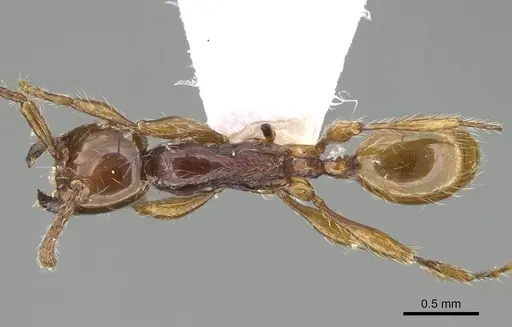
Literature
Loading distribution map...Loading products...