
Adelomyrmex hirsutus
- Sci. Name
- Adelomyrmex hirsutus
- Tribe
- Solenopsidini
- Subfamily
- Myrmicinae
- Author
- Mann, 1921
- Distribution
- Found in 3 countries
Introduction
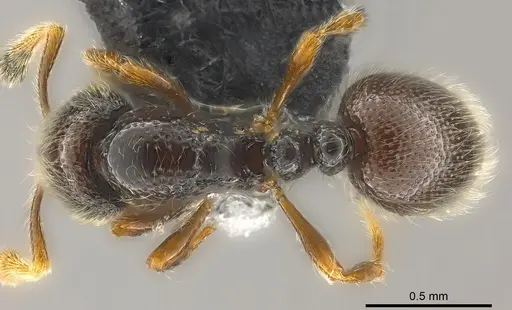
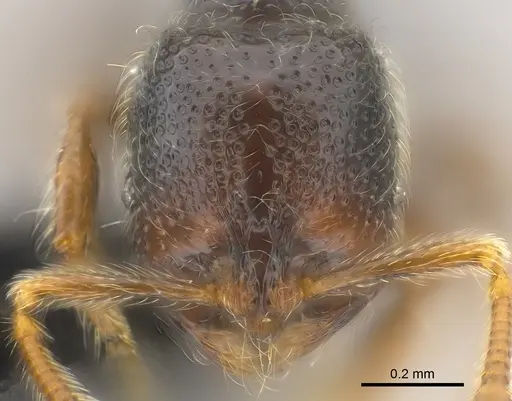
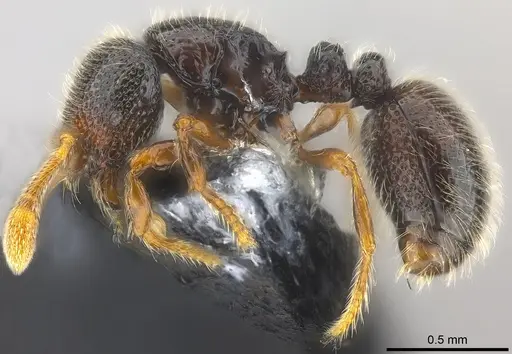
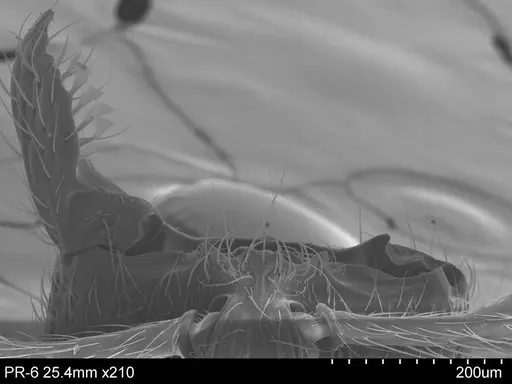
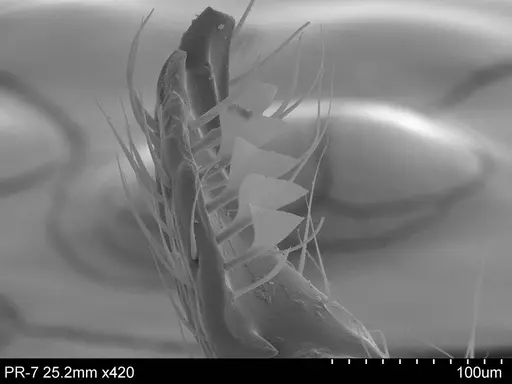
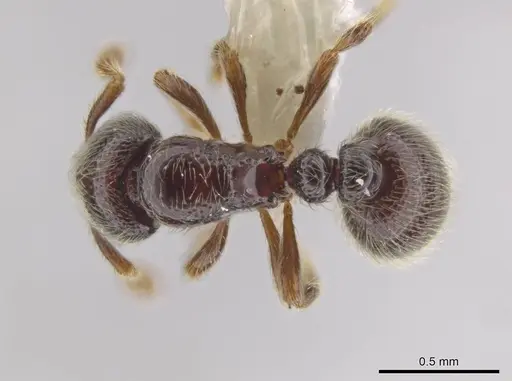
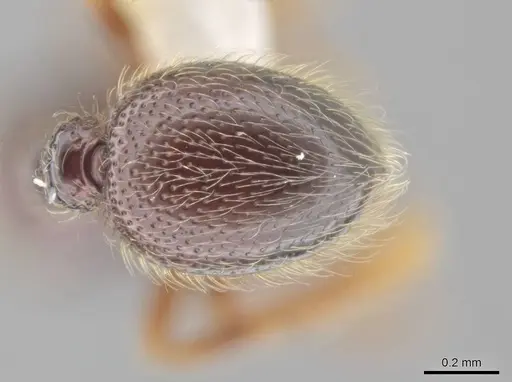
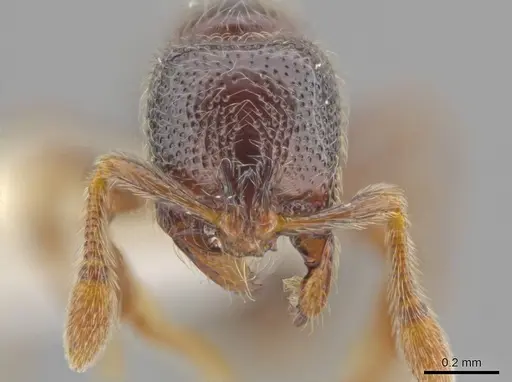
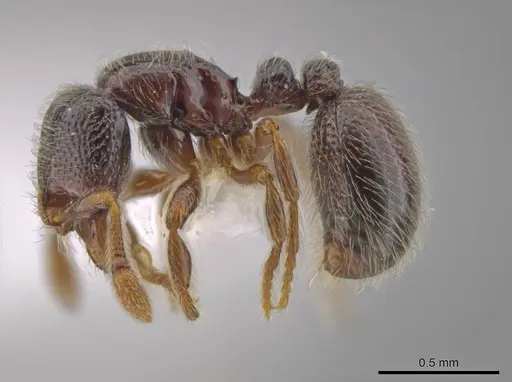
Adelomyrmex hirsutus are tiny ants measuring 2.36 mm in total length . They have dark shiny bodies with wide, well-defined pits (foveae) evenly distributed across the head and gaster . Their eyes are reduced to dark spots, leaving them essentially blind . The body is light brown with yellowish-brown legs, and they have abundant white hairs covering their head, body, and legs . These ants are endemic to Fiji, found on islands including Vanua Levu, Viti Levu, Koro, and Moala . They live underground in leaf litter and under stones, making them cryptic and rarely seen .
Quick Summary
- Difficulty: Expert
- Origin & Habitat: Fiji Islands (Vanua Levu, Viti Levu, Koro, Moala), found in sifted leaf litter and under stones in tropical forests [2][4].
- Colony Type: Unknown, colony structure and queen number have not been documented in available research.
- Size & Growth:
- Queen: Unknown, queens have not been described in available literature.
- Worker: 2.36 mm total length [1].
- Colony: Unknown, likely small based on body size, but no colony counts exist.
- Growth: Unknown, no growth rate data available.
- Development: Unknown, no developmental studies exist for this species. (No data available.)
- Antkeeping:
- Temperature: Warm and stable, approximately 24-26°C, inferred from tropical Fiji habitat. Avoid cool temperatures below 20°C.
- Humidity: High humidity required, keep substrate damp but not waterlogged, similar to the forest floor conditions where they live in sifted litter [2].
- Diapause: No, tropical species from Fiji does not require winter hibernation [2].
- Nesting: Naturalistic setup with soil and leaf litter layers, or small plaster nest with tight chambers. They are underground-dwelling (hypogaeic) and require darkness [2].
- Behavior: Cryptic and slow-moving. Being essentially blind (eyes reduced to dark spots), they rely entirely on touch and chemical trails to navigate [1][2]. Not aggressive toward humans due to tiny size, but escape risk is extreme, at 2.36 mm long they can squeeze through microscopic gaps [1].
- Common Issues: escape prevention is critical, at 2.36 mm long, they can squeeze through gaps invisible to the naked eye., desiccation risk, being from damp leaf litter, they dry out quickly without consistently moist substrate., feeding difficulties, their tiny size makes it challenging to provide appropriately small live prey like springtails or soil mites., lack of captive data, no documented successful captive breeding exists, meaning care requirements are largely speculative., conservation concerns, endemic to Fiji, so wild collection should be avoided to protect native populations.
Natural History and Habitat
Adelomyrmex hirsutus lives exclusively in the Fiji Islands, where it inhabits the forest floor microhabitat [2][4]. All recent collections have come from sifted leaf litter, confirming they are hypogaeic, meaning they live underground or deep within decomposing plant material rather than on the surface [2]. The original specimen was found beneath a stone, suggesting they also nest under flat rocks in the soil [2]. Their eyes are reduced to tiny dark spots, an adaptation to permanent darkness that means they navigate entirely by touch and chemical signals [1]. This blindness makes them dependent on high humidity and stable substrate conditions, they cannot forage visually and rely on stumbling into prey or following scent trails in their confined underground world.
Housing and Escape Prevention
At just 2.36 mm long, these ants present extreme escape risks that make housing challenging [1]. Standard barriers like Fluon may be insufficient, you need fine mesh barriers for ventilation, and every seam must be sealed with silicone or epoxy. A naturalistic setup works best: a small container with several centimeters of sterilized soil mixed with leaf litter, kept consistently damp but not muddy [2]. Provide flat stones or bark pieces on the soil surface to mimic their natural under-stone habitat. If using an artificial nest, choose plaster or Y-tong with very small chambers rather than large open spaces. Keep the setup in dim light or darkness, being blind, bright light stresses them unnecessarily.
Feeding and Diet
No direct dietary studies exist for this species, but based on their litter-dwelling habits and tiny size, they likely prey on micro-arthropods like springtails, mites, and tiny insect larvae found in soil [2]. Offer small live prey such as springtails or minute soil mites. Prey should be small enough for 2.36 mm workers to subdue, larger prey may be ignored or rot. They may also accept crushed insects or protein sources placed directly on the substrate. Sugar sources like honey or sugar water are worth offering, but acceptance is uncertain given their cryptic nature. Feed small amounts frequently rather than large meals that could mold in the humid environment they require.
Temperature and Humidity
Coming from tropical Fiji, these ants need warm, stable conditions year-round [2]. Keep them at approximately 24-26°C with minimal fluctuation. They do not require hibernation, being from an equatorial region, they experience little seasonal temperature change [2]. Humidity is critical: the substrate should feel damp to the touch at all times, similar to the forest floor litter where they naturally occur [2]. Use a water reservoir beneath the substrate or frequent misting to maintain moisture, but ensure ventilation prevents stagnant air and mold.
The Challenge of Captive Care
Adelomyrmex hirsutus represents an expert-level challenge due to multiple factors. First, queens have never been described in the available literature, we do not know if they are winged, wingless, or even what they look like, making founding attempts impossible [1][2]. Second, their microscopic size means standard ant-keeping equipment is often unsuitable, test tubes are too large, barriers are ineffective, and even water droplets can be drowning hazards. Third, their specialized leaf-litter habitat is hard to replicate in captivity without creating mold issues. Finally, as an endemic Fiji species, ethical concerns about wild collection apply, removing colonies from their limited native range impacts local populations. Successful captive care would likely require collecting entire soil sections with established colonies and maintaining them in specialized naturalistic setups.
Frequently Asked Questions
Can I keep Adelomyrmex hirsutus in a test tube?
No, test tubes are too large and open for these 2.36 mm ants [1]. They need small, enclosed spaces with soil or plaster substrates that mimic their underground leaf-litter habitat [2].
What is the egg to worker timeline for Adelomyrmex hirsutus?
Unknown, no developmental studies exist for this species.
How do I prevent escapes with Adelomyrmex hirsutus?
Use fine mesh barriers and seal all seams with silicone. At 2.36 mm long, they fit through gaps invisible to the naked eye [1]. Standard Fluon may be insufficient.
Do Adelomyrmex hirsutus ants sting?
They belong to the Myrmicinae subfamily which typically have a stinger, but at 2.36 mm total length it would be too small to effectively penetrate human skin [1].
Are Adelomyrmex hirsutus good for beginners?
No, they are expert-level ants due to their tiny size, unknown founding behavior, lack of captive breeding data, and specialized habitat requirements [1][2].
What do Adelomyrmex hirsutus eat?
Likely small soil arthropods like springtails and mites based on their leaf-litter habitat [2]. Offer tiny live prey or crushed insects, but acceptance of sugar water is uncertain.
Do Adelomyrmex hirsutus need hibernation?
No, they are from tropical Fiji and do not experience cold seasons [2]. Keep them warm year-round at 24-26°C.
How big do Adelomyrmex hirsutus colonies get?
Unknown, no colony size estimates exist in the literature.
Can I keep multiple Adelomyrmex hirsutus queens together?
Unknown, colony structure is unconfirmed. Combining unrelated queens is not recommended without evidence of polygyny in this species.
Where can I buy Adelomyrmex hirsutus?
You likely cannot, they are endemic to Fiji and rarely collected [4]. Wild collection is discouraged due to their limited range. They are virtually unavailable in the ant-keeping trade.
Report an Issue
The current care sheet is based fully on literature. See inconsistencies, or something that's incorrect? Please , it will be resolved after review from an admin. Contributing to the blogs tab also helps providing information, to make us be able to further improve the caresheets. Thank you for your support!
References

This caresheet is licensed under CC BY-SA 4.0 .
Community Blogs
Literature
Loading distribution map...Loading products...