
Acanthomyrmex glabfemoralis
- Sci. Name
- Acanthomyrmex glabfemoralis
- Tribe
- Crematogastrini
- Subfamily
- Myrmicinae
- Author
- Zhou & Zheng, 1997
- Distribution
- Found in 1 countries
Introduction
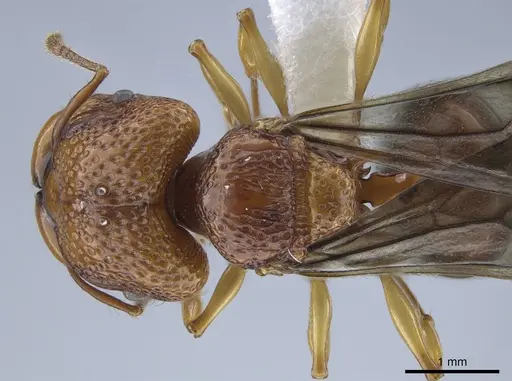
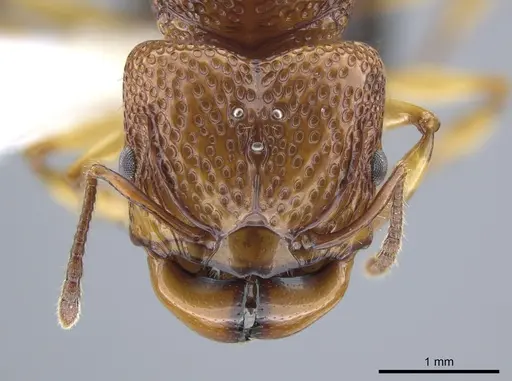
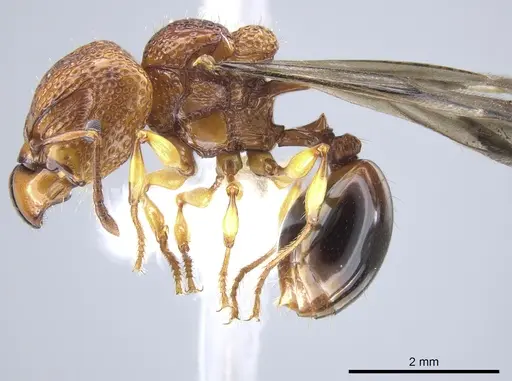
Acanthomyrmex glabfemoralis is a dimorphic ant from the forests of Vietnam and southern China. Majors sport massive, blocky heads nearly as wide as their entire body, while minors are slender with proportionally sized heads. These ants nest in rotting twigs, under stones, and in wood cavities on the forest floor . What makes this species unusual is their flexible queen system: depending on where they live, colonies either have a single normal winged queen, or use one or more dwarf wingless queens (ergatoids) that resemble large workers with reduced thoraxes . They are opportunistic seed collectors, storing small seeds and even phasmid eggs in their nest chambers alongside insect prey .
Quick Summary
- Difficulty: Expert
- Origin & Habitat: Vietnam (Lao Cai, Bac Giang, Quang Ninh, Ninh Binh, Nghe An provinces) and southern China (Guangxi, Guangdong) [1][5]. Found in forest floor habitats nesting in rotting wood and under stones at elevations around 900-1500 meters [4][1].
- Colony Type: Variable structure, either single normal queen or single/multiple dwarf ergatoid queens depending on population location [1][3].
- Size & Growth:
- Queen: Normal queens ~4-5 mm total length (inferred from genus), Dwarf queens ~3-4 mm total length (inferred from genus). Head measurements available but not suitable for body size reporting.
- Worker: Majors ~5-7 mm total length, Minors ~2-3 mm total length (both inferred from genus patterns based on head measurements) [1].
- Colony: Usually under 100 workers [3].
- Growth: Slow
- Development: Unconfirmed, development time is unknown for this species. (Small colony size suggests extended development time.)
- Antkeeping:
- Temperature: Likely 22-26°C based on tropical forest habitat, but specific requirements unconfirmed. Keep stable year-round.
- Humidity: High humidity required, keep nest substrate moist but not waterlogged, similar to rotting wood conditions [1].
- Diapause: Not required, tropical species from subtropical forests [1].
- Nesting: Small cavities in rotting wood or under stones. Use Y-tong, plaster, or naturalistic setups with small chambers and good moisture retention [1][2].
- Behavior: Short foraging range of only 0.58 meters [4]. Majors likely serve defensive roles given their huge heads and robust mandibles [4]. They store seeds and phasmid eggs in nest corners [4][1]. Minors are tiny and can escape through minute gaps.
- Common Issues: slow colony growth requires patience, colonies remain small (under 100 workers) for extended periods [3]., tiny minor workers can escape through minute gaps, use fine mesh barriers and Fluon., seed storage behavior requires providing appropriate small seeds, colonies may struggle without this natural food source [4][1]., high humidity needs increase mold risk if ventilation is poor.
Queen Polymorphism and Colony Structure
Acanthomyrmex glabfemoralis shows remarkable geographic variation in its reproductive strategy. In northern Vietnam populations (West Yen Tu, Chua Yen Tu, Ky Thuong, Cuc Phuong, and Pu Mat), colonies have a single normal dealate queen with a full thorax and wings [1][3]. However, in Van Ban and potentially other areas, colonies contain single or multiple dwarf ergatoid queens instead [1][3]. These dwarf queens are wingless with reduced thoraxes and come in two forms: Type A resembles normal queens but wingless, while Type B has more worker-like features including increased hairiness [1]. Researchers suggest this species represents a transitional stage toward the exclusive use of ergatoid queens for reproduction, a system seen in related Acanthomyrmex species [1]. For keepers, this means you might acquire either type, but care requirements remain similar. Colonies with multiple dwarf queens may show slightly faster initial growth, but all colonies remain small, rarely exceeding 100 workers [3].
Nest Preferences and Setup
In nature, these ants nest in cavities of rotting twigs and wood fragments, in cracks between stones, and under flat stones on the forest floor [1][2]. They prefer small, enclosed spaces with high humidity. For captive colonies, use Y-tong (AAC) blocks, plaster nests, or naturalistic setups with small chambers proportional to their size. The nest material should feel damp to the touch but not waterlogged. Provide adequate ventilation to prevent mold while maintaining humidity. Because their foraging range is only about half a meter [4], they do not require large outworlds, but the outworld should have secure lids and fine mesh barriers to prevent escapes from the tiny minors.
Feeding and Diet
These ants are generalist foragers with a strong preference for seeds. They collect small seeds with edible parts like elaiosomes and store them in nest chambers [4][1]. They also gather phasmid eggs, likely consuming the capitulum (nutritious attachment) [4]. Animal matter is also taken, and workers are attracted to cheese bait [4]. In laboratory settings, colonies have been maintained for over a year on cut pieces of mealworms and cockroaches [4]. Offer a variety of small seeds (such as chia, poppy, or mustard seeds) alongside protein sources. Sugar water or honey may be accepted, but seeds appear important for their natural behavior and should not be omitted.
Temperature and Seasonal Care
Coming from subtropical and tropical forests in Vietnam and southern China, these ants prefer warm, stable conditions [1][4]. Keep them at approximately 22-26°C year-round. They do not require hibernation (diapause), though they may benefit from a slight temperature reduction to 18-20°C during winter months if kept in temperate climates [1]. Avoid prolonged exposure to temperatures below 15°C. Use a heating cable on one side of the nest to create a gentle gradient, allowing the ants to self-regulate.
Behavior and Temperament
Acanthomyrmex glabfemoralis shows limited foraging behavior, with workers traveling only about 0.58 meters from the nest [4]. The majors with their massive heads and robust, nearly toothless mandibles likely serve as soldiers for colony defense and possibly for processing hard seeds [4][1]. They are not particularly aggressive but majors can deliver a noticeable bite. The minors are extremely small and can squeeze through tiny gaps, making escape prevention critical. They are primarily diurnal and active during warmer parts of the day.
Frequently Asked Questions
Can I keep Acanthomyrmex glabfemoralis in a test tube?
Yes, test tubes work well for founding colonies or small established colonies. Provide a water reservoir blocked with cotton, and ensure the tube is kept in a humid environment. You should also offer small seeds in the test tube, as they naturally store seeds in their nest chambers [4][1].
How long until Acanthomyrmex glabfemoralis gets first workers?
The exact timeline is unconfirmed, development time has not been documented for this species. Expect a longer wait compared to faster-growing Myrmicinae due to their naturally small colony size.
What do Acanthomyrmex glabfemoralis eat?
They are generalists that require both seeds and protein. They store small seeds (likely with elaiosomes) in their nests and also collect phasmid eggs [4][1]. In captivity, they accept cut mealworms, cockroaches, and are attracted to cheese [4]. Offer a mix of small seeds and insect protein for best results.
Do Acanthomyrmex glabfemoralis need hibernation?
No, they do not require hibernation. They come from tropical and subtropical regions of Vietnam and China where temperatures remain mild year-round [1]. Keep them at stable room temperature or slightly warmed (22-26°C) throughout the year.
Can I keep multiple Acanthomyrmex glabfemoralis queens together?
Only if you have acquired a colony that naturally contains multiple dwarf ergatoid queens from populations like Van Ban [1][3]. Do not attempt to combine unrelated founding queens, this has not been documented and likely results in fighting. Normal winged queens found colonies alone.
How big do Acanthomyrmex glabfemoralis colonies get?
Colonies remain small, usually containing fewer than 100 workers even when mature [3]. This slow growth makes them a long-term project requiring patience.
Why are some workers so much bigger than others?
Acanthomyrmex glabfemoralis is dimorphic, meaning they have two distinct worker sizes. Majors have huge heads and robust bodies, while minors are slender with proportionally sized heads [1]. The majors likely serve as soldiers for defense and processing food.
Are Acanthomyrmex glabfemoralis good for beginners?
No, they are considered expert-level ants. They require specific care including seed provision, high humidity control, excellent escape prevention for the tiny minors, and patience due to their slow growth and small colony size [3][4].
Do Acanthomyrmex glabfemoralis sting?
They are not known to sting humans. The majors can bite with their strong mandibles, but they are not aggressive and pose no significant danger to humans [4][1].
How do I identify an Acanthomyrmex glabfemoralis queen?
You may encounter two types: Normal queens look like typical ant queens with large thoraxes and wing scars. Dwarf queens (ergatoids) are wingless with reduced thoraxes and look like large workers, sometimes with more hair like workers [1]. Both types can head colonies depending on their origin.
Report an Issue
The current care sheet is based fully on literature. See inconsistencies, or something that's incorrect? Please , it will be resolved after review from an admin. Contributing to the blogs tab also helps providing information, to make us be able to further improve the caresheets. Thank you for your support!
References

This caresheet is licensed under CC BY-SA 4.0 .
Community Blogs
CASENT0651302
View on AntWeb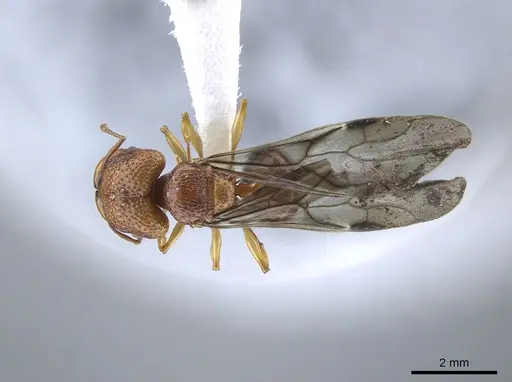
Literature
Loading distribution map...Loading products...