
Acanthomyrmex dusun
- Sci. Name
- Acanthomyrmex dusun
- Tribe
- Crematogastrini
- Subfamily
- Myrmicinae
- Author
- Wheeler, 1919
- Distribution
- Found in 1 countries
Introduction
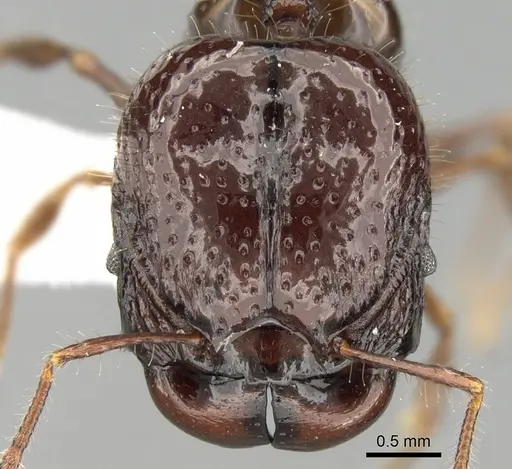
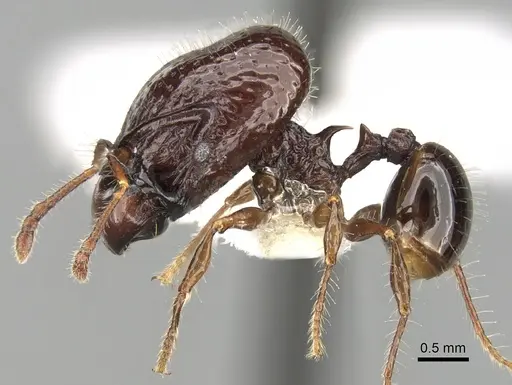
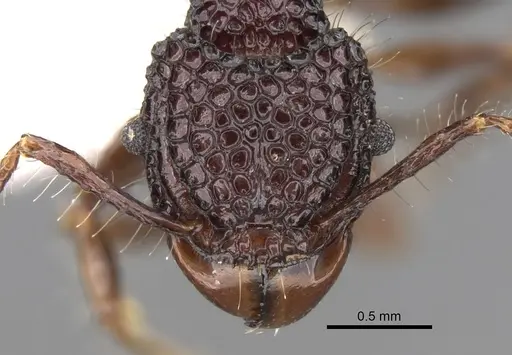
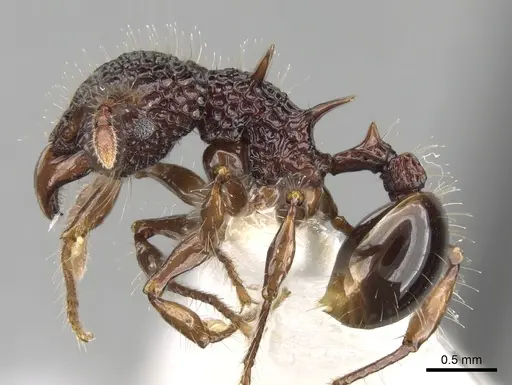
Acanthomyrmex dusun is a tiny orange-yellow ant found only on the island of Borneo in Sarawak, Malaysia. Major workers have noticeably large heads, short downward-curving spines on their backs, and a distinct hollow on top of the head . The species was originally collected from submontane forest on Mount Matang . This species remains largely a mystery to science. Researchers have only described the major workers, the minor workers, queens, and males have never been documented . Based on its close relative Acanthomyrmex careoscrobis, colonies likely stay small with fewer than 100 workers and may have wingless, worker-like queens (ergatoid queens) nesting in twigs or under stones . They appear extremely rare in the wild, with just one individual recorded in extensive ground surveys of Bornean forests .
Quick Summary
- Difficulty: Expert
- Origin & Habitat: Borneo (Sarawak, Malaysia), submontane forests [2][1]
- Colony Type: Unknown, likely small single-queen colonies with ergatoid (wingless) queens based on related species [3]
- Size & Growth:
- Queen: Size data unavailable, ergatoid queens are worker-sized based on related species [3]
- Worker: Size data unavailable, major workers described but total body length not measured [1]
- Colony: Likely under 100 workers based on related species [3]
- Growth: Unknown
- Development: Unknown (No development data exists for this species)
- Antkeeping:
- Behavior: Unknown, majors have large heads typical of seed-processing or defense in this genus
- Common Issues: species is virtually unknown in captivity with no documented care records., only major workers described, colony composition and care requirements unconfirmed., extremely rare in nature with limited collection data available., tiny size creates high escape risk if housed.
Scientific Mystery and Rarity
Acanthomyrmex dusun represents one of the many ant species known only from a handful of specimens. The original description by Wheeler in 1919 came from a single major worker collected on Mount Matang in Sarawak [1]. Moffett redescribed this major worker in 1986,confirming its orange-yellow coloration and distinctive head shape with a well-developed hollow on top [1].
No minor workers have ever been described for this species. In most Acanthomyrmex species, majors act as soldiers or food processors while smaller minors handle foraging and nursing. The complete absence of minor worker descriptions suggests either extreme rarity or possibly that minors are genuinely absent or extremely specialized [1].
In forest surveys conducted in Bornean dipterocarp forests, researchers encountered this species only once despite extensive daytime ground sampling [4]. This extreme rarity makes the species effectively unavailable to antkeepers and means captive care has never been documented.
Natural Nest Preferences
While Acanthomyrmex dusun itself has no documented nest records, its close relative Acanthomyrmex careoscrobis nests in small cavities in dead twigs, rotten wood, under stones, and in leaf litter on the forest floor [3]. These ants prefer tight, enclosed spaces with access to high humidity.
If keeping this species hypothetically, you would want a small naturalistic setup with twigs, small stones, and moist substrate to mimic these microhabitats. The nest chamber should be tiny, these are small ants that live in small colonies.
Morphology and the Major Worker
The only known caste of Acanthomyrmex dusun is the major worker. These majors show classic Acanthomyrmex traits: enlarged heads, short cylindrical spines on the back of the thorax that curve downward, and a distinct hollow on the top of the head with a groove running down the face [1][2].
The head surface shows scattered small pits, with larger pits near the antenna grooves. The face plate (clypeus) has a noticeable forward projection. The color is orange-yellow throughout [1].
Housing and Practical Considerations
Given the complete lack of captive breeding success, any housing advice is theoretical. Based on the species' tiny size and inferred biology, you would need an extremely secure setup. These ants can squeeze through gaps that stop larger species.
A test tube setup with a very fine mesh cover might work initially, though the lack of knowledge about founding behavior means you would not know if a queen needs to forage or seal herself in. Temperature should match Bornean conditions, warm and stable around 24-26°C with high humidity. Feeding would likely involve tiny seeds as seen in related species and small insects, but this is speculation. [3]
Frequently Asked Questions
Can I keep Acanthomyrmex dusun as a pet?
Effectively no. This species is known from only a handful of specimens collected in Borneo and has never been kept in captivity. They are not available in the ant trade, and their extreme rarity means they should remain in their natural habitat for scientific study.
How big do Acanthomyrmex dusun colonies get?
Unknown for this specific species. Based on the related Acanthomyrmex careoscrobis, colonies likely remain small with fewer than 100 workers [3].
What do Acanthomyrmex dusun eat?
Unknown. Related species in the genus collect tiny seeds and likely hunt small insects [3], but the specific diet of Acanthomyrmex dusun has never been observed.
Do Acanthomyrmex dusun need hibernation?
No. They come from tropical Borneo where temperatures remain warm year-round, so they do not require a winter rest period.
Are Acanthomyrmex dusun good for beginners?
No. This species is unsuitable for beginners due to extreme rarity, unknown biology, and tiny size requiring expert-level micro setups.
How long until Acanthomyrmex dusun get their first workers?
Unknown. The development timeline from egg to worker has never been documented for this species.
Can I keep multiple Acanthomyrmex dusun queens together?
Unknown. Combining multiple queens has not been studied in this species. Based on related species that likely have single wingless queens, multiple queens would probably not be tolerated [3].
Where do Acanthomyrmex dusun live in the wild?
They live in submontane forests on Mount Matang in Sarawak, Borneo [2][1].
Report an Issue
The current care sheet is based fully on literature. See inconsistencies, or something that's incorrect? Please , it will be resolved after review from an admin. Contributing to the blogs tab also helps providing information, to make us be able to further improve the caresheets. Thank you for your support!
References

This caresheet is licensed under CC BY-SA 4.0 .
Community Blogs
CASENT0281793
View on AntWeb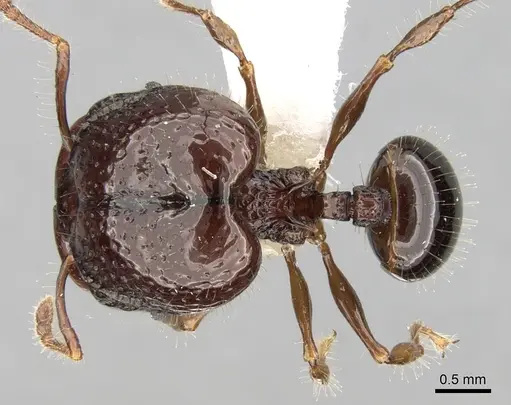
CASENT0281794
View on AntWeb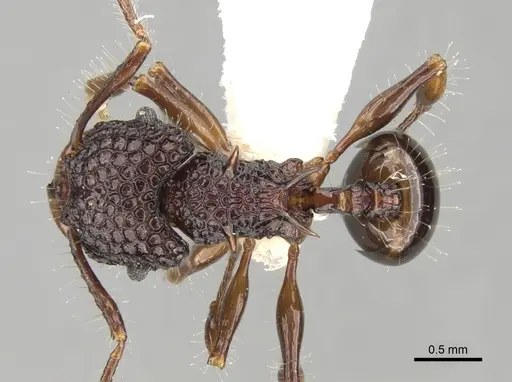
Literature
Loading distribution map...Loading products...