
Vombisidris philippina
- Wiss. Name
- Vombisidris philippina
- Tribus
- Crematogastrini
- Unterfamilie
- Myrmicinae
- Autor
- Zettel & Sorger, 2010
- Verbreitung
- In 0 Ländern gefunden
Einleitung
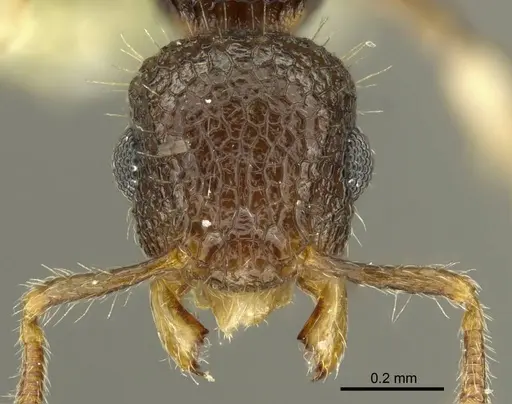
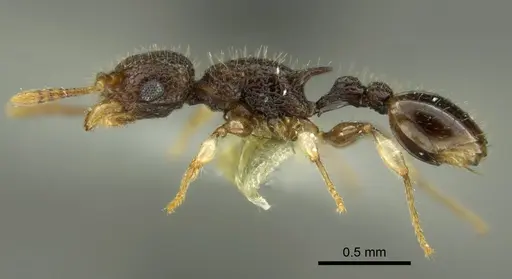
Vombisidris philippina is a tiny myrmicine ant. Workers measure 2.8-2.9mm in total length, making it one of the smallest species in its genus . They have a blackish-brown body, bright yellow mandibles, and yellowish-brown leg segments. The eyes are large and strongly protruding, and the antennae and legs are relatively short - all features of the V. australis species group . This ant is only known from the Philippines, on the islands of Luzon, Cebu, and Negros . Its biology is completely unknown: only single workers have ever been collected, and no colonies, queens, or males have been found . Available evidence suggests it lives mostly or entirely in trees (subarboreal to arboreal) .
Quick Summary
- Difficulty: Expert
- Origin & Habitat: Philippines (Luzon, Cebu, Negros islands), tropical forest environments, near creeks and waterfalls, likely subarboreal to arboreal [1]
- Colony Type: Unknown, only worker caste has been collected, colony structure unconfirmed
- Size & Growth:
- Queen: Unknown, queen caste not yet described
- Worker: 2.8-2.9 mm [1]
- Colony: Unknown, no colonies have been documented
- Growth: Unknown
- Development: Unknown, no breeding or development data exists for this species (Development timeline is unknown. Do not rely on estimates, there is no published data.)
- Antkeeping:
- Temperature: Keep at 24-28°C, this is a tropical species from the Philippines. If room temperature falls below this range, use a heating element on one side of the nest to create a gradient.
- Humidity: Keep the nest substrate consistently damp but not waterlogged. Mist the outworld regularly to maintain moisture. Good ventilation is important to prevent mold.
- Diapause: No, this tropical species does not need winter cooling. Keep at stable warm temperatures all year.
- Nesting: Use an arboreal-style setup, these ants are subarboreal to arboreal. A Y-tong (AAC), plaster, or 3D-printed nest with narrow chambers works well. Provide climbing structures and vertical space in the outworld.
- Behavior: Behavior is unstudied. Based on their large eyes, they may rely on vision for foraging. Like other Crematogastrini, they likely use a smearing venom defense (flat, spatulate stinger). Escape prevention is critical due to their tiny size, use fine mesh. Aggression levels are unknown, but small forest ants are usually moderate.
- Common Issues: biology is completely unknown, keepers must experiment with care conditions, no established husbandry guidelines exist, this is a true specialist species, tiny size makes escape prevention challenging, only known from workers, obtaining a colony may be difficult, tropical requirements mean no diapause tolerance
Why This Species Is Challenging
Vombisidris philippina is one of the most challenging ants to keep because absolutely nothing is known about its wild biology or captive needs. This species has only ever been collected as single workers, no colonies, no queens, no males, and no observed behaviors have ever been documented [1]. There are no established care guidelines, no known feeding preferences, and no information about colony development or social structure. You are essentially pioneering the husbandry of a species that has never been studied. This makes V. philippina an expert-level species suitable only for experienced antkeepers who enjoy careful experimentation.
Natural History and Distribution
This ant is endemic to the Philippines, known only from three islands: Luzon, Cebu, and Negros [1][2]. The type specimens were collected from degraded forest near creeks and waterfalls, at elevations from near sea level to around 800m [1]. Being in the V. australis species group, it shares a complete groove under the eye and relatively short antennae and legs [1]. The large, protruding eyes (containing 9-10 lenses in each eye) suggest this species may rely heavily on vision, possibly being active during daylight in the forest canopy [1].
Housing and Nest Setup
Since this species is subarboreal to arboreal, set up an arboreal-style enclosure. A Y-tong (AAC), plaster, or 3D-printed nest with narrow chambers works well for their tiny size. The outworld should include climbing structures like twigs, cork, or artificial plants. Use excellent escape prevention, at 2.8-2.9mm, these ants can slip through tiny gaps. Fine mesh on all ventilation holes is essential. Provide a constant water source via a test tube with cotton. Because their biology is unknown, consider trying multiple nest setups to see what works. [1]
Temperature and Humidity
As a tropical species from the Philippines, V. philippina needs warm, humid conditions. Keep the nest at 24-28°C. If your room is cooler, use a heating cable on one side to create a gentle temperature gradient. For humidity, keep the nest substrate consistently damp but not waterlogged. Mist the outworld occasionally to maintain moisture. The natural habitat near creeks suggests they prefer damp conditions. Avoid both drying out and stagnant air, good ventilation is key. [1]
Feeding and Diet
Feeding preferences are completely unknown. Based on typical Myrmicinae ants, they likely accept a standard diet: sugar sources (honey water, sugar water) and protein (small insects like fruit flies, pinhead crickets, springtails). Given their tiny size, offer appropriately small prey. Start with both sugar and protein and observe what gets consumed. Provide a constant sugar source and offer protein every few days. [1]
Growth and Development
No information exists about colony development, brood stages, or growth rates for this species. Workers measure 2.8-2.9mm, making them among the smallest Vombisidris, only V. australis (2.3-2.6mm) and V. humboldticola (2.4mm) are smaller [1]. Since no colonies have been found, we have no data on colony size, queen reproduction, or development timeline. If you obtain a colony, document everything, your observations could be the first published data on this species.
Frequently Asked Questions
Is Vombisidris philippina good for beginners?
No. This is an expert-level species because absolutely nothing is known about its biology. There are no established care guidelines, and only experienced antkeepers who enjoy experimentation should attempt it.
How do I keep Vombisidris philippina?
Since biology is unknown, start with standard tropical ant setups: keep at 24-28°C, nest substrate damp but not waterlogged. Use a Y-tong or plaster nest scaled to their tiny size. Provide a constant water source, offer sugar (honey water) and small insects for protein. Expect to experiment to find what works.
What do Vombisidris philippina ants eat?
Unknown, no feeding observations have been documented. Based on related species, they likely accept sugar sources and small insects. Start with honey water and small prey like fruit flies or springtails. Observe and adjust.
Do Vombisidris philippina ants need hibernation?
No. This is a tropical species from the Philippines that does not experience cold winters. Keep them at stable warm temperatures (24-28°C) year-round. Do not cool them.
How big do Vombisidris philippina colonies get?
Unknown, no colonies have ever been documented. Workers are tiny at 2.8-2.9mm, and based on related small Myrmicinae, colonies are likely modest in size, possibly under 100 workers, but this is speculation.
Can I keep multiple queens together?
Unknown, the queen caste has never been described for this species. We have no information about colony structure or queen behavior. Do not attempt combining unrelated queens until biology is better understood.
How long does it take for eggs to become workers?
Unknown, no development data exists. Do not rely on speculative estimates, there is no published information.
Do Vombisidris philippina ants sting?
Like all Myrmicinae, they have a functional stinger, but whether they use it defensively is unknown. Handle gently regardless.
What is the best nest type for Vombisidris philippina?
Use a Y-tong (AAC), plaster, or 3D-printed nest with narrow chambers scaled to their tiny size. Since they are subarboreal to arboreal, include climbing structures in the outworld. Ensure excellent escape prevention with fine mesh.
Where does Vombisidris philippina live in the wild?
Only in the Philippines, specifically Luzon, Cebu, and Negros islands. They have been collected in forest near creeks and waterfalls, suggesting humid, shaded microhabitats. They appear to be mostly or entirely subarboreal to arboreal [1].
Why is Vombisidris philippina so hard to find?
This species is known only from six single workers collected during biodiversity surveys at five localities [1]. No colonies have ever been found. This suggests they may have small, dispersed colonies or live in cryptic microhabitats in the forest canopy. They may also be naturally rare.
Is Vombisidris philippina aggressive?
Unknown, no behavioral observations have been documented. Based on general Myrmicinae patterns, they are likely moderate in aggression like most small forest ants. Their tiny size suggests they are more likely to flee than fight.
Report an Issue
The current care sheet is based fully on literature. See inconsistencies, or something that's incorrect? Please , it will be resolved after review from an admin. Contributing to the blogs tab also helps providing information, to make us be able to further improve the caresheets. Thank you for your support!
References

Dieses Caresheet ist lizenziert unter CC BY-SA 4.0 .
Community-Blogs
CASENT0919713
Auf AntWeb ansehen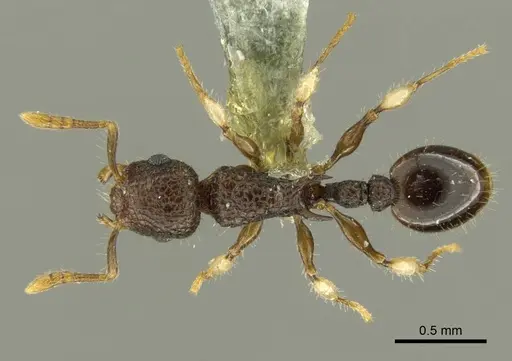
Literatur
Verbreitungskarte wird geladen...Produkte werden geladen...