
Strumigenys subnuda
- Wiss. Name
- Strumigenys subnuda
- Tribus
- Attini
- Unterfamilie
- Myrmicinae
- Autor
- MacGown & Hill, 2010
- Verbreitung
- In 0 Ländern gefunden
Einleitung
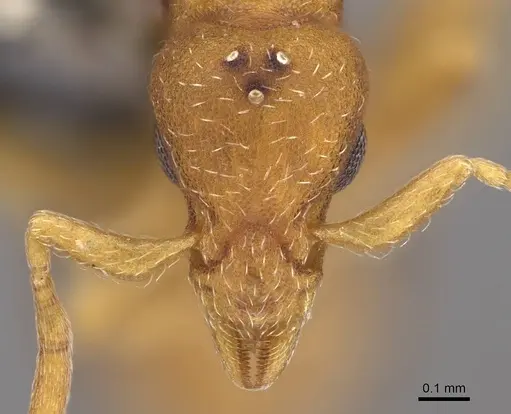
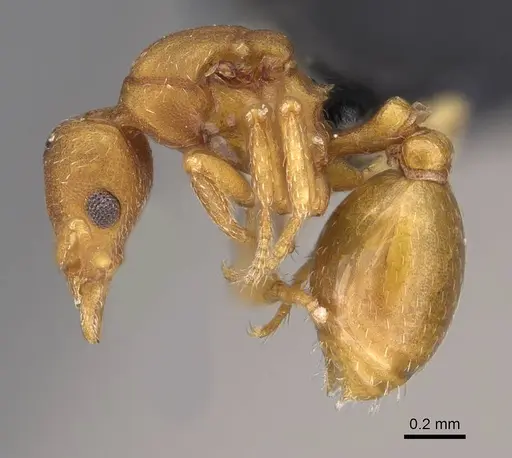
Strumigenys subnuda is an extraordinarily rare ant known only from a handful of dealate queens collected in Louisiana and Mississippi . The species is very small, but no total body length measurement has been recorded - only specific head and mesosoma measurements are available in the original description . The queen is yellowish-brown with a pyriform head and distinctive triangular mandibles bearing a unique dental pattern . The name 'subnuda' refers to its most notable feature: a general lack of spongiform appendages and scarcity of hairs, which set it apart from related species . This species is presumed to be an inquiline social parasite, likely living in the nests of its close relative Strumigenys margaritae . No workers have ever been collected, which strongly suggests it relies entirely on host workers for colony function . The entire known population consists of fewer than 10 specimens, making this one of the rarest ants in the world.
Quick Summary
- Difficulty: Expert
- Origin & Habitat: Known only from southern Mississippi and Louisiana (United States). The type specimen was collected from grass clippings piled at the base of a southern red oak (Quercus falcata) in an open area near Jeff Davis Lake, surrounded by mixed hardwood-pine forest [1][2].
- Colony Type: Presumed inquiline social parasite, no workers have ever been documented, suggesting the species may be obligately dependent on host colonies of Strumigenys margaritae [3]. Colony structure is unconfirmed.
- Size & Growth:
- Queen: Size data unavailable, no total body length measurement exists. Detailed head and mesosoma measurements are in the original description [1].
- Worker: Unknown, workers have never been collected [1]
- Colony: Unknown, no colonies have ever been found [1]
- Growth: Unknown
- Development: Unknown, no workers exist in any known collection [1] (This species may be obligately parasitic and unable to produce workers independently. The complete absence of worker specimens suggests it functions only as a reproductive parasite within host colonies.)
- Antkeeping:
- Temperature: Unknown, no captive specimens exist to establish requirements. Inferred from related tropical Strumigenys species to prefer warm, humid conditions [4].
- Humidity: Unknown, no captive data exists. Likely requires high humidity similar to other dacetine ants.
- Diapause: Unknown, no captive specimens exist to determine overwintering requirements.
- Nesting: Unknown, no nesting observations exist. As a presumed inquiline, it likely requires proximity to Strumigenys margaritae colonies.
- Behavior: Behavior is unstudied because no colonies have ever been found or maintained. The species is presumed to be a social parasite that infiltrates colonies of Strumigenys margaritae and uses host workers to raise its brood [3]. Escape risk cannot be assessed as no live specimens have been maintained.
- Common Issues: no captive specimens exist, this species has never been kept in captivity and no keeping guidance is available, workers have never been collected, suggesting the species may be obligately parasitic and unable to establish independent colonies, the type locality was destroyed by Hurricane Katrina in 2005,making additional field collection extremely difficult, the species may be extinct or nearly so in the wild, known from fewer than 10 specimens worldwide, as a presumed inquiline, it would require the presence of a host colony (Strumigenys margaritae) to survive
Rarity and Conservation Status
Strumigenys subnuda is one of the rarest ant species in the world, known from fewer than 10 specimens total. The sole collected queen (the holotype) was found in Mississippi in 2005,and eight additional alate queens were later discovered in museum collections from Louisiana [1]. The type locality was devastated by Hurricane Katrina just two weeks after the original specimen was collected, and subsequent extensive searching has failed to find any additional specimens [1][2]. The species may already be extinct in the wild, or it may exist only as a rare parasite within Strumigenys margaritae colonies that has simply evaded detection. This extreme rarity makes captive keeping essentially impossible, no specimens exist in the antkeeping hobby, and no path to acquiring this species is known.
Identification and Distinction from Related Species
Strumigenys subnuda belongs to the schultzi group, which is largely tropical with only one other species (Strumigenys margaritae) known to occur in the United States [1]. It can be distinguished from S. margaritae by several key features: its body hairs are slightly coarse to slightly clavate rather than distinctly clavate and translucent, the mesopleuron and dorsum of the petiole and postpetiole are smooth and shining rather than reticulate-punctate, the propodeal spine is much shorter, and the gaster appears shiny rather than densely striolate-punctate [1][2]. The species also differs from Strumigenys inopina (the only other North American Strumigenys lacking spongiform appendages) by having a less triangular face, a shiny mesosoma side, and reduced rather than absent spongiform tissue beneath the postpetiole [1]. The most distinctive feature is the general lack of spongiform appendages, which inspired the species name 'subnuda' meaning 'somewhat naked' in Latin [1][2].
Presumed Inquiline Biology
The most significant biological finding about Strumigenys subnuda is that it is presumed to be an inquiline social parasite, likely living within nests of Strumigenys margaritae [3]. This is based on several morphological characters it shares with other known inquilines: reduced sculpture, small or absent spongiform appendages, and simple non-expanded setae [3]. Inquiline ants are species that have lost their own worker caste and live permanently within host colonies, using host workers to raise their reproductive brood. This would explain why no workers of S. subnuda have ever been collected, they may not exist. The species may represent a case of extreme specialization where it has become entirely dependent on its host. If this is true, keeping S. subnuda would require maintaining a healthy colony of Strumigenys margaritae as a host, and establishing the parasite would be extraordinarily difficult [3].
Taxonomic Uncertainty
Strumigenys subnuda was originally described as Strumigenys subnuda in 2010 and later transferred to Strumigenys, though this combination change was noted as unpublished [1]. The species was placed provisionally in the schultzi group based on its mandibular dentition and lack of spongiform tissue on the petiole [1][2]. There is also uncertainty about whether the species is native to the Gulf Coast or represents an exotic introduction. The rest of the schultzi group is largely tropical, and many exotic ant species were collected at the type locality (including Brachymyrmex patagonicus, Solenopsis invicta, and Cyphomyrmex rimosus), raising the possibility that S. subnuda may be an introduced species [1][2]. This taxonomic and ecological uncertainty further complicates any consideration of captive keeping.
Frequently Asked Questions
Can I keep Strumigenys subnuda as a pet ant?
No. This species has never been kept in captivity and no specimens exist in the antkeeping hobby. It is known from fewer than 10 specimens worldwide, and no workers have ever been collected. As a presumed obligate social parasite, it would require a host colony of Strumigenys margaritae to survive, making captive maintenance essentially impossible.
Where can I get Strumigenys subnuda?
There is no known source. It has never been collected in sufficient numbers to establish a captive population, and the type locality was destroyed by Hurricane Katrina in 2005. The species may be extinct in the wild.
Do Strumigenys subnuda workers exist?
No workers have ever been documented. All known specimens are dealate (wingless) queens, and the complete absence of workers in extensive collecting efforts strongly suggests this species may be an obligate social parasite that has lost its worker caste entirely.
What do Strumigenys subnuda eat?
This is unknown. As a presumed inquiline, the species would rely on host workers for all foraging and feeding. No feeding observations exist.
Is Strumigenys subnuda a parasite?
Yes, it is presumed to be an inquiline social parasite, likely living in nests of Strumigenys margaritae. This is based on its reduced spongiform appendages, simplified sculpture, and the complete absence of workers, all characters associated with obligate social parasites in the dacetine ants.
How do I identify Strumigenys subnuda?
Identification requires microscopic examination of morphological characters. Key features include: yellowish-brown color, very small size (no total length recorded, but head and mesosoma measurements are available in the original description), lack of spongiform appendages on petiole and gaster, reduced spongiform tissue under postpetiole, smooth and shining mesopleuron, and short propodeal spine. Positive identification requires comparison with the original species description.
Are Strumigenys subnuda queens aggressive?
This is unknown. No live specimens have ever been observed, so no behavioral data exists. As an inquiline species, it would likely rely on chemical mimicry to integrate into the host colony rather than overt aggression.
Does Strumigenys subnuda need hibernation?
This is unknown. No captive specimens exist to test overwintering requirements. The species may be tropical in origin and unable to tolerate cold temperatures.
What is the closest species I can keep instead?
Strumigenys margaritae is the closest related species and the presumed host. It is more commonly available in the antkeeping hobby and can be kept in warm, humid conditions with small live prey. However, S. margaritae is also considered exotic in the United States and may be difficult to acquire.
Is Strumigenys subnuda endangered?
The conservation status is unknown, but the species is extremely rare with fewer than 10 known specimens. The type locality was destroyed in 2005,and no specimens have been found since. The species may be functionally extinct.
Report an Issue
The current care sheet is based fully on literature. See inconsistencies, or something that's incorrect? Please , it will be resolved after review from an admin. Contributing to the blogs tab also helps providing information, to make us be able to further improve the caresheets. Thank you for your support!
References

Dieses Caresheet ist lizenziert unter CC BY-SA 4.0 .
Community-Blogs
MEM87203
Auf AntWeb ansehen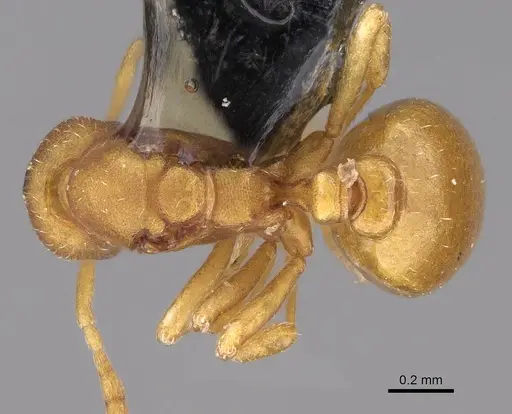
Literatur
Verbreitungskarte wird geladen...Produkte werden geladen...