
Strongylognathus potanini
- Wiss. Name
- Strongylognathus potanini
- Tribus
- Crematogastrini
- Unterfamilie
- Myrmicinae
- Autor
- Radchenko, 1995
- Verbreitung
- In 0 Ländern gefunden
Einleitung
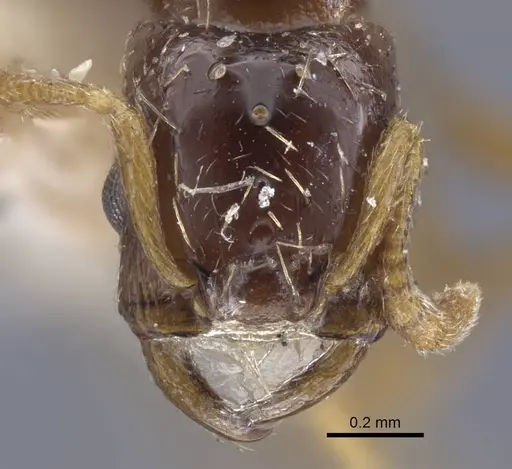
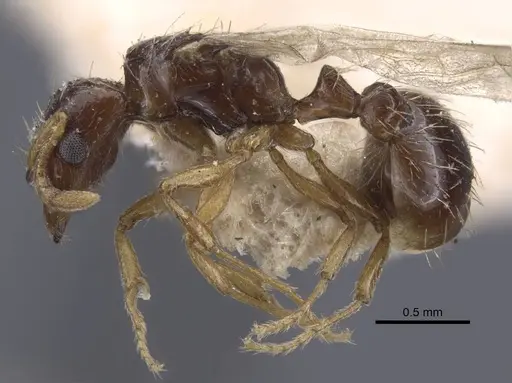
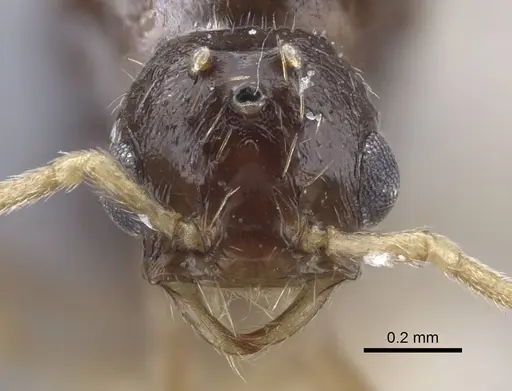
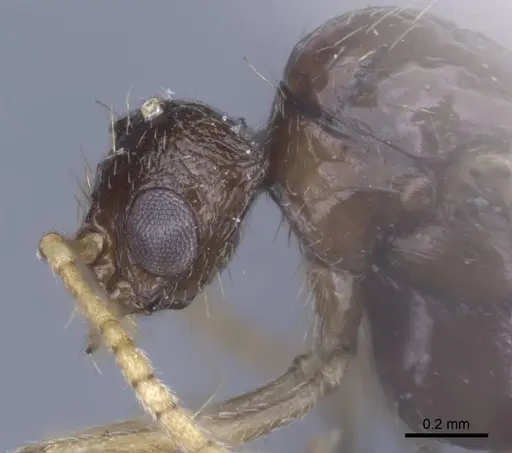
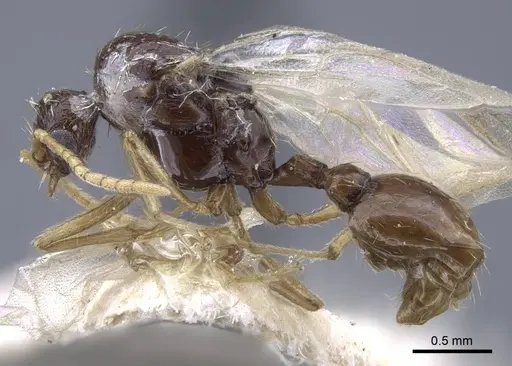
Strongylognathus potanini is a tiny slave-making ant from China, belonging to the Myrmicinae subfamily. Queens are very small, but exact total length is not documented – the only known measurements are of the head capsule (about 0.7 mm long). The species has a reddish‑brown coloration with a smooth, shining body and lacks the propodeal teeth found in many related ants . This ant is a dulotic social parasite – it depends entirely on a host species, Tetramorium tsushimae, because queens cannot start a colony on their own . This is one of the least studied ant species in existence. Almost nothing is known about its wild biology or captive behavior. The type specimens were collected in 1884,but the species was only formally described in 1995 . What is known is that it is a permanent social parasite that lives inside the host nest and relies on host workers for food and care. Belonging to the tribe Crematogastrini, it has a modified, flattened stinger used to smear venom onto enemies rather than piercing flesh – this 'smear' defense is typical of its subfamily.
Quick Summary
- Difficulty: Expert
- Origin & Habitat: China (Palaearctic region) – specifically from the area of the river Sang‑Tshang‑khe. The natural habitat is undocumented, but related species from the region typically nest in soil or under stones in temperate habitats [1][2].
- Colony Type: Dulotic (slave‑making) social parasite. The species cannot form independent colonies – it requires a host colony of Tetramorium tsushimae to survive. Queens are permanent parasites that live within the host nest [1].
- Size & Growth:
- Queen: size data unavailable (only head capsule length known, ~0.7 mm, but total length not documented) [1]
- Worker: size data unavailable – workers have never been described [1][3]
- Colony: Unknown – colony structure has never been documented
- Growth: Unknown
- Development: Unknown – development has never been studied (This species is a social parasite that depends entirely on host workers to raise its brood. The timeline would be entirely dependent on the host colony's physiology.)
- Antkeeping:
- Temperature: Unknown for this species. Based on related Tetramorium species from the region, aim for room temperature around 20–24 °C. Provide a temperature gradient so the colony can self‑regulate.
- Humidity: Unknown. Keep the nest moderately humid (50–70 %) similar to what Tetramorium tsushimae would require. The substrate should be kept slightly moist but not waterlogged.
- Diapause: Unknown. Most temperate ants from this region require a winter rest period. Based on related species, a 2–3 month diapause at 10–15 °C is likely beneficial.
- Nesting: No captive nesting data exists. In nature, they would live within the host nest (Tetramorium tsushimae). A naturalistic setup with a host colony is required – this is not a species you can keep independently.
- Behavior: This species is a dedicated social parasite and cannot survive without a host colony. Workers (if they exist) are presumed to conduct slave raids on Tetramorium colonies to capture brood, based on related dulotic species. The species is extremely rare in collections and has never been kept in captivity. Escape risk is high due to its tiny size, but keeping it directly is impossible without a host.
- Common Issues: This species cannot be kept without its host (Tetramorium tsushimae) – it is not a free‑living ant., No captive husbandry information exists – keeping this species would be entirely experimental., The host species (Tetramorium tsushimae) must be established first before introducing the parasite., Queens are permanent social parasites that cannot found colonies independently., Virtually no biological data exists – even basic information like colony size and development is unknown.
Species Overview and Identification
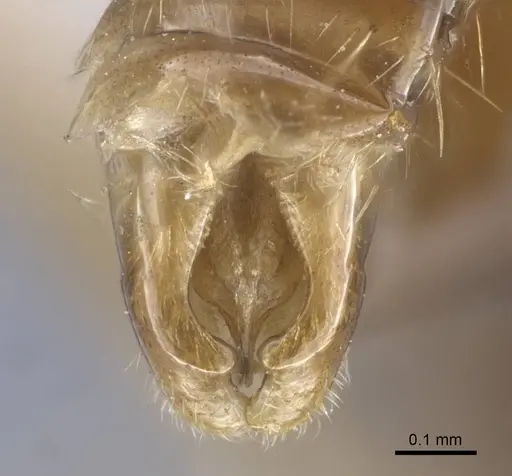
Strongylognathus potanini is a tiny dulotic ant species described by Radchenko in 1995,collected from China. It belongs to the testaceus‑group and is most closely related to Strongylognathus karawajewi [1]. Queens are very small – the only documented measurement is the head capsule (about 0.7 mm) – and have a smooth, shining reddish‑brown body. Key features are the complete absence of propodeal teeth and a flattened, pointed petiolar node [1]. Males are similarly tiny (head capsule about 0.56 mm) and have fine body sculpture that separates them from related species [1].
The type specimens were found pinned together with workers of Tetramorium tsushimae (now called Tetramorium tsushimae), which is believed to be the host species [1]. This connection is critical – Strongylognathus potanini cannot survive without its host, making it fundamentally different from typical ants that can live independently.
Biology and Social Parasitism
Strongylognathus potanini is a dulotic (slave‑making) species. It raids colonies of another ant to steal their brood, which then hatches and works for the parasite colony. This is one of the most specialized parasitic lifestyles in ants [1]. Because workers have never been described, it is unclear whether they exist or conduct raids, the assumption is based on other members of the genus.
The biology of this species is essentially unknown – no observations of wild colonies, nuptial flights, colony founding, or other basic behaviors have ever been recorded. The original type specimens were collected in 1884 but remained undescribed for over a century. What is known is limited to physical morphology and the association with its host [1]. This is a permanent social parasite – the queen lives within the host nest and is cared for by host workers. Unlike temporary social parasites (which eventually establish their own workforce), Strongylognathus potanini likely relies entirely on host workers throughout its life [1].
As a member of the Crematogastrini tribe, it uses a 'smear' defense: a modified, spatulate stinger that wipes venom onto enemies instead of piercing them.
Housing and Captive Care
There is no established husbandry guidance for this species – it has never been kept in captivity by antkeepers. This is not a species you can simply collect and house like typical ants. To keep Strongylognathus potanini, you must first establish a healthy colony of its host species (Tetramorium tsushimae), then introduce the parasite queen.
Even if you obtain queens, introducing a social parasite to a host colony is complex and often fails. The host colony may reject the intruder, and the parasite queen must be accepted by host workers to survive. This level of difficulty puts this species firmly in the expert‑only category [1].
For these reasons, Strongylognathus potanini is not recommended for antkeeping. If you are interested in slave‑making ants, consider more commonly available species like Formica sanguinea or various Polyergus, which have established captive protocols.
Related Species and Comparison
Strongylognathus potanini belongs to the testaceus‑group within the genus Strongylognathus. The most closely related species is Strongylognathus karawajewi, which also has reduced body sculpture and similar morphology [1]. Another related species is Strongylognathus testaceus.
Females of Strongylognathus potanini can be distinguished from both Strongylognathus karawajewi and Strongylognathus testaceus by their entirely smooth body (lacking the shagreen sculpture typical of related species), absence of propodeal teeth, distinctive petiolar node shape, and smaller overall body size [1]. Males are separated by their fine body sculpture.
The genus Strongylognathus includes several dulotic species, all specialized parasites of Tetramorium. If you want to observe slave‑making behavior, studying the more common Strongylognathus species or their host Tetramorium colonies would be more practical.
Frequently Asked Questions
Can I keep Strongylognathus potanini as a pet ant?
No. This species is a dedicated social parasite that cannot survive without its host (Tetramorium tsushimae). It has never been kept in captivity and no husbandry information exists. Even if you obtain a queen, she would need to be introduced to an established host colony – a complex process that typically fails. This species is not suitable for antkeeping [1].
What does Strongylognathus potanini eat?
Unknown. As a social parasite living within a host colony, it would likely be fed by host workers through trophallaxis (food sharing). In captivity, if a mixed colony were established, it would probably share whatever the host colony eats – typically small insects, seeds, and honeydew [1].
How big do Strongylognathus potanini colonies get?
Unknown. Colony size has never been documented for this species. Given its parasitic lifestyle, the colony would likely be smaller than the host colony. Related dulotic species typically have colonies ranging from a few dozen to several hundred individuals total (including host workers and slaves) [1].
Does Strongylognathus potanini sting?
It has a modified stinger, but not used for typical stinging. As a member of the Crematogastrini tribe, it uses a 'smear' defense – a flattened stinger that wipes venom onto enemies rather than piercing them. Actual sting behavior has never been documented in this species, and given its parasitic lifestyle, defensive abilities are likely reduced compared to free‑living ants [1].
Where is Strongylognathus potanini found?
The species is known only from China in the Palaearctic region. The type locality is the river Sang‑Tshang‑khe, with specimens collected in 1884. No specific province data is available, and the exact distribution within China is not well documented [1][2].
What is the host species for Strongylognathus potanini?
Tetramorium tsushimae (formerly identified as Tetramorium tsushimae) is believed to be the host. The type specimens of Strongylognathus potanini were found pinned together with workers of this species, indicating their natural association. This Tetramorium species is a small, common ant in the region [1].
Can I collect Strongylognathus potanini from the wild?
Not recommended. The species is extremely rare – it has only been collected a handful of times since 1884 and has never been recorded in recent surveys. Additionally, as a specialized parasite, finding one would require first locating its already‑rare host colony. Ethical collection of any rare species is discouraged [1].
Are there easier slave‑making ants to keep?
Yes. If you are interested in keeping slave‑making ants, consider more commonly available species like Formica sanguinea or various Polyergus species. These have established captive protocols and are much more readily available. Strongylognathus species in general are rare in the antkeeping hobby due to their parasitic lifestyle [1].
Report an Issue
The current care sheet is based fully on literature. See inconsistencies, or something that's incorrect? Please , it will be resolved after review from an admin. Contributing to the blogs tab also helps providing information, to make us be able to further improve the caresheets. Thank you for your support!
References

Dieses Caresheet ist lizenziert unter CC BY-SA 4.0 .
Community-Blogs
CASENT0916957
Auf AntWeb ansehen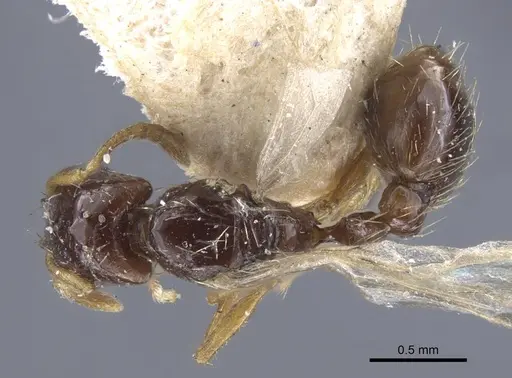
CASENT0916958
Auf AntWeb ansehen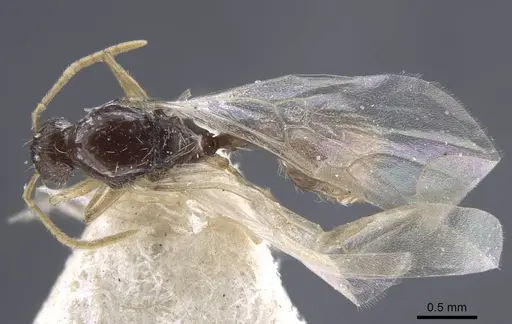
Literatur
Verbreitungskarte wird geladen...Produkte werden geladen...