
Sphinctomyrmex schoerederi
- Wiss. Name
- Sphinctomyrmex schoerederi
- Unterfamilie
- Dorylinae
- Autor
- Feitosa <i>et al.</i>, 2011
- Verbreitung
- In 0 Ländern gefunden
Einleitung
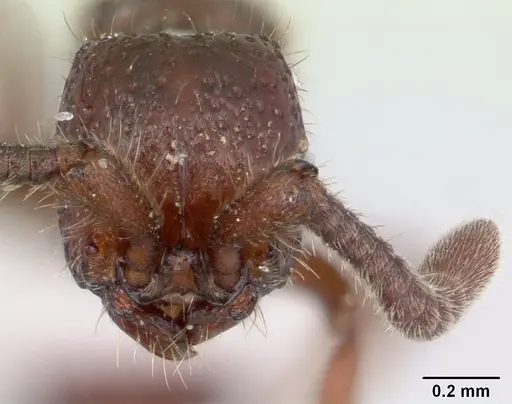
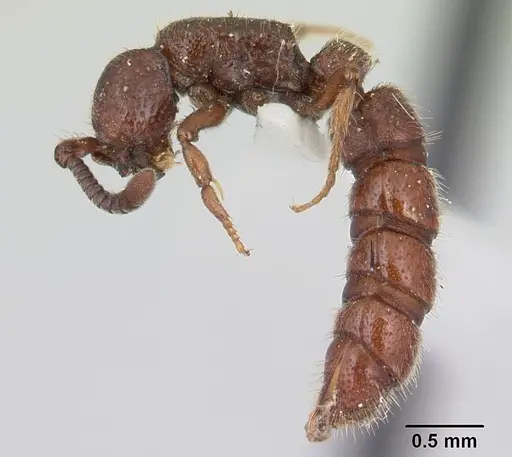
Sphinctomyrmex schoerederi is a rare Neotropical ant species known only from a single worker specimen collected in Brazil . Workers measure 4.48mm in total length, making them relatively large for the genus . They have a distinctive reddish-brown body with lighter-colored appendages, a nearly square-shaped head, and unusually well-developed pretergites (thin segments) on the rear portion of the abdomen that create a banded appearance . Their eyes are extremely reduced, consisting of only about three small facets, which suggests they are adapted to life in dark microhabitats like deep leaf litter or soil . The gaster (the rear body section) is covered in short, flat-lying hairs that give them a somewhat fuzzy appearance . This species was discovered in a forest fragment on the campus of Universidade Federal de Viçosa in Minas Gerais, Brazil, where it lives alongside its relative *Sphinctomyrmex stali* . Nothing is known about their colony structure, diet, behavior, or any aspect of their biology in the wild or in captivity .
Quick Summary
- Difficulty: Expert
- Origin & Habitat: Viçosa, Minas Gerais, Brazil, collected from leaf litter in a forest remnant [1][2]
- Colony Type: Unknown, only the holotype worker has ever been collected [1]
- Size & Growth:
- Queen: Unknown, no queens have ever been collected or described [1]
- Worker: 4.48mm total length (TL) [1]
- Colony: Unknown, only a single worker is known [1]
- Growth: Unknown
- Development: Unknown, no brood has ever been observed [1] (No developmental data exists for this species. Related *Sphinctomyrmex* species may provide rough estimates, but nothing specific is known.)
- Antkeeping:
- Temperature: Unknown, no thermal data exists. Based on its Brazilian origin, room temperature in the low-to-mid 20s°C may be appropriate, but this is entirely speculative.
- Humidity: Unknown, collected from leaf litter suggesting preference for humid forest floor conditions, but no specific requirements are documented.
- Diapause: Unknown, no seasonal data exists for this species [1]
- Nesting: Unknown, the single specimen was collected from leaf litter, suggesting they nest in forest floor microhabitats [1]. No captive nesting observations exist.
- Behavior: Behavior is completely unobserved. As a member of the subfamily Dorylinae, they might hunt small invertebrates like many related species, but this is purely speculative [3]. Their tiny eyes suggest they are likely nocturnal or live in dark microhabitats. No observations on aggression, foraging, or any other behavioral traits exist [1].
- Common Issues: this species is virtually unknown in captivity, no established care protocols exist, only a single specimen has ever been collected, making even basic biology unknown, no queens or colonies have ever been found or described, related species may have specialized diets that this species cannot survive without, wild-caught colonies may carry unknown parasites or diseases with no documented treatment
Species Overview and Discovery
Sphinctomyrmex schoerederi was described in 2011 from a single worker specimen collected in February 1994 from leaf litter samples at Universidade Federal de Viçosa in Minas Gerais, Brazil [1]. The species was named in honor of Dr. José Henrique Schoereder, a prominent ant ecologist at that university who allowed the researchers to study specimens from his collection [1][2]. This ant belongs to the subfamily Dorylinae, which includes army ants and other specialized predatory species [3]. The genus Sphinctomyrmex is known for its unusual banded appearance caused by deeply constricted abdominal segments that create the appearance of a series of narrow waists [1]. The species occurs in sympatry (the same area) with Sphinctomyrmex stali, another member of the genus [1].
Identification and Morphology
Workers of S. schoerederi are relatively large for the genus at 4.48mm total length [1]. They can be identified by their nearly square head, the distinctive two-lobed front margin of the clypeus that projects over the mandibles, and the strongly developed pretergites on abdominal segments IV through VII [1][2]. Their body is reddish-brown with slightly lighter-colored legs and antennae [1]. The gaster is covered in short, appressed (flat-lying) hairs, a feature that helps distinguish them from related species [1]. Their eyes are extremely reduced, barely visible and only about three facets across, suggesting adaptation to dark environments [1]. The antennal club is formed by just the single apical segment, which is longer than the preceding three segments combined [1].
Why This Species Is Not Recommended for Keeping
Sphinctomyrmex schoerederi is one of the least-known ant species in the world. Only a single worker has ever been collected, described, and deposited in a museum [1]. No queens, colonies, or brood have ever been observed by scientists. This means absolutely no biological data exists, we do not know what they eat, how they form colonies, what temperature they need, or anything else about their care. There are no established protocols for keeping this species, and no source to obtain a colony even if someone wanted to try. The entire global knowledge of this species consists of one dead specimen in a museum collection. Attempting to keep this species would be essentially impossible and scientifically meaningless without first discovering and studying wild colonies. For antkeepers interested in rare or challenging species, well-documented rare species with established care protocols would be far more appropriate choices.
What We Might Infer About Their Biology
While nothing is known specifically about S. schoerederi, we can make educated guesses based on its taxonomic position. As a member of the subfamily Dorylinae, it is related to army ants and other predatory species that typically hunt small invertebrates [3]. The extremely reduced eyes suggest they may be adapted to foraging in dark places like deep leaf litter, soil, or under logs, similar to many other Dorylinae that live in concealed microhabitats [1]. Their collection from leaf litter samples indicates they inhabit the forest floor in humid, shaded environments typical of Brazilian Atlantic Forest fragments [1]. However, these are just informed speculations based on related species and morphology, the actual biology of this specific species could be entirely different. Any keeper considering this species would be working with pure speculation and no empirical evidence to guide them.
Frequently Asked Questions
Can I keep Sphinctomyrmex schoerederi ants?
No. This species is not available in the antkeeping hobby and has never been kept in captivity. Only a single worker specimen has ever been collected, and no colonies or queens have ever been found. Without any biological data, it would be impossible to provide appropriate care.
Where does Sphinctomyrmex schoerederi live?
This species is known only from a small forest remnant at Universidade Federal de Viçosa in Minas Gerais, Brazil. It was collected from leaf litter samples in 1994 and has never been found again since then.
What do Sphinctomyrmex schoerederi ants eat?
Unknown. No feeding observations or gut content analyses have ever been conducted on this species. As a Dorylinae ant, they may be predatory like their relatives, but this is purely speculative.
How big do Sphinctomyrmex schoerederi colonies get?
Unknown. We have no data on colony size because only a single worker has ever been collected. The colony structure (single queen vs. multiple queens) is completely unconfirmed.
What temperature do Sphinctomyrmex schoerederi ants need?
No specific temperature data exists. Their Brazilian origin suggests they likely prefer warm, humid conditions typical of tropical forests, but exact requirements are completely unknown.
How long do Sphinctomyrmex schoerederi ants live?
Unknown. No lifecycle observations exist for this species. We do not know how long queens live, how long development takes, or anything about their longevity.
Are Sphinctomyrmex schoerederi good for beginners?
No. This species is not available, not studied, and completely unsuitable for any antkeeper. Even expert antkeepers would have no framework for caring for a species with zero biological data.
Do Sphinctomyrmex schoerederi need hibernation?
Unknown. No seasonal data exists. Their tropical Brazilian origin suggests they may not require a cold period, but this is unconfirmed.
Can I find Sphinctomyrmex schoerederi in the wild?
Extremely unlikely. Despite being named after a prominent ant ecologist and collected from a university campus, this species has never been found since its single collection in 1994. It may be extremely rare, locally extinct, or simply living in microhabitats that are difficult to sample.
Report an Issue
The current care sheet is based fully on literature. See inconsistencies, or something that's incorrect? Please , it will be resolved after review from an admin. Contributing to the blogs tab also helps providing information, to make us be able to further improve the caresheets. Thank you for your support!
References

Dieses Caresheet ist lizenziert unter CC BY-SA 4.0 .
Community-Blogs
CASENT0178849
Auf AntWeb ansehen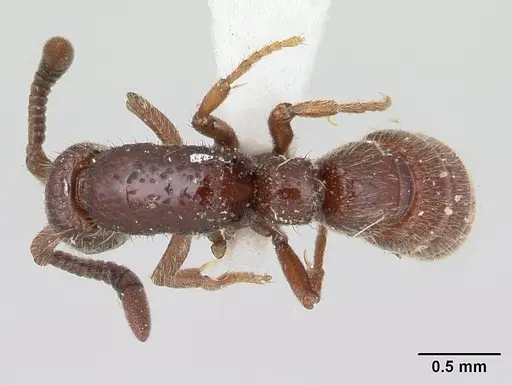
Literatur
Verbreitungskarte wird geladen...Produkte werden geladen...