
Pristomyrmex schoedli
- Wiss. Name
- Pristomyrmex schoedli
- Tribus
- Crematogastrini
- Unterfamilie
- Myrmicinae
- Autor
- Zettel, 2006
- Verbreitung
- In 0 Ländern gefunden
Einleitung
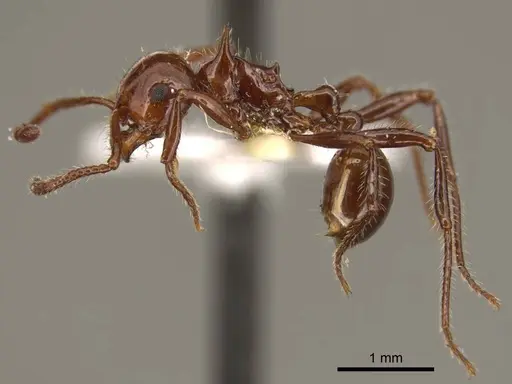
Pristomyrmex schoedli is a small ant species endemic to the Philippines, specifically found on the island of Leyte. Workers have a total length of 3.41-4.19 mm and are reddish-brown with a smooth, polished body. They have extremely long pronotal spines and a prominent tooth on the underside of the clypeus . Unlike most Pristomyrmex species, they are active foragers on leaves during daylight hours . Colonies in the wild contain up to 100 workers, often found in fallen logs .
Quick Summary
- Difficulty: Medium
- Origin & Habitat: Tropical Philippines, specifically Leyte island. Found in lowland areas near rivers and streams at 50-100m elevation, nesting in fallen logs and decaying wood [1][2].
- Colony Type: Colony structure is unconfirmed. Wild colonies have been observed with up to 100 workers, suggesting smaller colony sizes [1].
- Size & Growth:
- Antkeeping:
- Temperature: Keep warm year-round around 24-28°C, reflecting their tropical origin [2].
- Humidity: Keep the nest substrate consistently moist but not waterlogged, as they naturally inhabit damp, decaying wood near streams [1][2].
- Diapause: No, tropical species do not require hibernation [2].
- Nesting: Use Y-tong, plaster, or naturalistic setups with decaying wood pieces. They naturally nest in fallen logs, so include wood fragments to mimic their environment [1].
- Behavior: Workers are diurnal foragers, active on leaves during the day [1]. They are not aggressive and lack a painful sting, their defense involves smearing venom, typical of Myrmicinae. Their small size (3-4mm) makes escape prevention critical [1].
- Common Issues: escape prevention is critical due to tiny size, use fine mesh and tight-fitting lids, small colonies are sensitive to disturbance, avoid frequent nest inspections, tropical species require consistent warmth, cold temperatures can be fatal, wild-caught colonies may have parasites, quarantine and monitor closely, nest substrate must stay moist to match their natural habitat
Nest Preferences
In the wild, Pristomyrmex schoedli nests in fallen logs and decaying wood on the forest floor. Colonies are often concentrated in logs, as about 100 workers were collected from a single log within 10 minutes [1]. For captive care, provide a nest that mimics this, such as Y-tong or plaster with embedded wood pieces. Maintain consistent moisture in the nest material to reflect their damp habitat [1].
Feeding and Diet
These ants are omnivorous, likely feeding on small arthropods and honeydew, as workers forage on leaves [1]. In captivity, offer small live prey like fruit flies or pinhead crickets, along with sugar sources like diluted honey. Feed protein prey 2-3 times per week and keep sugar water available [1][2].
Temperature and Care
As a tropical species, they require warm temperatures year-round. Aim for 24-28°C in the nest area, using a heating cable to create a gentle gradient [2]. Room temperature may suffice if consistently warm. No winter cooling is needed [2].
Behavior and Temperament
Workers are diurnal, foraging on leaves during the day, which is unusual for Pristomyrmex [1]. They are not aggressive and use a smear defense mechanism rather than stinging. Their small size means escape prevention is essential [1].
Growth and Development
No specific development data exists for this species. Based on typical Myrmicinae patterns, eggs may develop into workers in 6-8 weeks at optimal temperatures. Colony growth is moderate, maxing out around 100 workers [1].
Frequently Asked Questions
How long does it take for Pristomyrmex schoedli to produce first workers?
Exact timing is unconfirmed, but based on typical Myrmicinae development, expect first workers in approximately 6-8 weeks at warm temperatures.
What do Pristomyrmex schoedli ants eat?
They are omnivorous. Offer small live prey like fruit flies and sugar sources like honey water [1].
Can I keep Pristomyrmex schoedli in a test tube?
Test tubes can work for founding, but long-term, a Y-tong or plaster nest with moisture retention is better due to their preference for decaying wood [1].
Do Pristomyrmex schoedli ants sting?
They are not known to have a painful sting, their defense involves smearing venom.
Are Pristomyrmex schoedli good for beginners?
They are intermediate difficulty due to small size and warmth requirements, best for keepers with some experience [2].
How big do Pristomyrmex schoedli colonies get?
Natural colonies max out around 100 workers, and captive colonies will likely stay in this range [1].
Do Pristomyrmex schoedli need hibernation?
No, as a tropical species, they do not require hibernation and should be kept warm year-round [2].
Why are my Pristomyrmex schoedli escaping?
Their tiny size allows them to squeeze through small gaps. Use fine mesh, tight lids, and barriers like fluon [1].
When should I move my colony to a formicarium?
Move from a test tube once the colony has 30-50 workers and needs more space, using a nest with wood elements [1].
Can I keep multiple Pristomyrmex schoedli queens together?
This has not been studied, colony structure is unconfirmed, so combining queens is not recommended.
Report an Issue
The current care sheet is based fully on literature. See inconsistencies, or something that's incorrect? Please , it will be resolved after review from an admin. Contributing to the blogs tab also helps providing information, to make us be able to further improve the caresheets. Thank you for your support!
References

Dieses Caresheet ist lizenziert unter CC BY-SA 4.0 .
Community-Blogs
CASENT0919751
Auf AntWeb ansehen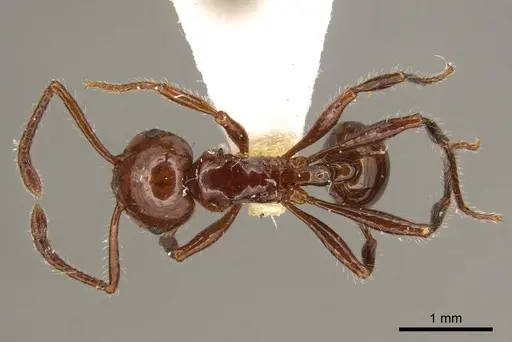
Literatur
Verbreitungskarte wird geladen...Produkte werden geladen...