
Polyrhachis maryatiae
- Wiss. Name
- Polyrhachis maryatiae
- Untergattung
- Myrmhopla
- Tribus
- Camponotini
- Unterfamilie
- Formicinae
- Autor
- Kohout, 2007
- Verbreitung
- In 0 Ländern gefunden
Einleitung
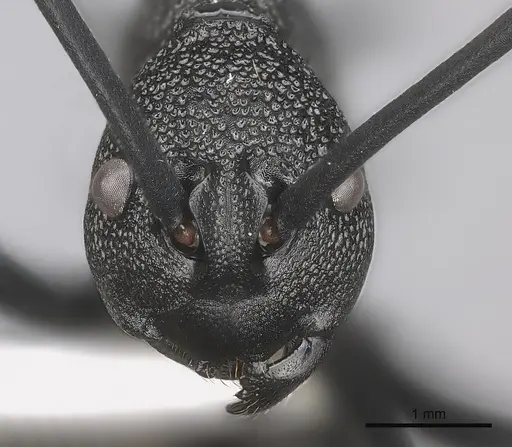
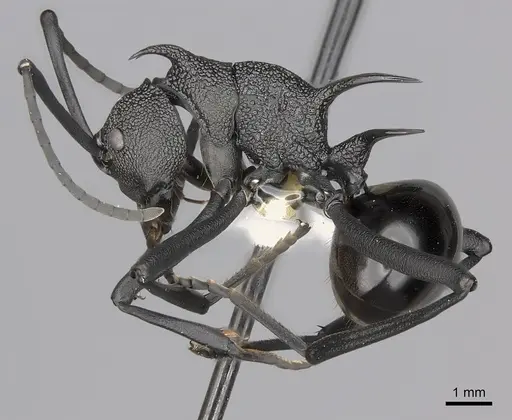
Polyrhachis maryatiae is a large rainforest ant native to Borneo, belonging to the subgenus Myrmhopla. Workers measure 10.68-11.94 mm in total length and are entirely black except for reddish-yellow leg joints and golden spurs on the front legs . They are part of the armata species group and closely related to Polyrhachis armata, but distinguished by larger size, more prominent sculpturing, and longer pronotal and propodeal spines . The gaster is smooth and polished, unlike P. armata . This species is rare and known only from higher elevation rainforest in Borneo . P. maryatiae nests high in the rainforest canopy, with workers rarely descending to ground level . Specimens were collected foraging on felled trees at about 700m elevation . When trees were cut, colonies were brought to ground level but workers disappeared within a week , suggesting adaptation to arboreal life.
Quick Summary
- Difficulty: Expert
- Origin & Habitat: Borneo (Sabah, Sarawak), Indonesia/Malaysia. Found in primary rainforest at elevations of 700-1000m. This is a canopy-dwelling species that nests high in trees and rarely descends to ground level [1].
- Colony Type: Unconfirmed. Based on Polyrhachis patterns, likely single-queen colonies.
- Size & Growth:
- Queen: Approximately 14.26 mm [1]
- Worker: 10.68-11.94 mm [1]
- Colony: Unknown, no colony size data exists [1]
- Growth: Unknown
- Development: Unconfirmed, no direct data. Based on typical Polyrhachis patterns, estimate 6-10 weeks at optimal temperature. (Development timeline has not been studied for this species.)
- Antkeeping:
- Temperature: Based on high-elevation origin, likely requires 24-28°C. Avoid temperatures below 22°C.
- Humidity: Keep nest substrate consistently moist but not waterlogged.
- Diapause: No, as a tropical species, year-round activity is expected.
- Nesting: Arboreal species that nests high in canopy. In captivity, provide vertical structures like branches or cork bark [1].
- Behavior: Based on Polyrhachis patterns, typically calm and non-aggressive. Workers are large with prominent spines. Escape risk is moderate due to climbing behavior.
- Common Issues: arboreal nature makes captive housing challenging, they prefer vertical spaces and may not adapt to standard horizontal nests., rare species with no established captive breeding protocols, wild-caught colonies may struggle in captivity., canopy-dwelling behavior means they need high humidity and vertical structures that typical formicaria do not provide., limited distribution and rarity means finding founding colonies is extremely difficult., lack of documented care information makes successful husbandry uncertain.
Natural History and Distribution
Polyrhachis maryatiae is endemic to Borneo and known only from a handful of collections in primary rainforest at higher elevations. The species was described in 2007 by Rudolf J. Kohout from specimens collected in the Maliau Basin Conservation Area in Sabah, East Malaysia [1]. Additional specimens have been recorded from the Crocker Range at 950-1000m elevation and from Mt Dulit in Sarawak [1].
This is a canopy-dwelling species that nests high in the rainforest trees. Workers only occasionally descend to ground level [1]. The type specimens were collected when trees were felled for a research camp, bringing at least one colony down to ground level. After the initial collection, the frequency of specimens rapidly declined and within less than a week no more were seen [1]. This suggests the species is highly specialized for arboreal life.
The species is closely related to Polyrhachis armata, a widespread southeast Asian species. P. maryatiae can be distinguished by its larger size, more prominent sculpturing, and longer pronotal and propodeal spines [1]. The gaster is smooth and polished in P. maryatiae versus reticulate-punctate in P. armata [1].
Housing and Nest Preferences
Housing Polyrhachis maryatiae presents challenges due to their arboreal nature. In the wild, they nest high in the rainforest canopy, so standard horizontal test tube setups may not be suitable. A naturalistic setup with vertical elements is recommended.
Provide a formicarium with multiple chambers at different heights, including vertical spaces with branches or cork bark to mimic tree trunks. The nest material should hold moisture well while providing grip for climbing. Ensure the setup allows for high humidity without causing mold issues, good ventilation is essential.
The escape risk is moderate, while workers are large, their arboreal nature means they will attempt to climb extensively. Use barrier tape or fluon on container edges, but focus on providing adequate vertical climbing space within the enclosure.
Feeding and Diet
The specific diet of P. maryatiae has not been documented. Based on related Polyrhachis species, they are likely omnivorous with a preference for honeydew and small insects.
In captivity, offer a varied diet including sugar sources (honey water, sugar water) and protein sources (small insects like fruit flies, pinhead crickets). Feed sugar water continuously and protein prey 2-3 times per week, removing uneaten prey after 24 hours.
Observe your colony's preferences carefully, as this is a poorly known species. If they ignore certain foods, try alternatives.
Temperature and Humidity Requirements
As a high-elevation rainforest species from Borneo, P. maryatiae requires warm, humid conditions. Keep the nest area at 24-28°C, avoiding temperatures below 22°C. A gentle temperature gradient allows the colony to self-regulate.
Humidity is critical, the nest substrate should remain consistently moist but never waterlogged. Mist the enclosure regularly and consider using a water reservoir in the nest to maintain humidity. Ensure good ventilation to prevent mold growth.
Because they are canopy dwellers, avoid substrate that is too wet, they prefer somewhat drier conditions than ground-nesting ants. The key is consistent moisture without saturation.
Challenges and Considerations
Polyrhachis maryatiae is challenging to keep due to its specialized arboreal lifestyle and lack of documented captive care information. This is not a species for beginners.
The primary challenge is replicating their natural canopy environment. Standard horizontal formicaria do not suit their arboreal nature. You will need to create a setup with significant vertical space and climbing structures.
Because the species is rare and poorly documented, expect a learning curve. There are no established protocols for breeding this species in captivity. Wild-caught colonies may struggle to adapt to captive conditions.
Additionally, the limited distribution means that obtaining founding colonies is extremely difficult. If you acquire a colony, document your observations carefully. [1]
Frequently Asked Questions
Is Polyrhachis maryatiae a good species for beginners?
No. This is an expert-level species not recommended for beginners. It is arboreal, requiring vertical housing setups that differ from standard ant keeping setups. Additionally, there is no established captive care information, making successful husbandry uncertain even for experienced keepers.
What kind of nest should I use for Polyrhachis maryatiae?
Standard horizontal test tubes are not ideal. This canopy-dwelling species needs a naturalistic setup with vertical structures like branches or cork bark. A formicarium with multiple chambers at different heights works best.
How long does it take for Polyrhachis maryatiae to produce first workers?
The development timeline has not been documented for this species. Based on typical Polyrhachis patterns, expect approximately 6-10 weeks from egg to first worker at optimal temperature (24-28°C).
What do Polyrhachis maryatiae eat?
Based on related species, they are omnivorous. Offer sugar sources (honey water, sugar water) continuously and protein (small insects like fruit flies, pinhead crickets) 2-3 times weekly.
Do Polyrhachis maryatiae need hibernation?
No. As a tropical rainforest species from Borneo, they do not require hibernation. Keep them at warm temperatures year-round.
How big do Polyrhachis maryatiae colonies get?
The maximum colony size is unknown. Only a few collections exist, and no colony size data has been documented [1].
Can I keep multiple queens together?
The colony structure is unconfirmed. There is no data on whether this species is monogyne or polygyne. Based on related Polyrhachis species, single-queen colonies are more common.
Where does Polyrhachis maryatiae live in the wild?
It is endemic to Borneo, found only in primary rainforest at elevations of 700-1000m in Sabah and Sarawak. The species nests high in the canopy and workers rarely descend to ground level [1].
Why is Polyrhachis maryatiae so rare in captivity?
This species is rare even in the wild, known only from a few collections [1]. Additionally, their arboreal canopy-nesting behavior makes them difficult to locate and collect. The lack of documented captive breeding protocols further limits availability.
Report an Issue
The current care sheet is based fully on literature. See inconsistencies, or something that's incorrect? Please , it will be resolved after review from an admin. Contributing to the blogs tab also helps providing information, to make us be able to further improve the caresheets. Thank you for your support!
References

Dieses Caresheet ist lizenziert unter CC BY-SA 4.0 .
Community-Blogs
CASENT0217434
Auf AntWeb ansehen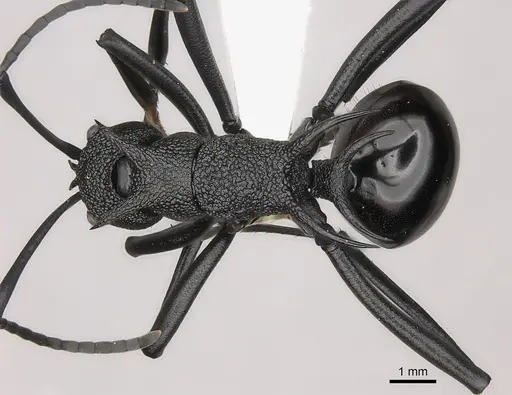
Literatur
Verbreitungskarte wird geladen...Produkte werden geladen...