
Podomyrma simillima
- Wiss. Name
- Podomyrma simillima
- Tribus
- Crematogastrini
- Unterfamilie
- Myrmicinae
- Autor
- Smith, 1860
- Verbreitung
- In 0 Ländern gefunden
Einleitung
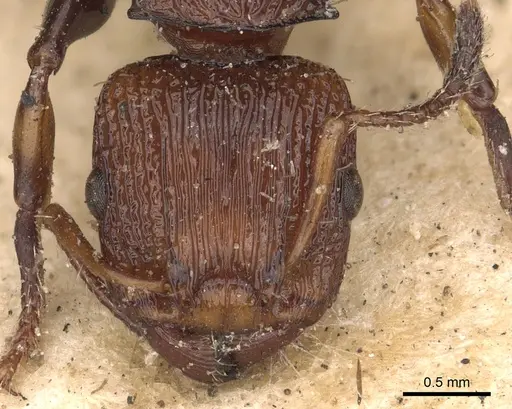
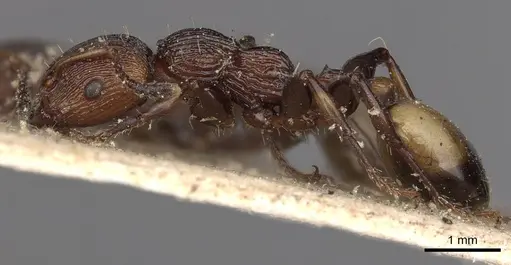
Podomyrma simillima is a small myrmicine ant first described by Frederick Smith in 1860 from Bacan Island in the Indonesian archipelago . Workers measure approximately 6.35 mm and have a distinctive rusty brown (ferruginous) coloration with coarse longitudinal grooves on the head and thorax. The abdomen is shiny with a pale base. This species closely resembles Podomyrma basalis from Aru Island but is larger with darker legs and a more oblong abdomen . This species is poorly documented with limited modern research. Based on its tropical distribution, it likely inhabits humid forest environments in the Indonesian archipelago and Papua New Guinea. The genus Podomyrma is not commonly kept in captivity, and no husbandry information exists.
Quick Summary
- Difficulty: Unknown, Insufficient data for reliable assessment
- Origin & Habitat: Natively found on Bacan Island, Maluku Islands, Indonesia [1][2], with additional records from Papua New Guinea [3]. Likely inhabits humid lowland forest environments.
- Colony Type: Colony structure is unconfirmed. No data on queen number or colony size exists for this species.
- Size & Growth:
- Queen: Unknown, not described in available literature
- Worker: Approximately 6.35 mm (3 lines) based on original description [1]
- Colony: Unknown, no colony size data available
- Growth: Unknown
- Development: Unknown, no development data exists for this species. Your observations would be the first documented timeline. (Development timeline is unconfirmed. No direct observations of colony growth exist.)
- Antkeeping:
- Temperature: Aim for warm conditions around 24-28°C based on tropical Indonesian distribution. Provide a gentle gradient so the colony can choose its preferred temperature.
- Humidity: Keep nest substrate consistently moist but not waterlogged. High humidity is likely required given tropical forest origins.
- Diapause: Unknown, as a tropical species, it likely does not require formal hibernation, but may have reduced activity during cooler periods.
- Nesting: No specific nesting data exists. Based on related species and tropical distribution, they likely nest in soil, rotting wood, or under stones in humid microhabitats. A naturalistic setup with moist substrate or a Y-tong/plaster nest would be appropriate starting points.
- Behavior: Behavior is undocumented. As a myrmicine ant, standard escape prevention measures should be followed (workers are ~6 mm). Based on its subfamily, this species likely uses a smear defense: it has a modified flattened stinger used to wipe venom onto enemies.
- Common Issues: lack of documented care information makes proper husbandry challenging, tropical humidity requirements may be difficult to maintain consistently, no data on accepted food sources, dietary needs are unknown, colony development timeline is unconfirmed, making progress tracking difficult, limited availability in antkeeping trade means few keeper resources exist
Species Identification and History
Podomyrma simillima was first described by Frederick Smith in 1860 from specimens collected on Bacan Island (historically spelled Bachian) in the Maluku Islands of Indonesia [1]. The original description notes workers measuring approximately 3 lines (about 6.35 mm) with a rusty brown coloration. The head and thorax feature coarse longitudinal grooves or striations, while the abdomen is shiny with a pale basal half. Smith noted this species closely resembles Podomyrma basalis from Aru Island but is larger with darker legs and a more oblong abdomen, suggesting it may represent only a climatic variety [1]. The species has subsequently been recorded in German New Guinea (modern Papua New Guinea) by Viehmeyer in 1912,expanding the known range [3]. This remains a poorly studied species with virtually no modern biological or ecological research.
Distribution and Habitat
Podomyrma simillima is known from Bacan Island in the Maluku Islands, Indonesia [1]. Historical records also place this species in German New Guinea (modern-day Papua New Guinea) [3]. This suggests a broad distribution across the Indomalayan region spanning the islands between western Indonesia and eastern Papua New Guinea. The exact habitat preferences are not documented, but the tropical distribution suggests they inhabit humid lowland forest environments. The species is not commonly encountered in antkeeping collections, and no captive husbandry information exists in the hobby literature.
Keeping Podomyrma simillima - What We Don't Know
This is one of the most poorly documented species in antkeeping. No scientific papers exist on the biology, behavior, or captive care of Podomyrma simillima. The following represents informed estimates based on the genus, family, and geographic distribution rather than species-specific data. For temperature, aim for 24-28°C as a starting point, typical for tropical ants. For humidity, keep the nest substrate consistently moist but not waterlogged, high humidity is likely essential. For nesting, a naturalistic setup with moist soil or a plaster/Y-tong nest would be appropriate. For diet, offer a mix of sugar sources (honey, sugar water) and protein (small insects) but acceptance is completely unconfirmed. Keep detailed records of your colony's preferences and share them with the antkeeping community, this species needs dedicated keepers to build husbandry knowledge from scratch.
Recommended Care Approach
Given the complete lack of captive husbandry data, approach this species with a scientific mindset. Start with a test tube setup for founding colonies, transitioning to a small formicarium or naturalistic setup once the colony is well established. Maintain warm temperatures (24-28°C) and keep the nest substrate consistently moist. Offer both sugar water and small live prey insects. Document everything: which foods are accepted, preferred temperature ranges, humidity preferences, and any observations on development. Consider this species a documentation project, every observation adds to our collective knowledge. Join antkeeping communities and share your findings. Without keeper contributions, we may never develop reliable care protocols.
Frequently Asked Questions
How do I care for Podomyrma simillima ants?
Care is unconfirmed as no captive husbandry data exists. Start with warm (24-28°C), humid conditions (keep nest substrate moist but not waterlogged) and a naturalistic or plaster nest. Offer sugar water and small insects. Document your colony's preferences to help build husbandry knowledge.
What do Podomyrma simillima ants eat?
Diet is completely unconfirmed. Based on related Myrmicinae, they likely accept sugar sources and small protein prey. Offer honey/sugar water and small live insects and observe acceptance.
How long does it take for Podomyrma simillima to develop from egg to worker?
Unknown, no development data exists for this species. Your observations would be the first documented timeline.
Do Podomyrma simillima ants sting?
Unknown, no sting or pain data exists. As a member of the Myrmicinae subfamily, it likely has a modified stinger used for smearing venom (smear defense), but its potency is unconfirmed. Handle with standard precautions.
Are Podomyrma simillima good for beginners?
No, this species is not recommended for beginners due to completely unconfirmed care requirements. The lack of documented husbandry makes proper care extremely challenging. Choose a species with established care protocols instead.
Where does Podomyrma simillima come from?
This species is native to Bacan Island in the Maluku Islands, Indonesia [1][2], with additional records from Papua New Guinea [3].
How big do Podomyrma simillima colonies get?
Unknown, no colony size data exists.
Do Podomyrma simillima need hibernation?
Unknown, as a tropical species, they likely do not require formal hibernation. They may have reduced activity during cooler periods. Monitor colony behavior and adjust temperature accordingly.
Can I keep multiple Podomyrma simillima queens together?
Unknown, no data exists on colony structure. Do not attempt combining unrelated queens without documented evidence of acceptance.
What size are Podomyrma simillima workers?
Workers are approximately 6.35 mm (3 lines) based on the original 1860 description [1].
Report an Issue
The current care sheet is based fully on literature. See inconsistencies, or something that's incorrect? Please , it will be resolved after review from an admin. Contributing to the blogs tab also helps providing information, to make us be able to further improve the caresheets. Thank you for your support!
References

Dieses Caresheet ist lizenziert unter CC BY-SA 4.0 .
Community-Blogs
CASENT0901393
Auf AntWeb ansehen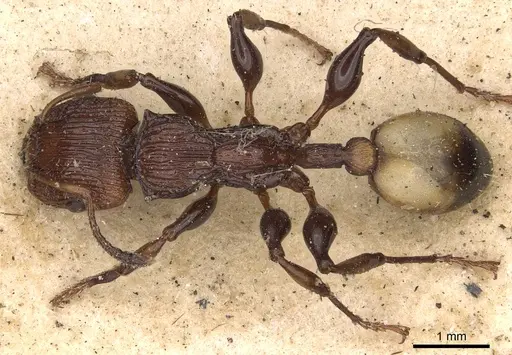
Literatur
Verbreitungskarte wird geladen...Produkte werden geladen...