
Parasyscia flavaclavata
- Wiss. Name
- Parasyscia flavaclavata
- Unterfamilie
- Dorylinae
- Autor
- Donisthorpe, 1938
- Verbreitung
- In 0 Ländern gefunden
Einleitung
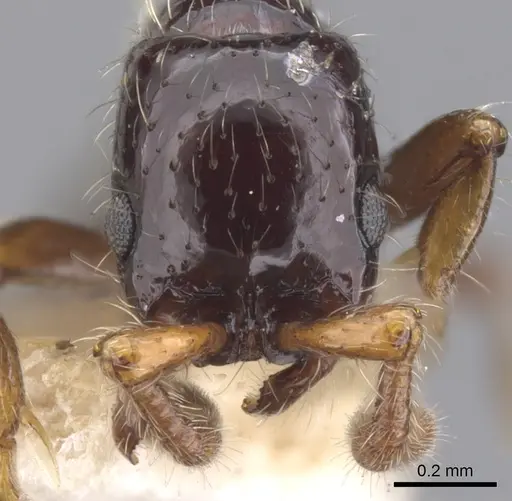
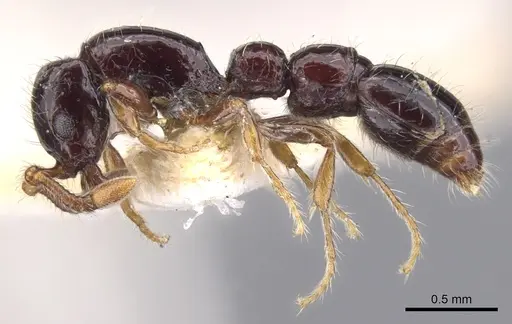
Parasyscia flavaclavata is a small, slender ant in the Dorylinae subfamily, formerly classified as Cerapachys. Specific size data is unavailable, as no total length measurements have been published . This species is known only from the type locality in the Cyclops Mountains of Irian Jaya, Indonesia (New Guinea), collected at approximately 1200 feet elevation in 1936 . Only four syntype workers have ever been documented, making this one of the least-studied ants in the hobby. The genus Parasyscia contains predatory ants that likely hunt small invertebrates, though specific behaviors for this species remain unobserved . The lack of any documented queen or reproductive castes means captive breeding success would represent a significant contribution to ant biology.
Quick Summary
- Difficulty: Expert
- Origin & Habitat: Irian Jaya (Indonesian New Guinea), Cyclops Mountains at Sabron, approximately 1200 feet elevation. The region features tropical humid forest with high rainfall [1][2].
- Colony Type: Unknown, only workers have been documented. Colony structure (single-queen or multi-queen) has not been studied.
- Size & Growth:
- Queen: size data unavailable
- Worker: size data unavailable
- Colony: Unknown, no colony size data available
- Growth: Unknown
- Development: Unknown, development has not been studied (No data available on any life stage beyond adult workers)
- Antkeeping:
- Temperature: Temperature needs are unclear, start around 24-28°C and observe, based on New Guinea habitat [1].
- Humidity: Keep substrate consistently moist but not waterlogged, as New Guinea is tropical [1].
- Diapause: No, tropical species from near-equator with minimal seasonal variation [1].
- Nesting: No natural nesting data available. Based on related Dorylinae, they likely prefer humid soil or rotting wood [1].
- Behavior: Behavior is unstudied. Related cerapachyine ants are typically predatory [1]. Escape prevention should be good for medium-sized ants, but specific behavior is unknown. No documented sting or defense mechanisms.
- Common Issues: this species has never been kept in captivity, no established care protocols exist [1]., only four workers have ever been documented in scientific literature [1]., no queens or reproductive castes have ever been collected [1]., founding behavior is completely unknown, it is unclear how this species establishes colonies., obtaining live specimens would require field collection in remote New Guinea [1].
Species Overview and Rarity
Parasyscia flavaclavata represents one of the rarest and least-documented ant species in the antkeeping hobby. First described by Donisthorpe in 1938 from just four worker specimens collected in the Cyclops Mountains of New Guinea, this species has never been observed in captivity and has barely been studied in the wild [1]. The entire scientific knowledge base consists of the original type description and a few taxonomic cataloguings [2]. This makes keeping this species an exercise in informed experimentation rather than following established protocols. The genus Parasyscia was separated from Cerapachys in 2016,and many former Cerapachys species remain poorly understood. For dedicated antkeepers, the challenge of establishing this species would be significant but potentially scientifically valuable.
Distribution and Natural Habitat
This species is known only from a single collection event in Irian Jaya (Indonesian New Guinea). The type locality at Sabron in the Cyclops Mountains sits at approximately 1200 feet elevation. The region features tropical humid forest with year-round high rainfall and warm temperatures [1]. The Cyclops Mountains are a remote, biologically underexplored region of New Guinea [2]. No additional collections have been documented since 1936,suggesting either extreme rarity, very localized distribution, or simply lack of research effort in the area. The elevation suggests it may tolerate slightly cooler conditions than true lowland rainforest species, but temperature preferences remain speculative.
Taxonomy and Classification
Parasyscia flavaclavata was originally described as Cerapachys flavaclavatus in 1938 and was moved to the genus Parasyscia in 2016 during a comprehensive generic revision of the Dorylinae subfamily [2]. The species is classified in the tribe Cerapachyini, which contains predatory ants known for their elongated bodies and often specialized hunting behaviors [1]. The Dorylinae subfamily includes army ants and other predatory species, though the genus Parasyscia contains smaller, more cryptic species rather than the large swarm-hunting army ants. Only the worker caste has been described, no queens, males, or larvae have ever been documented for this species [1].
Challenges of Keeping Undescribed Species
Attempting to keep Parasyscia flavaclavata presents extraordinary challenges. First, obtaining live specimens would require field collection in remote Indonesian New Guinea, which presents significant practical and legal obstacles [1]. Second, even if workers were obtained, without any knowledge of the queen or founding behavior, establishing a breeding colony would be nearly impossible. Third, there is no baseline data on temperature tolerance, humidity preferences, diet acceptance, or any other husbandry parameter. Any successful keeper would essentially be pioneering husbandry through trial and error. This species is categorically not suitable for beginners or even intermediate antkeepers, it represents an extreme expert-level challenge that would require extensive resources and tolerance for failure.
Related Species and Inferences
While P. flavaclavata specifically is unstudied, some inferences can be drawn from related Parasyscia species and general Dorylinae biology [1]. The subfamily is predominantly predatory, with workers hunting small invertebrates. Related cerapachyine ants are typically ground-nesting and prefer humid environments. They do not construct elaborate nests like some Formicinae, instead using natural cavities in soil or rotting wood. However, these are broad generalizations, and this species may have entirely atypical behaviors. Any keeper should approach with no expectations and document everything carefully. Success with more common Parasyscia species may provide rough guidance, but species-specific needs could differ dramatically.
Frequently Asked Questions
Can I keep Parasyscia flavaclavata in captivity?
There are no documented cases of this species being kept in captivity [1]. Obtaining live specimens would require field collection in New Guinea, and even then, no one has ever documented a queen or founding behavior for this species. This is an expert-level challenge with virtually no supporting information.
Where can I get a Parasyscia flavaclavata queen?
It is extremely unlikely you can obtain this species. Only four workers have ever been documented in scientific literature, collected in 1936 [1]. No queens have ever been described or collected. There is no established captive breeding population.
What do Parasyscia flavaclavata ants eat?
This is completely unknown. Based on related Dorylinae, they are likely predatory on small invertebrates, but no specific feeding observations exist for this species [1].
What temperature and humidity do they need?
No husbandry data exists. Based on the New Guinea habitat, they likely prefer warm (24-28°C) and humid conditions, but this is an educated guess rather than established requirement [1].
How big do colonies get?
Unknown, no colony size data has ever been documented. Even maximum colony size in the wild is unknown.
Is this species good for beginners?
Absolutely not. This is one of the least-documented ant species in existence. There are no established care protocols, no documented queens, and no possibility of obtaining specimens through legal means [1].
How long do workers live?
Unknown, no longevity data exists for this or related species at this level of specificity.
Do they need hibernation?
No. This is a tropical species from near-equator New Guinea with minimal seasonal temperature variation. No diapause behavior has been documented [1].
Can I start a colony from multiple queens?
No information exists on colony founding. Even whether the species is single-queen or multi-queen is unknown.
Report an Issue
The current care sheet is based fully on literature. See inconsistencies, or something that's incorrect? Please , it will be resolved after review from an admin. Contributing to the blogs tab also helps providing information, to make us be able to further improve the caresheets. Thank you for your support!
References

Dieses Caresheet ist lizenziert unter CC BY-SA 4.0 .
Community-Blogs
CASENT0902742
Auf AntWeb ansehen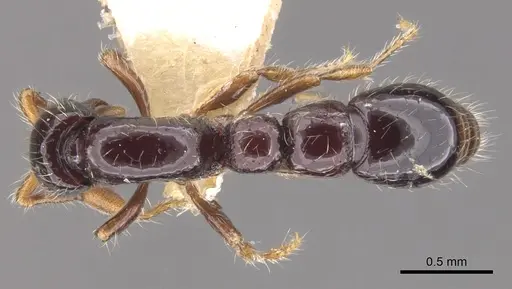
Literatur
Verbreitungskarte wird geladen...Produkte werden geladen...