
Oxyopomyrmex magnus
- Wiss. Name
- Oxyopomyrmex magnus
- Tribus
- Stenammini
- Unterfamilie
- Myrmicinae
- Autor
- Salata & Borowiec, 2015
- Verbreitung
- In 0 Ländern gefunden
Einleitung
Oxyopomyrmex magnus is a dark brown to brown ant endemic to Spain. Workers measure around 5.2 mm and feature a distinctly wide, quadrate head with massive triangular propodeal spines. The species name means large in Latin, reflecting its size relative to other members of the genus. They nest in soil in open, sunny areas across central and southern Spain, often at higher elevations between 590 and 1411 meters. Despite their wide distribution across several Spanish provinces, their biology remains completely unstudied . The most notable feature is the variation in reproductive timing across different regions. In the Sierra de Alcaraz, sexuals emerge in spring, while populations in Granada province fly in autumn. This regional difference suggests unique local adaptations to climate .
Quick Summary
- Difficulty: Expert
- Origin & Habitat: Iberian Peninsula (Spain), specifically Madrid, Albacete, and Granada provinces. They inhabit open, sunny areas at altitudes of 590 to 1411 meters, tolerating both arid conditions and somewhat humid enclaves [2][3].
- Colony Type: Unconfirmed, colony structure has not been documented in scientific literature
- Size & Growth:
- Queen: ~6.2 mm [1]
- Worker: ~5.2 mm [1]
- Colony: Unknown, no colony size data available
- Growth: Unknown
- Development: Unconfirmed, no development data exists for this species. Based on typical Mediterranean Myrmicinae, development likely takes 6 to 10 weeks at optimal temperature (Temperature dependency is unknown.)
- Antkeeping:
- Temperature: Estimated 22 to 26°C based on Mediterranean distribution and related Stenammini species. Provide a gentle temperature gradient allowing ants to self-regulate [5].
- Humidity: Prefers somewhat humid environments in nature but also tolerates arid conditions. Keep nest substrate moderately moist but not waterlogged, with some drier areas available [3].
- Diapause: Unknown, likely requires a cool period during winter given Mediterranean temperate climate, but specific requirements unstudied
- Nesting: Natural nesting occurs in soil in open areas, away from forested zones. A standard test tube setup or plaster nest with soil chambers should work well. Provide access to an outworld for foraging [2].
- Behavior: Workers are small but robust with massive triangular propodeal spines. Temperament is unstudied but related species are typically non-aggressive. Escape risk is moderate due to small size, use standard barrier methods. Foraging style is unknown but likely ground-active like related Stenammini.
- Common Issues: no captive husbandry information exists., biology is completely unstudied., wild-caught colonies may not adapt to captive conditions., distribution is extremely limited., nuptial flight timing varies by region.
Species Identification and Distinguishing Features
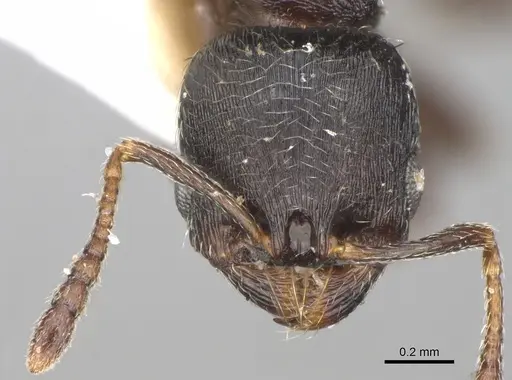
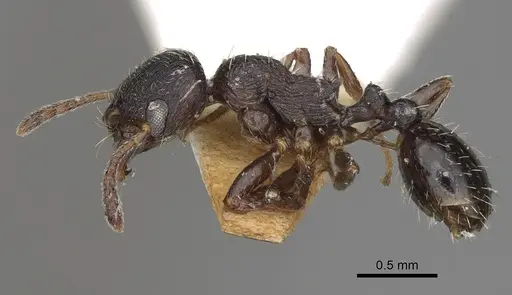
Oxyopomyrmex magnus stands out with a head that is always wider than long. The center of the frons shows rugulose texture with uniformly distributed longitudinal striae. The overall coloration ranges from dark brown to black. It is significantly larger than its relative Oxyopomyrmex pallens. Workers carry massive triangular propodeal spines that rise obliquely upwards, while males either lack propodeal spines entirely or possess only minute nodes. The species name reflects its notably large size compared to other Oxyopomyrmex species [1][2].
Distribution and Habitat
This species is endemic to the Iberian Peninsula and is only known from Spain. The type locality is Aranjuez in Madrid province, with additional populations in Sierra de Alcaraz (Albacete) and Granada province. The species shows a marked orophilous character, being found at altitudes ranging from 590 meters to 1411 meters. Unlike many ants, Oxyopomyrmex magnus is not forest-loving and prefers open areas away from forested zones. It tolerates direct human alteration and can survive in shallow soil conditions. The species has been found in both arid environments and in shrubland or oak forest clearings [3][2].
Reproduction and Seasonal Activity
Sexual reproduction in Oxyopomyrmex magnus varies by geographic location. In Sierra de Alcaraz, males and females have been captured in April, with dealated isolated females found in May. However, in Granada province, sexuals appear in autumn, contrasting with the spring flight period observed in other regions. This variation suggests either regional climatic adaptation or potentially different reproductive strategies. The species is endemic to the Southern Plateau refugium area according to biogeographic studies [4][3].
Keeping Considerations
Because nothing is known about the captive biology of Oxyopomyrmex magnus, keeping this species would be entirely experimental. There are no established husbandry protocols or confirmed care requirements. If attempting to keep this species, start with conditions typical of Mediterranean Myrmicinae: moderate temperature, moderately humid nest conditions, and a diet of small insects and seeds. The limited distribution means wild-caught colonies would be difficult to obtain and should be approached with conservation awareness. This species would be suitable only for experienced antkeepers interested in pioneering captive breeding of poorly studied species [6].
Frequently Asked Questions
Can I keep Oxyopomyrmex magnus in a test tube?
Probably yes, based on related Stenammini species, a test tube setup with a water reservoir would be a reasonable starting point. However, no one has successfully kept this species in captivity, so this is entirely speculative.
How long does it take for Oxyopomyrmex magnus to develop from egg to worker?
This is completely unconfirmed. No development data exists for this species. Based on typical Mediterranean Myrmicinae, estimates would be 6 to 10 weeks at optimal temperature, but this is just an educated guess.
Are Oxyopomyrmex magnus good for beginners?
No. This species has never been kept in captivity and nothing is known about its husbandry requirements. It would be extremely challenging to maintain successfully.
What temperature do Oxyopomyrmex magnus need?
Estimated 22 to 26°C based on their Mediterranean distribution. This is inferred from climate data and related species, not from direct studies on this ant.
Where does Oxyopomyrmex magnus live in the wild?
Only in Spain, specifically central Madrid region and southern Granada province. They live in soil nests in open areas at altitudes of 590 to 1411 meters, avoiding forested zones [2][3].
Report an Issue
The current care sheet is based fully on literature. See inconsistencies, or something that's incorrect? Please , it will be resolved after review from an admin. Contributing to the blogs tab also helps providing information, to make us be able to further improve the caresheets. Thank you for your support!
References

Dieses Caresheet ist lizenziert unter CC BY-SA 4.0 .
Community-Blogs
CASENT0923214
Auf AntWeb ansehen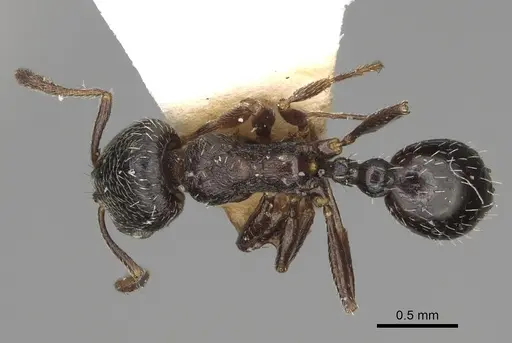
Literatur
Verbreitungskarte wird geladen...Produkte werden geladen...