
Lordomyrma nima
- Wiss. Name
- Lordomyrma nima
- Tribus
- Crematogastrini
- Unterfamilie
- Myrmicinae
- Autor
- Liu <i>et al.</i>, 2021
- Verbreitung
- In 0 Ländern gefunden
Einleitung
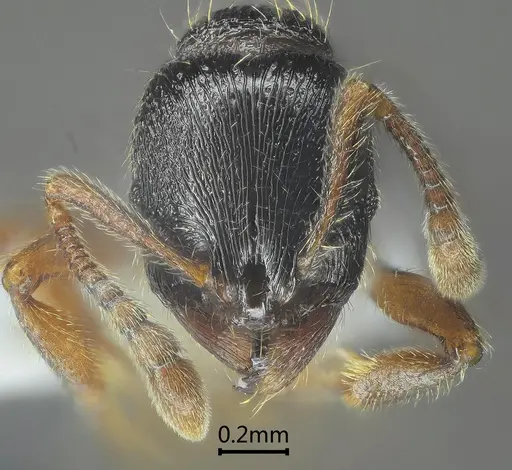
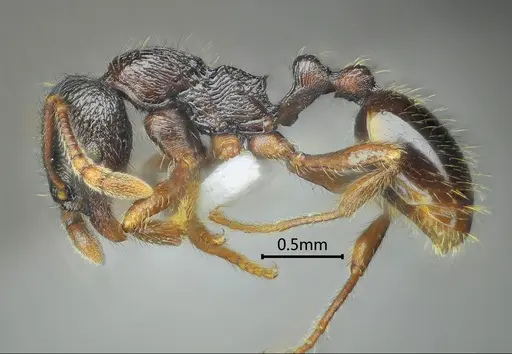
Lordomyrma nima is a small Myrmicinae ant species native to the high-altitude forests of southeastern Tibet, China. Workers measure 3.4-4.3mm in total length and have a distinctive appearance with a blackish-brown body, reddish-brown petiole, postpetiole and gaster, and yellowish-brown mandibles, antennae and legs . Their head has characteristic dense posteriorly divergent rugae (ridged texture), and their 12-segmented antennae end in a 3-segmented club . Queens are larger at 5.2mm and have three ocelli on the vertex . This species was only recently described in 2021 and is known from only a handful of specimens collected in Medog and Nyingchi Counties at elevations between 2620-2750m . Colonies are small and inconspicuous, typically nesting under stones or in soil on sunny slopes within undisturbed broadleaf and coniferous forests .
Quick Summary
- Difficulty: Unknown, Limited data available
- Origin & Habitat: Southeastern Tibet, China (Medog and Nyingchi Counties) at 2620-2750m elevation. Found in undisturbed broadleaf forest and coniferous forest (Alnus nepalensis and Abies forests), with colonies under stones or in soil on sunny slopes [1].
- Colony Type: Unconfirmed, colony structure has not been documented for this species. Based on collected specimens, colonies appear to be small.
- Size & Growth:
- Queen: 5.2mm [1]
- Worker: 3.4-4.3mm [1]
- Colony: Likely small, described as small inconspicuous colonies in the original description [1]
- Growth: Unknown
- Development: Unknown, no development data exists for this species (Based on related Myrmicinae species from similar habitats, expect 6-10 weeks at optimal temperature. This is an estimate only.)
- Antkeeping:
- Temperature: Cool to moderate conditions expected based on high-altitude Tibetan habitat. Start around 18-22°C and observe colony activity. Avoid overheating, these ants come from a cool mountain environment [1].
- Humidity: Moderate to high, they nest in forest soils which typically retain moisture. Keep substrate consistently damp but not waterlogged. Provide a moisture gradient so ants can choose their preferred humidity [1].
- Diapause: Likely yes, based on high-altitude origin in Tibet where winters are cold. Expect a winter rest period around 10-15°C for 3-4 months [1].
- Nesting: Natural nesting is under stones and in soil. In captivity, a naturalistic setup with soil or a Y-tong/plaster nest with narrow chambers works well. They prefer dark, humid nest conditions similar to their forest floor habitat [1].
- Behavior: Not well documented in captivity. Based on their small size and forest floor habitat, they are likely secretive and not aggressive. Workers forage individually rather than in visible trails. Their sting is present (extruding in preserved specimens) but given their tiny size, sting effectiveness on human skin is minimal [1]. As members of the tribe Crematogastrini, they have a modified stinger used to smear venom rather than pierce. Escape prevention should be moderate, they are small but not among the tiniest ants.
- Common Issues: limited availability, this is a rarely kept species with very little captive breeding history, temperature sensitivity, high-altitude origin means they may be sensitive to overheating, slow colony growth, small colony sizes in the wild suggest slow development in captivity, humidity management, forest-dwelling ants need consistent moisture without flooding, hibernation stress, improper diapause conditions may cause colony failure
Natural History and Distribution
Lordomyrma nima is endemic to the high-altitude forests of southeastern Tibet, China, specifically found in Medog and Nyingchi Counties [1]. The type locality is at approximately 2620m elevation in Medog County, with paratypes collected up to 2750m [1]. This species inhabits undisturbed broadleaf forests dominated by trees like Alnus nepalensis (Nepalese alder) as well as coniferous Abies (fir) forests [1]. Colonies are small and inconspicuous, found nesting under stones or directly in soil on sunny slopes [1]. The name nima refers to a common male name used in Tibet and Qinghai, honoring the regional cultural context [1]. This species was only formally described in 2021,meaning there is very limited biological data available compared to more commonly kept ant species.
Identification and Appearance
Workers of Lordomyrma nima are small ants measuring 3.4-4.3mm in total length [1]. The body is primarily blackish-brown, with the petiole, postpetiole and gaster showing a reddish-brown coloration [1]. Their mandibles, antennae and legs are yellowish-brown [1]. The head has a distinctive texture with dense posteriorly divergent rugae that become reticulate-rugose on the sides [1]. The mesosoma is longitudinally rugose, while the gaster is smooth and shining [1]. Queens are larger at 5.2mm with three ocelli on the vertex and relatively larger eyes [1]. A distinguishing feature from the similar species Lordomyrma bhutanensis is the longitudinally rugose dorsum of the promesonotum and the thick, trapezoidal petiolar node [1].
Housing and Nesting
In their natural habitat, Lordomyrma nima nests under stones and in soil within forest environments [1]. For captive care, a naturalistic setup with a soil-filled container or a Y-tong/plaster nest with narrow chambers works well. These ants prefer dark, humid nest conditions similar to their forest floor habitat. The nest material should retain moisture without becoming waterlogged, a damp but not saturated substrate is ideal. Given their small size and secretive nature, provide plenty of hiding spaces and avoid disturbing the colony frequently. Escape prevention should be moderate, they are small enough to squeeze through standard test tube cotton if gaps exist, so ensure connections are secure.
Temperature and Seasonal Care
Based on their high-altitude Tibetan origin (2600-2750m elevation), these ants likely prefer cool to moderate temperatures [1]. Start around 18-22°C and observe colony behavior, if workers become sluggish, slightly increase temperature, if they avoid heated areas, reduce it. Avoid overheating, as these mountain ants are not adapted to tropical warmth. For seasonal care, expect a winter diapause period. In their native habitat, Tibet experiences cold winters, so a hibernation period of 3-4 months at 10-15°C is appropriate [1]. This cool-temperature requirement makes them unsuitable for keepers who keep their ant rooms warm year-round. Provide a temperature gradient within the enclosure so ants can self-regulate.
Feeding and Diet
The specific diet of Lordomyrma nima has not been documented in scientific literature. As a member of the Myrmicinae subfamily and the tribe Crematogastrini, they likely have a typical ant diet consisting of small insects and honeydew from aphids or scale insects. In captivity, offer small protein sources like fruit flies, small mealworms, and other tiny arthropods. Sugar sources like honey water or sugar water may be accepted, though some Myrmicinae species have limited sugar intake. Feed small amounts initially and remove any uneaten food after 24-48 hours to prevent mold. Given their small colony sizes in the wild, avoid overfeeding.
Colony Development
Colony development for Lordomyrma nima has not been studied. The original species description notes colonies are small and inconspicuous, suggesting relatively small colony sizes compared to common ant species [1]. Based on related Myrmicinae species from similar cool habitats, egg-to-worker development likely takes 6-10 weeks at optimal temperature, but this is purely an estimate. Queens measure 5.2mm and workers 3.4-4.3mm [1]. The paratype queen was collected from the same nest as workers, indicating established colonies with a functional queen [1]. Expect slow growth given their small natural colony sizes, patience is essential with this species.
Frequently Asked Questions
How long does it take for Lordomyrma nima to produce first workers?
The exact development timeline is unknown, this species has not been studied in captivity. Based on related Myrmicinae from similar cool habitats, expect 6-10 weeks from egg to first worker at optimal temperature. This is an estimate only.
What temperature do Lordomyrma nima ants need?
Based on their high-altitude Tibetan origin, keep them cool to moderate at 18-22°C. Avoid overheating, they come from mountain forests where temperatures remain cool year-round. A heating cable on one side of the nest can create a gradient if room temperature is too low.
Do Lordomyrma nima ants sting?
Yes, they have a sting that extrudes in preserved specimens [1]. However, given their very small size (3.4-4.3mm workers), the sting is unlikely to penetrate human skin effectively. They are not considered dangerous to humans.
How big do Lordomyrma nima colonies get?
Based on field observations describing them as small inconspicuous colonies, maximum colony size is likely under 100 workers [1]. This is smaller than many commonly kept ant species.
Do Lordomyrma nima need hibernation?
Likely yes, based on their high-altitude origin in Tibet where winters are cold and long. Provide a winter rest period of 3-4 months at 10-15°C [1].
What do Lordomyrma nima ants eat?
Their specific diet is unconfirmed. Likely accept small insects like fruit flies and tiny arthropods. Sugar sources like honey water may be accepted but are not guaranteed. Start with small protein offerings and observe what they accept.
Are Lordomyrma nima good for beginners?
No, this is not recommended for beginners. This species was only described in 2021 and has virtually no captive breeding history. There is limited information on their care requirements, and they have specific cool-temperature needs from their high-altitude habitat. They are best suited for experienced antkeepers interested in keeping rare species.
Can I keep multiple Lordomyrma nima queens together?
Unknown, colony structure has not been documented for this species. The combination of unrelated queens has not been studied. Do not attempt combining queens without evidence they will tolerate each other.
What type of nest should I use for Lordomyrma nima?
In the wild they nest under stones and in soil. A naturalistic setup with damp soil or a Y-tong/plaster nest with narrow chambers works well. They prefer dark, humid conditions similar to forest floor environments.
Where is Lordomyrma nima found in the wild?
Only in southeastern Tibet, China, specifically Medog and Nyingchi Counties at 2620-2750m elevation. They live in undisturbed broadleaf and coniferous forests on sunny slopes [1].
Report an Issue
The current care sheet is based fully on literature. See inconsistencies, or something that's incorrect? Please , it will be resolved after review from an admin. Contributing to the blogs tab also helps providing information, to make us be able to further improve the caresheets. Thank you for your support!
References

Dieses Caresheet ist lizenziert unter CC BY-SA 4.0 .
Community-Blogs
ANTWEB1060549
Auf AntWeb ansehen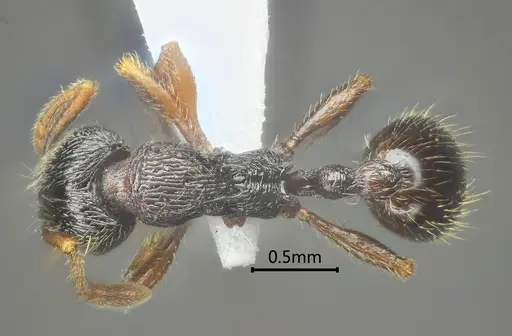
Literatur
Verbreitungskarte wird geladen...Produkte werden geladen...