
Leptogenys glabra
- Wiss. Name
- Leptogenys glabra
- Tribus
- Ponerini
- Unterfamilie
- Ponerinae
- Autor
- Lattke, 2011
- Verbreitung
- In 0 Ländern gefunden
Einleitung
Leptogenys glabra is a small predatory ant species belonging to the pusilla species group, described from the Bajo Calima region in Valle del Cauca, Colombia . This species is known only from two worker specimens collected at 120 meters elevation, making it one of the rarest and least studied ant species in the world . The species name 'glabra' means smooth and glossy in Latin, referring to the polished and mostly bare exoskeleton that gives these ants their distinctive shiny appearance . The body is predominantly dark brown with lighter-colored mandibles, clypeus, legs, antennae, and the tip of the abdomen . Almost nothing has been documented about this species' biology, colony structure, or behavior in the wild.
Quick Summary
- Difficulty: Expert
- Origin & Habitat: Native to the tropical forests of Colombia's Pacific coast region, specifically Bajo Calima in Valle del Cauca [1]. The region features lowland tropical rainforest with high humidity and warm temperatures year-round.
- Colony Type: Unknown, only workers have been collected. No queens, males, or colony samples have been documented [2]. Colony structure is completely unstudied.
- Size & Growth:
- Queen: Unknown, queens have not been described [2]
- Worker: Size data unavailable, only fragmentary measurements (head and mesosoma) exist in scientific literature [2]
- Colony: Unknown, no colony samples have been collected [1]
- Growth: Unknown
- Development: Unknown, no development data exists for this species (No brood development studies exist for this species.)
- Antkeeping:
- Temperature: Unknown, no captive care data exists. Based on Colombian origin, likely requires warm tropical conditions.
- Humidity: Unknown, no captive care data exists. The Bajo Calima region is tropical rainforest with high humidity.
- Diapause: Unknown, no data on dormancy or seasonal activity patterns.
- Nesting: No specific nesting data exists. Related pusilla group species typically inhabit rotting wood, leaf litter, or under stones in forest floor habitats.
- Behavior: No behavioral observations have been documented for this species. Leptogenys ants are typically predatory and possess functional stings for subduing prey [2]. Exercise caution when handling, Ponerine ants have functional stings and may use them defensively.
- Common Issues: no biological data exists, this is one of the least studied ant species in the world, colony structure is completely unknown, no one has documented whether they are single-queen or multi-queen, no confirmed diet preferences, must infer from genus patterns that they are predatory, queens and males are unknown, cannot obtain a mated queen for captive breeding, no captive-bred colonies exist, any specimens would require field collection in Colombia, extreme difficulty in identification requires expert taxonomic knowledge
Species Discovery and Taxonomy
Leptogenys glabra was formally described by J.E. Lattke in 2011 as part of a comprehensive revision of New World Leptogenys species [2]. The type specimens were collected in Bajo Calima, Valle del Cauca, Colombia, at an elevation of 120 meters [2]. The holotype worker and one paratype (a callow worker) are deposited in the Instituto de Investigación de la Universidad Nacional de Colombia (IAVH) [2]. The species belongs to the pusilla species group, which is characterized by small body size and specific morphological features including the shape of the clypeal lobe and eye structure [2]. Several other Leptogenys species occur in the same region, including Leptogenys gorgona and Leptogenys quadrata, which could be confused with Leptogenys glabra but differ in eye position and head shape [2].
Distribution and Habitat
This species is known only from its type locality in Bajo Calima, Valle del Cauca, Colombia [1]. The Bajo Calima region is located in the Pacific lowlands of Colombia, an area characterized by tropical rainforest with high annual rainfall and humidity. The region experiences temperatures consistently in the warm tropical range year-round. This is one of the most biodiverse areas in Colombia, with numerous ant species inhabiting the forest floor and canopy layers. The specific microhabitat within this region where Leptogenys glabra was found is not documented, but members of the pusilla group typically inhabit rotting wood, leaf litter, or soil cavities in shaded forest areas [3].
Identification Challenges
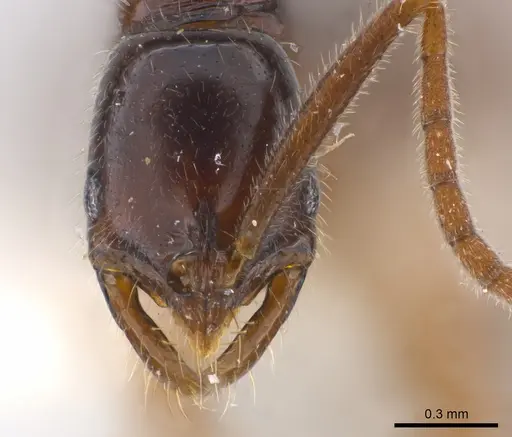
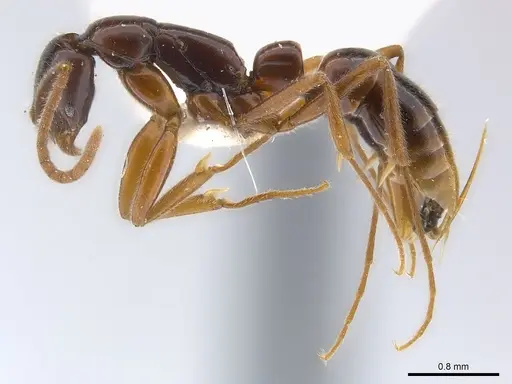
Identifying Leptogenys glabra requires attention to specific morphological features. The median clypeal lobe has a distinctive triangular shape with lateral lamellae and a median denticle at the apex, with no apical seta present [2]. The second funicular segment is notably narrow, less than a third of its length in width. The mesonotum is approximately three times wider than long when viewed from above. The propodeal declivity is mostly smooth with 3-5 transverse striae between the lobes [2]. The eyes are weakly convex and elongate, with length not exceeding 7 ommatidia. The body is predominantly dark brown while the mandibles, clypeus, legs, antennae, and gaster tip are lighter brown [2]. The smooth, glossy, and largely bare exoskeleton (hence the name 'glabra' meaning smooth) distinguishes this species from more setose relatives.
Keeping an Extremely Rare Species
Leptogenys glabra presents exceptional challenges for antkeepers. This species has never been documented in the antkeeping hobby, and no captive colonies exist. There is no documented information on colony size, founding behavior, diet preferences, temperature tolerance, humidity requirements, or any aspect of their biology in captivity. The only specimens known to science are the two workers collected as type specimens. Before attempting to keep this species, consider that acquiring specimens would require field collection in Colombia, which poses significant legal and logistical challenges. Additionally, without any baseline husbandry information, the likelihood of success is extremely low. For these reasons, Leptogenys glabra cannot be recommended for any level of antkeeper, even experienced specialists would be working with complete speculation. [1][2]
Defense Mechanism
Leptogenys glabra belongs to the subfamily Ponerinae and tribe Ponerini. Members of this subfamily possess functional stings used for subduing prey. Their venom is peptide-rich and can be painful to vertebrates. While no specific defensive behavior has been documented for Leptogenys glabra, the genus follows the typical Ponerine pattern of using sting-based defense. [2]
Frequently Asked Questions
Is Leptogenys glabra available in the antkeeping hobby?
No. This species has never been documented in the antkeeping hobby. Only two worker specimens have ever been collected, and no mated queens or colonies exist in captivity. The species is known only from its type locality in Colombia.
Can I keep Leptogenys glabra as a pet ant?
No. This species is not recommended for antkeeping under any circumstances. There is zero biological data available, no documented care requirements, and no captive-bred colonies exist. Attempting to keep this species would be speculative to the point of being irresponsible with ant life.
What does Leptogenys glabra look like?
Workers are tiny ants with a distinctive smooth, glossy, and mostly bare (glabra = smooth) dark brown exoskeleton. The mandibles, clypeus, legs, antennae, and tip of the abdomen are lighter brown. The eyes are elongate and weakly convex.
Where does Leptogenys glabra live?
Only known from Bajo Calima in Valle del Cauca, Colombia, at 120 meters elevation. This is a tropical rainforest region on Colombia's Pacific coast with warm temperatures and high humidity year-round.
How big do Leptogenys glabra colonies get?
Unknown. No colony samples have ever been collected or documented.
What do Leptogenys glabra eat?
Unconfirmed. Based on genus patterns, they are likely predatory like other Leptogenys species, hunting small invertebrates. Without any documented feeding observations, acceptance of specific foods in captivity is entirely unknown.
What temperature and humidity do Leptogenys glabra need?
Unconfirmed. No captive care data exists for this species. Based on their Colombian origin, they would likely require warm tropical conditions and high humidity, but specific requirements are unknown.
How long does it take for Leptogenys glabra to develop from egg to worker?
Unknown. No brood development has been documented for this species.
Is Leptogenys glabra endangered?
Insufficient data to assess. The species is known only from two worker specimens collected decades ago. Population status and conservation concerns have not been studied.
Report an Issue
The current care sheet is based fully on literature. See inconsistencies, or something that's incorrect? Please , it will be resolved after review from an admin. Contributing to the blogs tab also helps providing information, to make us be able to further improve the caresheets. Thank you for your support!
References

Dieses Caresheet ist lizenziert unter CC BY-SA 4.0 .
Community-Blogs
CASENT0217017
Auf AntWeb ansehen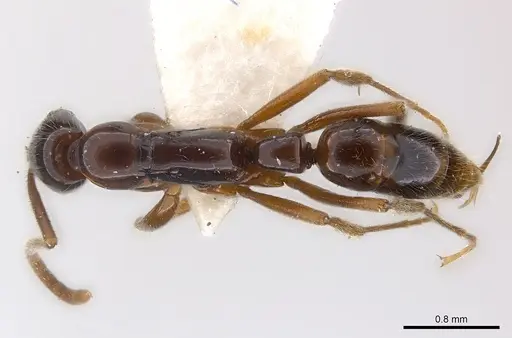
Literatur
Verbreitungskarte wird geladen...Produkte werden geladen...