
Diacamma aureovestitum
- Wiss. Name
- Diacamma aureovestitum
- Tribus
- Ponerini
- Unterfamilie
- Ponerinae
- Autor
- Zettel <i>et al.</i>, 2016
- Verbreitung
- In 0 Ländern gefunden
Einleitung
Diacamma aureovestitum is a relatively large Ponerine ant species native to the Philippines, found only on Mindanao Island. Workers measure 13.3-14.9mm in total length, making them substantial ants with a distinctive appearance. The body is primarily black with abundant erect setae and dense golden pilosity covering most of the trunk, giving them their species name meaning 'golden vested.' The head is moderately long with strongly convex sides, and the trunk is coarsely striated. This species was only described in 2016 from worker specimens, making it one of the more recently documented Diacamma species. As a Ponerine ant, they possess a functional sting. They are only known from Lanao del Sur in Mindanao, making them a rare and geographically restricted species in the antkeeping hobby.
Quick Summary
- Difficulty: Medium
- Origin & Habitat: Philippines: Mindanao Island (Lanao del Sur). This species is only known from a single locality in the Philippines. Being a tropical species from Mindanao, they likely inhabit humid lowland forest environments typical of the region [1].
- Colony Type: Queenless, no distinct queen caste, reproduction by gamergates (reproductive workers).
- Queen Status: Queenless Colony
- Size & Growth:
- Queen: Queenless species, reproduction by gamergate (reproductive worker) instead of a distinct queen caste.
- Worker: 13.3-14.9mm total length [1]
- Colony: Unknown, no colony size data exists for this recently described species
- Growth: Unknown, no development data available for this species
- Development: Unknown, no direct development studies exist for this species. (No specific development data exists. Related Diacamma species typically take several months from egg to worker at warm temperatures.)
- Antkeeping:
- Temperature: Keep at 24-28°C. As a tropical Philippine species, they need warm conditions. A heating cable on one side of the nest creates a gradient allowing them to thermoregulate.
- Humidity: Maintain high humidity, aim for 70-80%. These are forest-floor ants from a humid tropical region. Keep the nest substrate consistently moist but not waterlogged.
- Diapause: No, as a tropical species from Mindanao, they do not require hibernation. Keep them at stable warm temperatures year-round.
- Nesting: No specific nesting data exists for this species. Based on related Diacamma species, they likely nest in soil or under stones in shaded locations. A naturalistic setup with moist substrate or a Y-tong/plaster nest works well. Provide a deep soil area for potential burrowing.
- Behavior: No specific behavioral studies exist for this species. As Ponerine ants, they are likely predatory and will hunt small invertebrates. They possess a functional sting and may use it defensively. Their large size and potent sting mean they should be handled with care. Escape prevention should be good given their size, but ensure enclosures are secure. They are likely more active and aggressive compared to typical myrmicine ants.
- Common Issues: lack of available colonies, this is a recently described species with very limited distribution, making them rare in the antkeeping hobby, no species-specific care data, all recommendations are based on related Diacamma species rather than direct observation, tropical temperature requirements, they need constant warmth, which may require heating equipment in cooler climates, potential sting, their large size and Ponerine classification suggest a functional sting that can cause pain, limited information on founding, colony founding behavior has not been documented for this species
Appearance and Identification
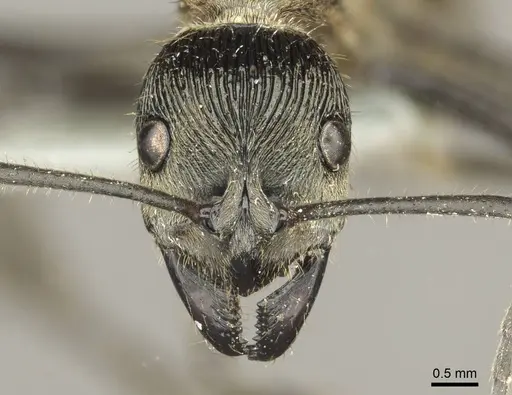
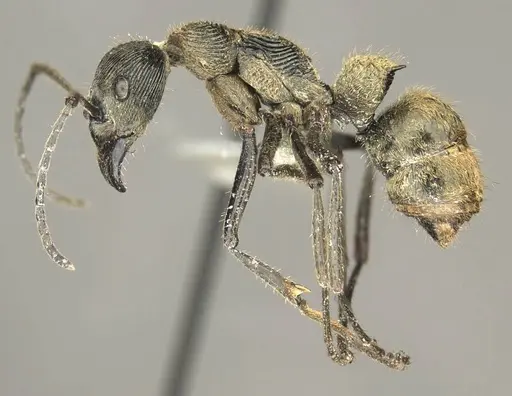
Diacamma aureovestitum workers are relatively large ants measuring 13.3-14.9mm in total length. They have a predominantly black body coloration without any metallic shimmer. The most distinctive feature is the dense golden pilosity (golden hairs) covering most of the trunk, giving them their species name 'aureovestitum' which means 'golden vested.' The body surface is shiny where bare, but the trunk is coarsely striated (grooved) from the genae to the petiole. The head is moderately long with strongly convex sides, and the eyes are relatively small. The petiole (the narrow 'waist' segment) is stout with medium-sized teeth. This combination of large size, black coloration, and golden fuzzy appearance makes them distinctive among Philippine Diacamma species [1].
Distribution and Habitat
This species is currently known only from Mindanao Island in the Philippines, specifically from Lanao del Sur province. It was only described in 2016 and remains known only from its type locality. The Philippines has a tropical climate with high humidity year-round. As a Ponerine ant from this region, they likely inhabit humid forest floor environments where they can find suitable prey and nesting sites. The limited distribution makes wild colonies difficult to find, and they remain rare in both scientific collections and the antkeeping hobby [1].
Temperature and Care Requirements
As a tropical species from the Philippines, Diacamma aureovestitum requires warm temperatures. Keep the nest area at 24-28°C, with cooler areas available so the ants can regulate their temperature if needed. A heating cable placed on part of the nest can help maintain these temperatures, but always provide a temperature gradient. High humidity is essential, aim for 70-80% relative humidity. These ants should not experience cool temperatures or dry conditions. Unlike temperate species, they do not require any winter cooling or diapause period. Maintain stable warm and humid conditions year-round for best colony health.
Feeding and Nutrition
No specific dietary studies exist for D. aureovestitum, but as a Ponerine ant, they are likely predatory on small invertebrates. Related Diacamma species are known to be active hunters that capture and subdue prey with their sting. In captivity, offer small live prey such as fruit flies, small crickets, mealworms, and other appropriately-sized insects. They may also accept sugar sources like honey or sugar water, though Ponerines are typically more protein-oriented. Feed protein-rich foods regularly, and provide a constant sugar water source. Remove uneaten prey after 24-48 hours to prevent mold issues.
Nesting Preferences
No specific nesting data exists for this species. Based on related Diacamma species and their Ponerine biology, they likely nest in soil or under stones in shaded, humid locations. For captive care, a naturalistic setup with deep, moist substrate works well, this allows the ants to create their own chambers. Alternatively, a Y-tong (AAC) nest or plaster nest with good humidity retention can work. Provide a water tube or moisture source to maintain humidity. Given their large size, ensure the nest has appropriately sized chambers and tunnels.
Frequently Asked Questions
How long does it take for Diacamma aureovestitum to produce first workers?
The egg-to-worker development time is unknown for this species, no studies exist. Without specific data, it is not possible to provide a reliable estimate.
Are Diacamma aureovestitum ants good for beginners?
This species is not ideal for beginners. It was only described in 2016, so almost no species-specific care information exists. Additionally, they require warm, humid tropical conditions year-round and likely need regular live prey. They also possess a functional sting. For these reasons, they are best suited for experienced antkeepers who can provide stable tropical conditions.
What do I feed Diacamma aureovestitum?
Based on related species, they are predatory and need live protein. Offer small insects like fruit flies, small crickets, mealworms, and similar prey. They may accept sugar water or honey as well. Feed protein regularly and provide a constant sugar source. Remove uneaten prey after a day or two.
Can I keep multiple Diacamma aureovestitum queens together?
The colony structure is unconfirmed for this species. No studies document whether they are monogyne (single queen) or polygyne (multiple queens). Without data, combining unrelated queens is not recommended.
Do Diacamma aureovestitum need hibernation?
No, they are a tropical Philippine species and do not require hibernation. Keep them warm year-round at 24-28°C. Cool temperatures can stress and potentially kill them.
How big do Diacamma aureovestitum colonies get?
Colony size is unknown, no colony size data exists for this recently described species.
What is the best nest type for Diacamma aureovestitum?
No species-specific data exists. Based on related species, a naturalistic setup with deep moist substrate or a Y-tong/plaster nest with good humidity works well. Provide chambers scaled to their large size (13-15mm workers).
Where can I get Diacamma aureovestitum?
This species is very rare in the antkeeping hobby. It was only described in 2016 and is known only from a single location in Mindanao, Philippines. They are unlikely to be available commercially. If available at all, they would be extremely expensive and difficult to obtain [1].
Are Diacamma aureovestitum aggressive?
No specific behavioral data exists, but Diacamma species are Ponerine ants known for being active predators with functional stings. They are likely more aggressive and defensive than typical ant species. Handle with care and ensure secure enclosure housing.
Report an Issue
The current care sheet is based fully on literature. See inconsistencies, or something that's incorrect? Please , it will be resolved after review from an admin. Contributing to the blogs tab also helps providing information, to make us be able to further improve the caresheets. Thank you for your support!
References

Dieses Caresheet ist lizenziert unter CC BY-SA 4.0 .
Community-Blogs
CASENT0916097
Auf AntWeb ansehen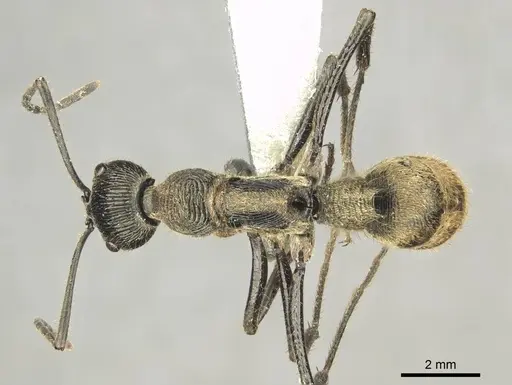
Literatur
Verbreitungskarte wird geladen...Produkte werden geladen...