
Cephalotes resinae
- Wiss. Name
- Cephalotes resinae
- Tribus
- Attini
- Unterfamilie
- Myrmicinae
- Autor
- De Andrade, 1999
- Verbreitung
- In 0 Ländern gefunden
Einleitung
Cephalotes resinae is an extremely rare ant species known from a single worker specimen preserved in Dominican copal. This is a fossil species, meaning it is only known from ancient resin deposits and no living colonies exist. Workers measure 6.84 mm in total length, making them a moderately sized Cephalotes species . The species belongs to the hamulus clade and is characterized by thick, regular body striation and distinctive long, thick hairs on the first gastral tergite . The body is black in color with lighter frontal carinae. This species was described in 1999 by de Andrade and is only found in the Dominican Republic . It is the sister species to Cephalotes auricomus, also known from the Dominican Republic, sharing similar dense body striation and black coloration .
Quick Summary
- Difficulty: Not applicable, fossil species cannot be kept
- Origin & Habitat: Dominican Republic, known only from copal (subfossil resin) deposits [1][2]
- Colony Type: Not applicable, only a single fossil worker specimen is known [2]
- Size & Growth:
- Antkeeping:
- Temperature: Not applicable, cannot be kept in captivity
- Humidity: Not applicable
- Diapause: Not applicable
- Nesting: Not applicable, known only from copal fossil [2]
- Behavior: Not applicable, no living specimens exist to observe behavior
- Common Issues: This species is only known from a single fossil specimen in copal and cannot be kept as a living colony, No living colonies or queens have ever been found, the species appears to be extinct or extremely rare, Cephalotes resinae is only found preserved in Dominican copal, not in living ant populations
Why This Species Cannot Be Kept
Cephalotes resinae is a fossil species that cannot be kept in captivity. Unlike some Cephalotes species that are still extant and can be collected from the wild, this species is only known from a single worker specimen preserved in Dominican copal. Copal is younger than amber but older than recent resin deposits, and specimens preserved in it are not alive, they are fossilized remains. No living colonies, queens, or additional specimens of this species have ever been documented. The species was described in 1999 from this single specimen, and it remains known only from this single fossil [1][2]. For antkeepers interested in the Cephalotes genus, consider looking at extant species such as Cephalotes varians, Cephalotes atratus, or other living species in the genus that are available through legitimate sources.
Taxonomic Position and Relations
Cephalotes resinae belongs to the hamulus clade of the genus Cephalotes, which is part of the tribe Attini in the subfamily Myrmicinae. It is considered the sister species to Cephalotes auricomus, a Recent species also endemic to the Dominican Republic. Both species share distinctive features including dense body striation, black coloration, and thick long hairs on the first gastral tergite [2]. The hamulus clade represents a group of Cephalotes species that are endemic to Hispaniola. Notably, both copal species described from the Dominican Republic in the original description (C. taino and C. resinae) belong to this Recent Hispaniolan endemic clade, rather than the much more numerous true fossils found in Dominican amber [2].
Physical Characteristics
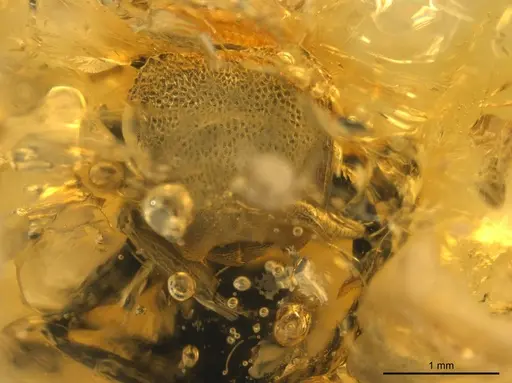
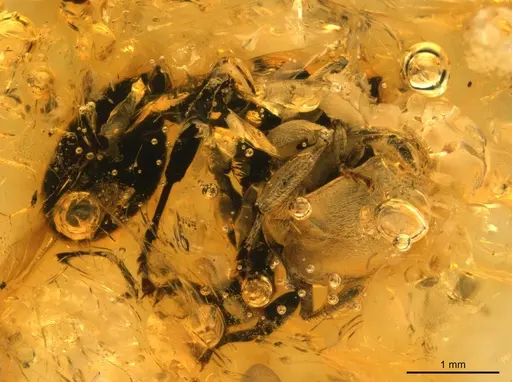
The holotype worker of Cephalotes resinae measures 6.84 mm in total length [2]. The species has several distinctive morphological features: thick and regular body striation that covers the head, mesosoma, petiole, and postpetiole, the pilosity is dense enough to hide the underlying sculpture, the first gastral tergite is black with long, thick hairs [1]. The vertexal angles are round with a crenulate margin, and the propodeal spines are shorter than the basal face of the propodeum, thin and oriented posterolaterally [2]. The species has a robust mesosoma in side view, with well-visible scapular angles and a pair of spines on the humeral angles directed anterolaterally with round tips [2].
Fossil Preservation Context
Cephalotes resinae is preserved in Dominican copal, which is a type of subfossil resin. Copal is younger than true amber but older than fresh resin, typically ranging from thousands to a few million years old. The specimen is embedded in copal sample Do-3566 from the Statliches Museum für Naturkunde Stuttgart [2]. The copal specimen lacks exact locality information within the Dominican Republic. The preservation in copal means the ant is not alive and cannot be used to establish a living colony. The species name 'resinae' was chosen from the Latin 'resina' to contrast with fossilized resin and refers to the copal in which the specimen is embedded [2].
Frequently Asked Questions
Can I keep Cephalotes resinae as a pet ant?
No, Cephalotes resinae cannot be kept as a pet. This is a fossil species known only from a single specimen preserved in Dominican copal. No living colonies exist, and the species appears to be extinct or extremely rare. If you are interested in keeping Cephalotes ants, look for extant species like Cephalotes varians or Cephalotes atratus that are available through legitimate ant keepers or dealers.
Where does Cephalotes resinae live?
Cephalotes resinae is only known from the Dominican Republic, specifically from copal deposits. The exact locality within the Dominican Republic is unknown because the copal specimen lacks precise location data. No living populations have ever been documented.
How big is Cephalotes resinae?
Workers measure 6.84 mm in total length. This makes them a moderately sized member of the Cephalotes genus.
Is Cephalotes resinae extinct?
The species is only known from fossil records in copal, and no living specimens have ever been found. While it is possible small populations may exist undiscovered, the species is effectively only known from the fossil record. The related species Cephalotes auricomus is still extant in the Dominican Republic.
What does Cephalotes resinae look like?
Cephalotes resinae is a black ant with distinctive thick, regular body striation and long thick hairs on the first gastral tergite. It has round vertexal angles with crenulate margins, a robust mesosoma, and propodeal spines that are shorter than the basal face of the propodeum.
What is the closest living relative of Cephalotes resinae?
The sister species is Cephalotes auricomus, which is also found in the Dominican Republic and is still extant. Both species share dense body striation, black coloration, and thick long hairs on the first gastral tergite.
Can I collect Cephalotes resinae from the wild?
No. The species is only known from a single fossil specimen in copal, and no living colonies have ever been documented. Even if small populations existed, collecting them would require scientific permits and expertise, and the species status would need to be assessed for conservation purposes.
What is copal and how does it preserve ants?
Copal is a type of subfossil resin that is younger than true amber but older than fresh resin. It can be thousands to a few million years old. Insects preserved in copal are fossilized, they are not alive and cannot be revived. The process preserves the ant's exoskeleton in remarkable detail, allowing scientists to describe species from ancient specimens.
Report an Issue
The current care sheet is based fully on literature. See inconsistencies, or something that's incorrect? Please , it will be resolved after review from an admin. Contributing to the blogs tab also helps providing information, to make us be able to further improve the caresheets. Thank you for your support!
References

Dieses Caresheet ist lizenziert unter CC BY-SA 4.0 .
Community-Blogs
SMNSDOC3566
Auf AntWeb ansehen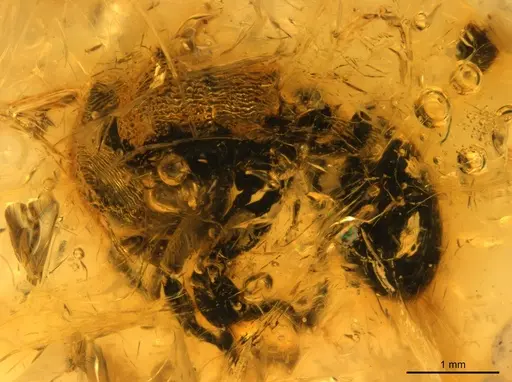
Literatur
Verbreitungskarte wird geladen...Produkte werden geladen...