
Cardiocondyla tenuifrons
- Wiss. Name
- Cardiocondyla tenuifrons
- Tribus
- Crematogastrini
- Unterfamilie
- Myrmicinae
- Autor
- Seifert, 2003
- Verbreitung
- In 0 Ländern gefunden
Einleitung
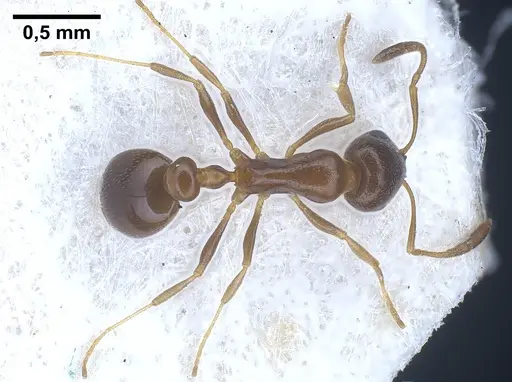
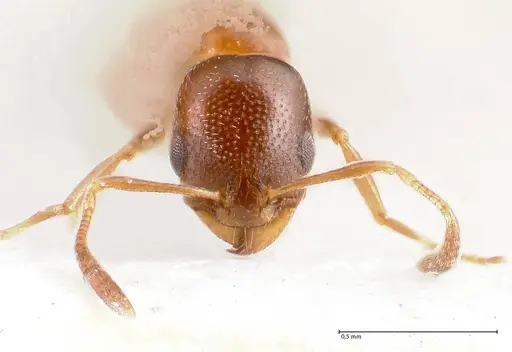
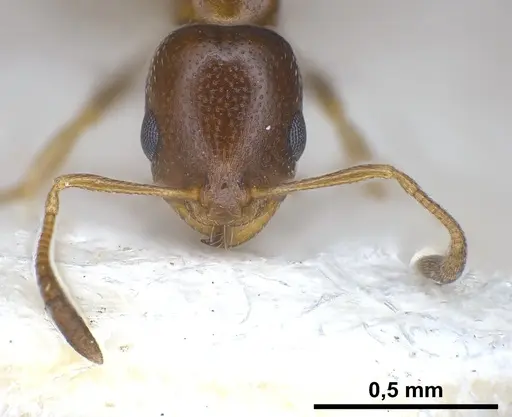
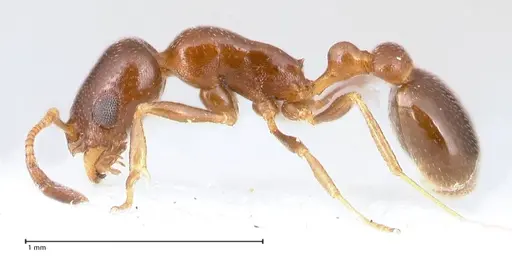
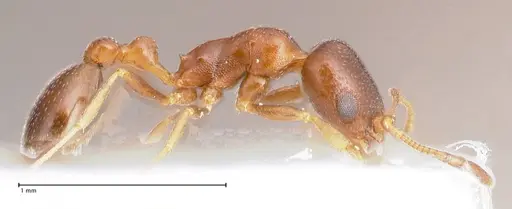
Cardiocondyla tenuifrons is an exceptionally rare tiny ant species, known only from three worker specimens collected in Jordan. Workers are very small - approximately 2-2.5mm inferred from the genus Cardiocondyla (no total body length measurement exists). They belong to the batesii species group, characterized by their elongated head, unusually large eyes, and strongly converging frontal carinae. The head and gaster are dark brown, while the mesosoma and waist are medium brown with a yellowish-red tint. This species has never been observed in captivity and virtually nothing is known about its biology, behavior, or colony structure in the wild. What makes this species particularly interesting is its extreme rarity - it has never been collected since its original description in 2003, suggesting it may be endangered or have a very restricted range .
Quick Summary
- Difficulty: Expert
- Origin & Habitat: Known only from the type locality in Jordan: Abdallah between Shobek and Wadi Musa in the Ma'an governorate at approximately 592m elevation (34.477°N, 70.365°E). The habitat is in the Palaearctic region, likely in a semi-arid to arid rocky terrain typical of this part of Jordan [1][2].
- Colony Type: Unknown, no colony has ever been observed.
- Size & Growth:
- Queen: Size data unavailable, no queen has ever been documented for this species [1]
- Worker: Approximately 2-2.5mm, inferred from Cardiocondyla genus patterns (no total length measurement exists)
- Colony: Unknown, only three workers have ever been collected [1]
- Growth: Unknown
- Development: Unknown, no development data exists for this species (No development timeline data is available for this species.)
- Antkeeping:
- Temperature: No specific thermal data exists. Based on the semi-arid climate of Jordan, likely tolerates warm conditions. Start around 22-26°C and observe colony activity.
- Humidity: No humidity data exists. The Jordan habitat suggests moderate to low humidity tolerance. Keep nest substrate slightly moist but allow drying periods between waterings.
- Diapause: Unknown, no seasonal data exists. Jordan has distinct winters, so a cool period may be beneficial, but this is speculative.
- Nesting: No natural nesting observations exist. Related Cardiocondyla species typically nest in soil or under stones in arid environments. A small test tube setup with minimal space would be appropriate.
- Behavior: Completely unobserved, no behavioral studies exist for this species. Based on genus patterns, they are likely docile and non-aggressive. Their tiny size means escape prevention is critical, they can squeeze through gaps invisible to the human eye. Use fine mesh and seal all openings meticulously.
- Common Issues: no biological data exists, this is an essentially unknown species in captivity, tiny size makes escape prevention extremely difficult, standard barriers may fail, no established care protocols, you will be pioneering husbandry for this species, colony may fail due to unknown dietary or environmental requirements, no information on founding behavior, queen requirements are completely unknown
Species Overview and Rarity
Cardiocondyla tenuifrons is one of the rarest ant species in the world to keep. It was described by Bernhard Seifert in 2003 from only three worker specimens collected in Jordan, and it has never been found since. This means no scientist has ever observed a live colony, witnessed nuptial flights, or documented any aspect of their biology. They belong to the batesii species group, which is characterized by large eyes and elongated heads. The entire global knowledge of this species consists of three dead specimens in a museum collection. If you obtain this species, you will be contributing genuinely new knowledge to science [1][2][3].
Housing and Escape Prevention
Given their tiny size, housing presents unique challenges. Standard ant keeping equipment is designed for ants 3mm and larger. You will need to use very small test tubes, and escape prevention must be exceptional. Even standard cotton ball barriers may allow passage. Fine mesh is essential, and all connections must be sealed with petroleum jelly or similar barriers. A small outworld with carefully controlled access is recommended. The nest chambers should be correspondingly tiny, even a standard test tube chamber will feel cavernous to these ants.
Temperature and Environmental Conditions
No specific temperature data exists for this species. The type locality in Jordan experiences a Mediterranean climate with hot, dry summers and mild, wet winters. Temperatures in the region range from near freezing in winter to above 40°C in summer. Based on this, the species likely tolerates a broad temperature range. For captive care, start with room temperature (22-24°C) and provide a slight thermal gradient using a heating cable on one side of the nest. Monitor colony behavior, if workers become sluggish, warm slightly, if they avoid the heated area, reduce temperature. A light cycle mimicking natural day/night patterns is advisable.
Feeding and Nutrition
No feeding observations exist for this species. However, Cardiocondyla genus members are typically omnivorous, feeding on small insects, honeydew, and nectar. Given their tiny size, prey items must be correspondingly small. Live springtails, fruit flies, and other micro-arthropods would be appropriate. Sugar water or honey diluted with water may be accepted. Feed small amounts initially and observe what the colony actually consumes. Remove uneaten food promptly to prevent mold. Because nothing is known about this species specifically, experimental feeding with various small prey items may yield useful information.
Colony Founding and Reproduction
No information exists about colony founding for this species. In related Cardiocondyla species, queens are typically claustral, they seal themselves in a chamber and survive on stored fat reserves until their first workers emerge. However, this is unconfirmed for C. tenuifrons. Nuptial flight timing is completely unknown. If you obtain a founding queen, document everything, you will be creating the first-ever biological observations of this species.
Legal and Ethical Considerations
This species is known only from Jordan and has never been found in significant numbers. If specimens become available, ensure they were collected legally and with appropriate permits. Given their extreme rarity and the complete lack of biological data, any captive colony has significant scientific value. Document your observations thoroughly, colony behavior, development times, feeding preferences, and any other details would represent genuine new knowledge. Consider collaborating with researchers studying Cardiocondyla to share observations.
Frequently Asked Questions
Is Cardiocondyla tenuifrons available for sale?
This species is extremely rare in the antkeeping hobby. It has only ever been collected three times (as workers), and no live colonies have ever been documented. You are unlikely to find this species commercially available. If you do obtain it, treat it as a significant scientific opportunity [1][2].
How big do Cardiocondyla tenuifrons colonies get?
Unknown, only three workers have ever been collected, so colony size in the wild is completely unstudied. Based on related Cardiocondyla species, colonies may reach dozens to a few hundred workers, but this is purely speculative [1].
What do Cardiocondyla tenuifrons eat?
No feeding observations exist. Based on genus patterns, they likely accept small live prey (springtails, fruit flies), honeydew, and sugar sources. Start with tiny live prey and diluted honey/sugar water, then observe what they actually consume.
Do Cardiocondyla tenuifrons ants sting?
Unknown, no defensive behavior has been documented. Given their tiny size, any sting would likely be imperceptible to humans. Related Cardiocondyla species are generally docile.
What temperature should I keep Cardiocondyla tenuifrons at?
No specific requirements are known. Based on the Jordan habitat, start around 22-26°C and observe colony behavior. Provide a thermal gradient so the ants can choose their preferred temperature. Adjust based on activity levels.
Do Cardiocondyla tenuifrons need hibernation?
Unknown, no seasonal data exists. Jordan experiences cold winters, so a cool period may be beneficial, but this is speculative. Monitor colony condition and adjust based on behavior.
How long does it take for Cardiocondyla tenuifrons to develop from egg to worker?
Unknown, no development data exists for this species.
Is Cardiocondyla tenuifrons good for beginners?
Absolutely not. This is one of the most poorly understood ant species in the world. No established care protocols exist, and keeping them successfully would require expert-level knowledge and careful experimentation. If you're interested in Cardiocondyla, consider more common and well-documented species.
Can I keep multiple Cardiocondyla tenuifrons queens together?
Unknown, no colony structure has ever been documented. Related Cardiocondyla species are typically single-queen, but some can form multi-queen colonies. Do not attempt combining unrelated queens without specific knowledge of this species.
Why is Cardiocondyla tenuifrons so rare?
This species is known only from a single collection event in 1996 in Jordan. It has never been found again despite targeted searches. Possible reasons include a very restricted range, low population density, seasonal activity patterns that make them difficult to find, or genuine rarity. The lack of specimens suggests either extreme localized distribution or potential endangerment [1][2][3].
Report an Issue
The current care sheet is based fully on literature. See inconsistencies, or something that's incorrect? Please , it will be resolved after review from an admin. Contributing to the blogs tab also helps providing information, to make us be able to further improve the caresheets. Thank you for your support!
References

Dieses Caresheet ist lizenziert unter CC BY-SA 4.0 .
Community-Blogs
FOCOL0729
Auf AntWeb ansehen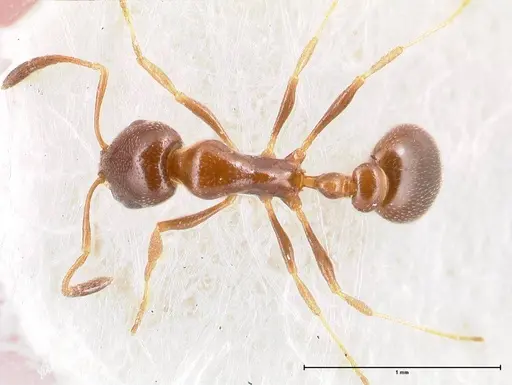
Literatur
Verbreitungskarte wird geladen...Produkte werden geladen...