
Aenictus indicus
- Wiss. Name
- Aenictus indicus
- Unterfamilie
- Dorylinae
- Autor
- Bharti <i>et al.</i>, 2012
- Verbreitung
- In 0 Ländern gefunden
Einleitung
Aenictus indicus is a small reddish-brown army ant found only in the Western Ghats mountains of southern India . Workers measure about 4.5mm total length and have a distinctive ridge on the thorax that separates the middle section from the side plates - a feature shared with only a few related Philippine species . Scientists described this species in 2012 from a single worker found in leaf litter at 1400 meters elevation in the High Wavy Mountains of Tamil Nadu . Despite searches in this biodiversity hotspot, only a handful of specimens have ever been collected, suggesting the species is genuinely rare or extremely difficult to find . As a member of the army ant group (Dorylinae), they likely live in large wandering colonies that hunt other insects, though no one has ever found a nest or observed living colonies of this species .
Quick Summary
- Difficulty: Expert, Not Feasible
- Origin & Habitat: Endemic to the Western Ghats of India (Tamil Nadu), collected from leaf litter at 1400m elevation in the High Wavy Mountains [1][3][2].
- Colony Type: Unknown, only the worker caste has been discovered [2].
- Size & Growth:
- Antkeeping:
- Temperature: Unknown, start around 20-24°C based on elevation and observe.
- Humidity: Unknown, likely prefers moist conditions given leaf litter habitat.
- Diapause: Unknown.
- Nesting: Unknown, natural nesting site never observed.
- Behavior: Unknown specifically. As an army ant, likely nomadic with large colonies, but no behavioral observations exist [1].
- Common Issues: no queens have ever been found, so founding a colony is impossible., the species is known from only a few specimens, collecting them would harm the wild population., army ants require massive colonies and specialized hunting behaviors that cannot be replicated in captivity., tiny size requires perfect escape prevention, though keeping is not recommended regardless.
Identification and Physical Description
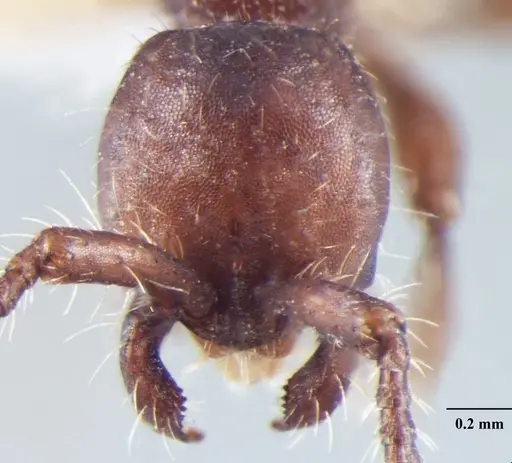
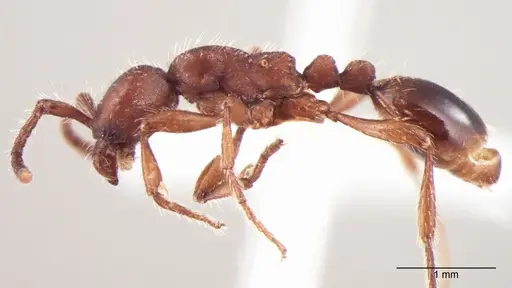
Workers of Aenictus indicus are medium reddish brown and measure about 4.5mm in total length [1]. The head is longer than it is wide and has a noticeable collar at the back edge [1]. A key identifying feature is the ridge between the middle section of the thorax (mesonotum) and the side plates (mesopleuron) [1]. They have 10-segmented antennae where the first segment (scape) reaches about four-fifths of the way to the back of the head [1]. The abdomen (gaster) is smooth and shiny, while the rest of the body has a fine net-like texture called microreticulation [1]. The mandibles are broad and triangular with a large apical tooth followed by eight smaller teeth [1].
Natural History and Distribution
This species lives in the leaf litter of the High Wavy Mountains in Tamil Nadu, India, at elevations around 1400 meters [1][2]. It is endemic to India, meaning it lives nowhere else in the world [3]. Despite the Western Ghats being a well-studied biodiversity hotspot, scientists have only collected a few specimens from this specific mountain range, suggesting the species is genuinely rare or extremely cryptic in its habits [2]. The type specimen was collected using a Winkler extractor from leaf litter in March 2002 [1]. This species belongs to the Aenictus philippinensis species group [4].
Army Ant Biology and Captive Feasibility
Aenictus indicus belongs to the army ant subfamily Dorylinae [2]. Army ants typically form huge colonies with thousands or millions of workers that move constantly and hunt large amounts of prey. Without ever observing a colony of this species, we cannot know their specific habits, but related Aenictus species require massive amounts of small prey and space to roam. Combined with the fact that no queens have ever been found and only a few workers exist in collections, keeping this species in captivity is not feasible [1][2].
Distinguishing from Similar Species
Aenictus indicus closely resembles Aenictus philippinensis but differs in several details. It has an angularly produced clypeus (the plate above the jaws) versus rounded in A. philippinensis, a shorter ridge near the front of the head (0.22mm versus 0.28mm), and a straight rather than convex base to the propodeum (the rear thorax segment) [1]. Additionally, A. indicus has a weak groove impression between the thorax segments, while A. philippinensis has a strongly developed one [1].
Frequently Asked Questions
Can I keep Aenictus indicus in captivity?
No. This species is not feasible to keep. Only workers have ever been found, no queens, no colonies, and no one knows how to found them [2]. Additionally, as an army ant, they likely require massive colonies and specialized hunting behaviors that cannot be replicated in captivity [1].
Where does Aenictus indicus live?
Only in the Western Ghats mountains of Tamil Nadu, India, specifically in leaf litter at high elevations around 1400 meters [1][3].
How big are Aenictus indicus workers?
Workers measure about 4.5mm in total length [1].
What does Aenictus indicus eat?
Unknown specifically. As an army ant, they likely prey on other small insects and arthropods, but no feeding observations exist [1].
Does Aenictus indicus have a queen?
Unknown. No queens have ever been collected or described for this species [2].
Is Aenictus indicus dangerous?
Unknown. They have large mandibles with teeth and can likely bite like other ants, but no specific information about venom or aggression exists [1].
How rare is Aenictus indicus?
Extremely rare. Only a few specimens exist in scientific collections, all from a small area in the Western Ghats [2].
Can I collect Aenictus indicus from the wild?
Absolutely not. The species is extremely rare and endemic to a biodiversity hotspot. Removing specimens could harm the wild population [2].
Report an Issue
The current care sheet is based fully on literature. See inconsistencies, or something that's incorrect? Please , it will be resolved after review from an admin. Contributing to the blogs tab also helps providing information, to make us be able to further improve the caresheets. Thank you for your support!
References

Dieses Caresheet ist lizenziert unter CC BY-SA 4.0 .
Community-Blogs
ANTWEB1008019
Auf AntWeb ansehen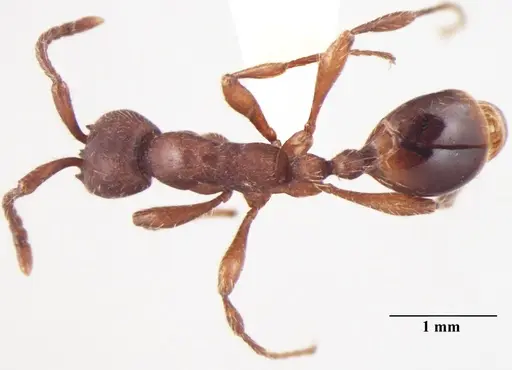
Literatur
Verbreitungskarte wird geladen...Produkte werden geladen...