
Aenictus hottai
- Wiss. Name
- Aenictus hottai
- Unterfamilie
- Dorylinae
- Autor
- Terayama & Yamane, 1989
- Verbreitung
- In 0 Ländern gefunden
Einleitung
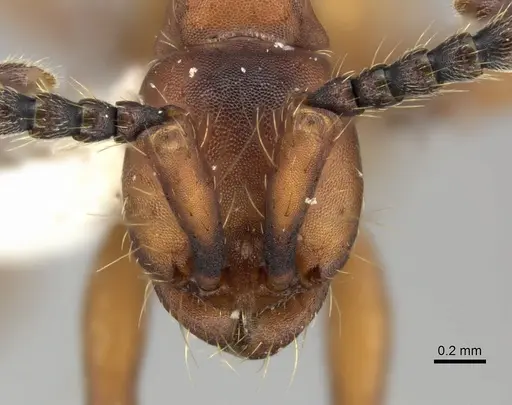
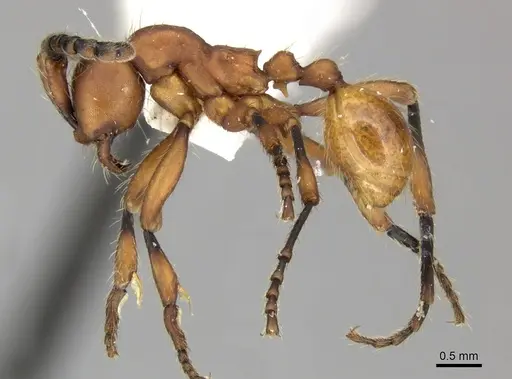
Aenictus hottai is a medium-sized army ant native to the rainforests of Sundaland in Southeast Asia. Workers measure 4.65-5.00 mm in total length and are dark reddish-brown with a distinctive subpetiolar process - an arm-like projection on the underside of their waist segment . They inhabit lowland primary rainforests across the Malay Peninsula (southern Thailand and Malaysia), Borneo (Sarawak), and Sumatra . Unlike typical pet ants, these are true army ants that hunt in coordinated groups and specialize in raiding other ant colonies, particularly targeting trap-jaw ants of the genus Odontomachus and carrying off their brood as food . They forage primarily on the forest floor but will climb tree stems up to 3 meters when hunting . This species is known only from the worker caste - no queens have been documented .
Quick Summary
- Difficulty: Expert
- Origin & Habitat: Lowland primary rainforests of Sundaland (southern Thailand, Malaysia, Borneo, Sumatra) [1][2]
- Colony Type: Army ant, reproduces by colony fission. Only the worker caste has been documented [1].
- Size & Growth:
- Queen: Unknown, only workers documented [1]
- Worker: 4.65-5.00 mm [1]
- Colony: Unknown, likely thousands based on army ant biology
- Growth: Unknown
- Development: Unknown, army ants reproduce by colony fission rather than traditional founding (Army ants grow by colony division, not by queens raising first workers)
- Antkeeping:
- Temperature: Warm tropical conditions approximately 25-28°C (inferred from lowland rainforest habitat)
- Humidity: High humidity required, damp rainforest floor conditions [1]
- Diapause: No, tropical species
- Nesting: Nomadic species, does not build permanent nests. Requires massive foraging space unsuitable for home setups.
- Behavior: Specialized group predator of other ants, particularly Odontomachus [3]. Forages on the forest floor but climbs vegetation when hunting [3].
- Common Issues: requires massive enclosures impossible in home settings due to nomadic army ant lifestyle, dietary specialization on other ants makes feeding nearly impossible for private keepers, colony size likely reaches thousands, requiring enormous prey input, only worker caste known, reproduction via colony fission means you cannot start with a single queen
Army Ant Biology and Reproduction
Aenictus hottai belongs to the subfamily Dorylinae, the true army ants. These ants do not build permanent nests like other species you might keep. Instead, colonies are nomadic, constantly moving through the forest and staying in temporary bivouacs. Reproduction occurs through colony fission (budding), where a colony splits into two parts, each containing workers and brood. This means you cannot start a colony from a single queen in a test tube. You would need to collect an entire colony fragment with thousands of workers, which is not feasible for private keepers. This species is known only from the worker caste, no queens have ever been documented for A. hottai [1].
Specialized Predatory Diet
These ants are not generalist scavengers that accept sugar water and mealworms. They are specialized predators of other ants. Research shows they specifically target colonies of Odontomachus (trap-jaw ants), raiding them and carrying off their brood as food [3]. They may also take adult ants opportunistically, as other ant species have been observed picking individual A. hottai workers from trails [3]. This dietary requirement makes captive keeping nearly impossible, as you would need constant access to living colonies of specific ant prey.
Housing Requirements
Standard ant farms, test tubes, and formicaria are completely unsuitable for army ants. These ants require massive foraging arenas to accommodate their nomadic behavior and group hunting strategies. In captivity, they would need facility-sized setups with multiple interconnected chambers and constant access to large amounts of prey. They are also skilled at escaping, workers are about 5mm long and can squeeze through tiny gaps. [1]
Natural Habitat and Climate
Aenictus hottai lives exclusively in lowland primary rainforests [1][3]. They require tropical conditions with high humidity and warm temperatures year-round. They forage primarily on the forest floor but will climb vegetation up to 3 meters when hunting [3]. The northern limit of their range is at the Thai-Malay border around 7°N latitude near the Kangar-Pattani line [1].
Frequently Asked Questions
Can I keep Aenictus hottai in a test tube?
No. These are army ants that require massive space and specific prey. They cannot be housed in test tubes or standard formicaria.
What do Aenictus hottai eat?
They are specialized predators of other ants, particularly Odontomachus (trap-jaw ants). They raid colonies and carry off brood [3].
How do I start an Aenictus hottai colony?
You cannot start from a single queen. Army ants reproduce by colony fission, meaning you would need to collect an entire colony fragment with thousands of workers. This is not feasible for private keepers. Additionally, only workers have ever been documented for this species, no queens have been found [1].
Are Aenictus hottai good for beginners?
No. They are expert-only species that are effectively impossible to maintain in captivity due to their specialized diet, nomadic behavior, and massive space requirements.
How big do Aenictus hottai colonies get?
Exact numbers are unknown, but as army ants, they likely maintain colonies of thousands to tens of thousands of workers.
Do Aenictus hottai need hibernation?
No. They are tropical rainforest ants and require warm conditions year-round.
Where do Aenictus hottai live in the wild?
Lowland primary rainforests of Sundaland (Malay Peninsula, Borneo, Sumatra) [1][2].
Report an Issue
The current care sheet is based fully on literature. See inconsistencies, or something that's incorrect? Please , it will be resolved after review from an admin. Contributing to the blogs tab also helps providing information, to make us be able to further improve the caresheets. Thank you for your support!
References

Dieses Caresheet ist lizenziert unter CC BY-SA 4.0 .
Community-Blogs
CASENT0249278
Auf AntWeb ansehen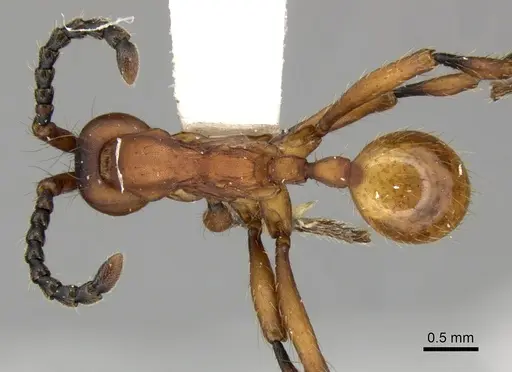
Literatur
Verbreitungskarte wird geladen...Produkte werden geladen...